Blog
/
AI Email Management

How to Automate Email Responses: Setup, Templates & Tools

Marvin Aziz
Marvin Aziz
Growth Engineer
Marvin is a Growth Engineer at Lindy focused on AI agents, automation, and product-led growth.
Marvin Aziz
Written by
Marvin Aziz
Lindy Drope
Lindy Drope
Founding GTM at Lindy
Lindy leads GTM at Lindy and is the team’s most prolific automation builder. She publishes weekly educational videos and articles on building AI assistants – And yes, she’s a real person!
Lindy Drope
Reviewed by
Lindy Drope
Published:
August 19, 2026
Expert Verified

The email had been sitting in my inbox for eleven hours. A prospect had asked a simple question: pricing, availability, could we get on a call? I was in back-to-back meetings all day and didn't see it until evening. By the time I replied, they'd signed with someone else and had the courtesy to let me know.

That deal was worth $14,000.

And this was when I got serious about figuring out how to automate email responses. I needed something that actually handled emails while I was busy, not just sent an acknowledgment that one had arrived. 

Over the next few months, I tested native tools, rule-based setups in Gmail and Outlook, and AI assistants that read an email and draft a reply without a template. Some saved hours a week. Others created more problems than they solved.

This guide covers what I found, in the order you should probably build it. Here's where to start.

What does it mean to automate email responses?

To automate email responses means sending a pre-written or AI-generated reply automatically when a specific trigger fires, without anyone touching the keyboard. Someone emails your support address, and a reply lands in their inbox within seconds. No one on your team wrote it just now. The system handled it.

There are two versions of this: 

  1. Static automation sends the same message every time, regardless of what the person actually wrote. An out-of-office reply works this way. So does a ticket receipt. The trigger fires, the message goes out, done.
  2. Dynamic automation goes further. Instead of matching a trigger to a fixed template, an AI tool reads the actual email and generates a reply based on what it says. The response changes depending on the question, the tone, and the context. No template required.

One distinction most guides skip: a basic autoresponder acknowledges receipt. It tells the sender that their email arrived. An AI-powered tool handles the email, reading the request and responding to it, with no human required at any point.

That gap between acknowledging and handling is where most of the interesting decisions sit.

Three levels of email response automation

Level Best for Setup effort Example tools
Native platform OOO (Out of Office), basic receipt acknowledgment Under 5 minutes Gmail, Outlook
Rule-based tools Recurring patterns, trigger-based replies 30 min - 2 hours Gmail filters + templates, Power Automate, Streak, Zapier
AI-powered assistant Mixed inboxes, contextual replies, autonomous handling Under 30 min-1 hour Lindy, Superhuman, Gmelius Meli, InboxPilot

Most people trying to automate email responses jump straight to looking for an AI tool, only to feel overwhelmed by the price or setup. The right level depends on your inbox. Someone answering 5 support questions a day needs almost none of the complexity that someone drowning in 100 mixed emails needs.

Here's how the three levels break down:

  1. Native platform: Native platform auto-replies work through tools already built into Gmail and Outlook, like Outlook's automatic replies. There's nothing to configure beyond turning it on and writing one message. It only handles simple, time-based situations, like an out-of-office notice, and sends the same reply to everyone.
  2. Rule-based tools: Rule-based tools add trigger and action logic on top of a template that you still write yourself. Gmail filters, Power Automate, Streak, and Zapier all work this way, watching for a condition like a keyword or sender, then firing a saved reply. You get more control than native tools, but you're still writing every template in advance.
  3. AI-powered assistant: AI-powered tools read the actual email that comes in, not just the sender or subject line. Lindy, Superhuman, Gmelius Meli, and InboxPilot draft or send a contextual reply based on the content itself, and some learn your writing style over time. This is the only level that handles a mixed inbox without pre-written templates for every scenario.

6 types of automated email responses

There are six types of automated email responses that cover the situations where automation makes sense. Each handles a specific trigger, like an absence, a new support ticket, or a first inquiry. Each has a different job. Getting them right means the reader feels handled appropriately.

Here are the six types, each with a ready-to-use template:

1. Out-of-office replies

Thanks for your email. I'm out of the office until [return date] with limited access to email. For anything urgent, reach out to [alternate contact] at [email/phone]. I'll respond to your message as soon as I'm back.

An OOO that doesn't include a return date or an alternate contact leaves the sender with no options. I've seen replies that make the person feel like they've emailed into a void. That's worse than no reply. Give a real date and a real name, or don't send it.

2. Support ticket receipt

Thanks for reaching out. Your ticket number is [ticket #]. Our team typically responds within [real timeframe]. We'll follow up as soon as someone picks this up.

Include a reference number and a real timeline. "ASAP" is not a timeline. And don't send this from a do-not-reply address. A support ticket is exactly the moment someone might need to write back with more detail. Give them somewhere to go.

3. Lead or inquiry acknowledgment

Thanks for reaching out about [product/service]. I got your message, and I'll follow up with details shortly. In the meantime, here's [helpful link] if you want to take a look.

Response speed on a first inquiry matters more than most people realize.

 A lead that waits too long tends to look elsewhere, and they usually find something. This reply buys you time without losing the relationship. It bridges the gap between interest and your actual follow-up.

4. Order confirmation or appointment booking

Your order [order #] is confirmed for [date]. You can view or update the details, or reschedule, at [link]. Thanks for booking with us.

This one is expected. Customers send an order, and they want confirmation it landed. Keep it transactional and clear. Include the order number, the date, and a reschedule link, because that's what people actually open the email to find.

5. After-hours reply

Thanks for your message. Our team is currently outside business hours. We're back online at [time] and will get to your email then.

This is not the same as an OOO. It tells the sender they hit a timing gap, not an absence, and it gives them an exact time to expect a reply. That specificity is what makes it useful. Silence in the same situation just reads as ignored.

6. FAQ deflection reply

Thanks for your email. This question comes up a lot, so here's a link that should help right away: [self-service link]. If that doesn't solve it, reply here, and a real person will follow up.

Used well, this cuts reply volume without feeling like a brush-off. Used poorly, it signals you'd rather not deal with them. The line is always leaving the door open. If the link doesn't solve it, they need to know a human is one reply away.

How to set up automated email responses in Gmail

Gmail handles this through two separate features, depending on what you need. The vacation responder sends one blanket message to everyone while you're away. Filters combined with templates send a specific saved reply only when certain conditions match. Both are free and built into Gmail with no extensions required.

1. Vacation responder

 Go to Settings, then See all settings, scroll to the General tab, and find Vacation responder. Turn it on, set a start and end date, and write your message. Gmail sends one reply per sender per four-day window, so someone who emails you repeatedly while you're away won't get flooded with your OOO.

2. Filters and templates (two steps)

First, enable templates. Go to Settings > See all settings > Advanced > Templates > Enable > Save Changes. Then create a template: open a new compose window, write your reply, click the three-dot menu at the bottom, and go to Templates > Save draft as template.

Once saved, go to the Filters and Blocked Addresses tab, click Create a new filter, set your trigger by sender or keyword, and under actions, check Send template and select the one you saved.

2 Ways to set up automated email responses in Outlook

Outlook has two paths depending on your account type. Microsoft 365 and Exchange accounts get Automatic Replies, which can be managed from a single screen with a date range. IMAP and POP3 accounts use Outlook Rules instead. Rules work, but only while Outlook is open and running.

Here's how to set up each one:

1. Automatic Replies

Go to File and look for the Automatic Replies button. If you see it, click it, turn it on, set a date range so it expires automatically, and write your message. Microsoft 365 and Exchange accounts include this feature. You can write separate messages for people inside and outside your organization from the same screen.

2. Rules (for accounts without Automatic Replies)

Start by saving your reply as a template. Compose a new email, write your message, go to File > Save As, and save it as an Outlook Template (.oft file). 

Then go to File > Manage Rules and Alerts > New Rule. Select Apply rule on messages I receive, leave the conditions blank to apply it to all incoming messages, and set the action to reply using a specific template. 

Select your .oft file and finish the rule. Turn it on when you leave, turn it off when you're back, and keep Outlook running while you're away, or the rule will not fire.

5 AI tools that automate email responses in 2026

The tools below go further than Gmail filters or Outlook rules. They read the actual email, understand what's being asked, and draft or send a reply without a pre-written template for every scenario. 

The best ones learn your writing style over time, pull answers from your own knowledge base, and handle email alongside calendar and CRM in the same place. The manual step between an email arriving and a response going out disappears.

1. Lindy: Best for mixed inbox management without rule-building

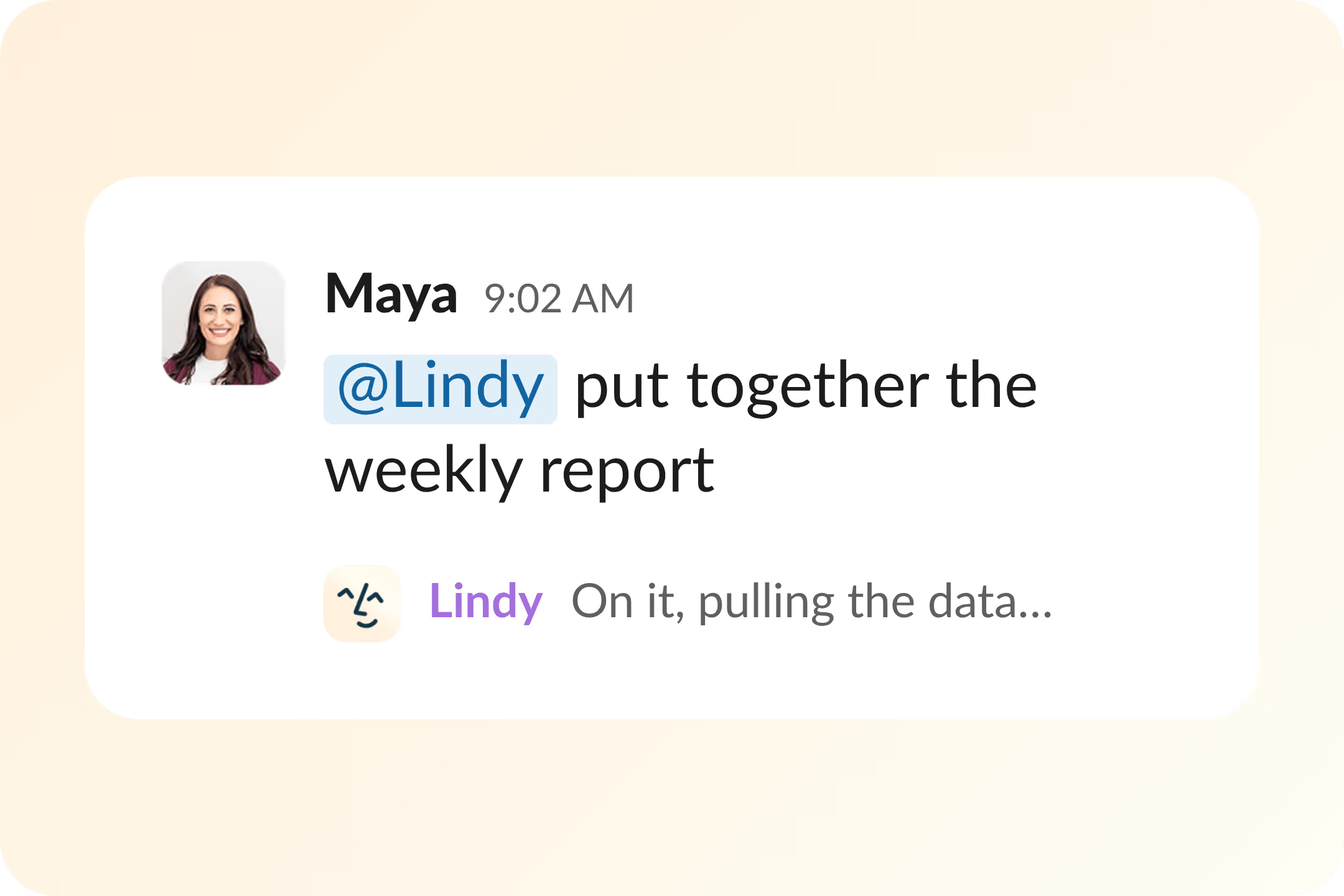
What it is: Lindy is a company-wide AI teammate that lives in Slack; @mention it in any channel and your whole team gets answers, or DM it as your own assistant to handle your inbox, calendar, and CRM. You can also text it on iMessage or SMS.

Best for: Solo founders and small teams who want an assistant that handles a mixed inbox without pre-built templates.

What it does:

  • Learns your writing style from how you edit its drafts over time
  • iMessage integration and choice of AI model on Pro and above
  • Connects to hundreds of apps, with drafts held for your approval by default
  • Handles meeting scheduling, note-taking, and follow-ups in the same assistant

The trade-off: full value requires a Slack workspace.

Pricing: Plus is $29.99/user/month. Pro is $99.99/user/month. Max is $199.99/user/month. Enterprise is custom.

{{templates}}

2. Gmelius Meli: Best for AI drafting inside Gmail

What it is: Gmelius Meli is an AI assistant layer built inside Gmail rather than a separate app. You get AI drafting, inbox classification, and automation without leaving the interface you already use.

Best for: Solo Gmail users and small teams who want AI drafting without switching interfaces.

What it does:

  • Browser extension plus web, iOS, and Android apps
  • Up to 5,000 email conversations per month on the entry tier
  • Shared inboxes and automation rules on Growth and above
  • AI draft assistant for replies, plus AI sorting and tagging for inbox classification

The trade-off: AI drafting is Gmail-only with no Outlook support.

Pricing: Meli is $21/user/month. Growth is $33/user/month. Pro is $50/user/month. Enterprise is custom. 

3. Superhuman: Best for inbox speed over automation

What it is: Superhuman is a keyboard-first email client built on top of Gmail and Outlook, with AI drafting as a feature rather than the core product.

Best for: High-volume professionals who value speed through the inbox first and AI drafting second.

What it does:

  • Web, desktop, and mobile on Gmail and Outlook
  • Salesforce, HubSpot, and Pipedrive CRM integration
  • Natural-language search across your whole inbox history
  • Split inbox, command palette, read statuses, and snippets

The trade-off: automation is light. If fully hands-off replies are the goal, this isn't the right tool.

Pricing: Pro is $15/member/month. Business is $40/member/month (full email features start here). Enterprise is custom. Annual billing drops Pro to $12 and Business to $33 per member/month.

4. InboxPilot: Best for support teams on a tight per-seat budget

What it is: InboxPilot is an AI email assistant priced by draft volume rather than seats, with replies grounded in your own documents and FAQs.

Best for: Support teams where headcount is high but the software budget is not.

What it does:

  • AI drafts, summaries, and suggested actions per email
  • Shared and group inbox support on Standard and above
  • Knowledge base grounding pulls answers from your own docs
  • Smart triage and auto-labeling that do not count against your draft quota

The trade-off: draft quotas mean heavy-volume teams hit limits fast on lower tiers.

Pricing: Free plan includes 25 drafts. Hobby is $29/month. Standard is $149/month. Growth is $249/month. Pro is $499/month.

5. Fyxer AI: Best for inbox triage and meeting notes in one tool

What it is: Fyxer is an AI layer over Gmail and Outlook that triages your inbox into categories, drafts replies in your voice, and joins meetings to take notes.

Best for: Professionals who want inbox triage and meeting notes bundled in one subscription.

What it does:

  • Setup via OAuth in a couple of minutes
  • Meeting notetaker included on both tiers
  • Multiple inboxes, Fyxer Chat search, and HubSpot integration on Professional
  • Auto-categorization into To Respond, FYI, and Marketing, plus drafted replies on Starter

The trade-off: meeting notes and inbox triage are bundled, so you pay for both even if you only need one.

Pricing: Starter is $30/user/month. Professional is $50/user/month. Enterprise is custom.

{{cta}}

When to and not to automate email responses

You should automate email responses when the reply wouldn't change no matter who sent the email. When ten different people could ask the same thing and get the same answer, a template or AI tool earns its place. The moment a reply needs to reflect who's asking, what's happened before, or how they're feeling, automation gets in the way.

Situation Why
High incoming volume Same questions, different senders. Manual attention adds nothing
Identical reply every time Content doesn't change based on sender; human touch adds nothing
Transactional triggers Reader wants a reference number and timeline, not a personal note
Outside business hours Sets a real expectation; silence reads as indifference
Complaints and refund disputes Sender wants acknowledgment. Only a person can give that
Personal or high-stakes emails Needs a reply specific to the situation
Relationship contacts They know your voice. A template signals they're a contact record
Emails that need context No rule-based system can connect dots across past conversations

One test covers most edge cases. Would you be embarrassed if this exact automated reply went to a long-term client who's already frustrated? If the answer is yes, keep it human.

Final verdict

If you want to stay in Gmail and just need AI drafting without a new app, Gmelius Meli is the starting point. If inbox speed is the problem and automation is secondary, Superhuman is the clearest answer. 

If you run a support team and the per-seat math is killing your budget, InboxPilot's volume-based pricing changes the equation. If you want triage and meeting notes in one subscription without technical setup, Fyxer handles both.

If the problem is a mixed inbox that needs more than templates and filters, Lindy handles it without rule-building. The trade-off: it works best in Slack-native teams, and the full value shows up over time as it learns your writing style.

FAQs

Can I automate email responses without any paid tools?

Yes, for basic cases, you can automate email responses without paying for anything. Gmail's vacation responder handles out-of-office messages for free, and Gmail filters combined with saved templates handle trigger-based replies. Outlook's automatic replies feature works the same way. The tradeoff is that you write every template yourself, and personalization stays limited. 

How do I automate email responses based on keywords or sender?

In Gmail, go to Settings, Filters and Blocked Addresses, and create a new filter based on sender or keyword. Choose Send template as the action, then save one under Settings > Advanced > Templates. In Outlook, use File, Manage Rules and Alerts, create a rule triggered by sender or subject keywords, then set the action to reply using a saved .oft template. 

Will automating my email responses hurt my sender reputation?

No, not for individual auto-replies like out-of-office messages or ticket receipts. These are expected and aren't treated as mass mail by spam filters. The real risk sits with marketing automation, where high-volume outbound email needs proper domain warm-up and list hygiene. For inbound automation, the bigger danger is a broken trigger that replies to the same sender repeatedly. 

What kinds of emails should I never automate?

Never automate complaints, refund disputes, escalations, or any email from a clearly distressed customer. The same goes for sensitive personal messages, legal or privacy questions, and anyone in a relationship where a template would be obvious. A simple rule of thumb works here. If someone needs more than three sentences to explain their situation, they need a real human reply.

How does AI-powered email automation work differently from standard autoresponders?

A standard autoresponder sends a fixed message when a trigger fires, regardless of the incoming email. AI-powered email automation reads the email, understands context, and drafts or sends a reply addressing the content. Some tools go further, and they skip trigger configuration entirely and let you describe what you want handled in plain language.

Save 2 Hours Every Day
Lindy is your ultimate AI assistant that manages inbox, meetings, and follow-ups—so you stay ahead of the chaos.
Try Lindy for Free
About the editorial team
Marvin Aziz
Marvin Aziz
Growth Engineer

Marvin is a Growth Engineer at Lindy focused on AI agents, automation, and product-led growth.

Lindy Drope
Lindy Drope
Founding GTM at Lindy

Lindy leads GTM at Lindy and is the team’s most prolific automation builder. She publishes weekly educational videos and articles on building AI assistants – And yes, she’s a real person!

Ready when you are.

Free to try. In your Slack in two minutes.

Try for free
7-day free trial • Cancel anytime