Hiring an Executive Assistant vs. AI: When Each Pays Off
Lindy analyzed dozens of executive assistant hiring guides, salary benchmarks, and interview frameworks to create a practical, step-by-step guide for hiring the right executive assistant.


Hire an executive assistant when you need human judgment and relationship work, and pick an AI alternative when the bulk of your admin lives in your inbox and calendar.
I've sat on both sides of this decision as an operator, and I keep seeing people pay a six-figure fully loaded cost for work that's largely email triage.
Should you even hire an executive assistant in 2026?
Choose an executive assistant if your workload is heavy with stakeholder communication, travel, and confidential decisions that are hard to delegate to an AI assistant.
Choose an AI alternative if your admin is mostly digital and repetitive. It's a fraction of the cost, around $50 per month versus $100K+ a year for a hire.
The key difference is when each makes sense: hire an executive assistant when the work needs human judgment and someone to represent you, and go with an AI alternative when the bulk of the work is routine admin you want done fast.
Hire an executive assistant or go AI? At a glance
Both options solve the same problem (too much admin, too little time), but they do so differently. The table below puts the key trade-offs side by side.
| Aspect | Executive assistant (human hire) | AI assistant |
|---|---|---|
| Definition | A full-time or part-time employee providing high-level admin support to an executive | An AI assistant that connects to your email, calendar, and apps to handle admin tasks |
| When to use | Stakeholder-heavy roles, in-person needs, confidential decisions | Digital, repetitive admin like inbox triage, scheduling, meeting notes, follow-ups |
| Common example | An EA who preps board materials and manages a CEO's travel | An assistant you text to clear your inbox and prep you for meetings |
| Key difference | Salaries run from $44K to $121K/year per Indeed, plus benefits; hiring takes weeks | Far lower cost, it works 24/7, but can't replace a person's judgment |
What is an executive assistant?
An executive assistant is a professional who manages an executive's calendar, email, travel, and meeting prep, and serves as a gatekeeper between the executive and anyone who wants their time. A good EA does far more than admin: they catch scheduling conflicts before they blow up, handle sensitive information with care, and represent you in rooms where tone matters.
That kind of skill costs money. Indeed puts the average executive assistant salary at $73,151 a year, and the fully loaded cost runs higher (more on that below). Hiring is slow, on top of the cost:
- Scope the role first: calendar-only, or full operational support. The job description follows from there
- Source and interview: job boards or a staffing agency, screening for discretion and prioritization
- Expect a wait: staffing agency Insight Global quotes 1 to 3 weeks from first contact to start date, and running the search yourself stretches the calendar further
What is an AI executive assistant?
An AI executive assistant connects to your inbox, calendar, and work apps, then handles the recurring parts of the EA job on its own. That covers email triage, drafting replies, scheduling meetings, taking notes, and follow-ups.
These tools fall into two camps:
- General chatbots like ChatGPT can connect to your email and calendar through apps, but they're mainly useful for drafting and summarizing rather than running your admin on autopilot
- Independent AI assistants operate on their own: they connect to your tools and run the work without waiting for a prompt. Lindy is one you can text to manage your inbox, schedule meetings, and handle daily tasks
Scheduling-focused tools like Motion and Reclaim plan your calendar for you. I've compared the full field in our roundup of the best AI executive assistants and best virtual assistant software.
Fair warning, though. An AI assistant needs a ramp-up period too. The first couple of weeks involve correcting drafts and giving feedback, so your instructions get dialed in to the way you work.
It also can't be in the room for you or navigate a sensitive personnel issue. On the other hand, it works around the clock without vacation, sick days, or a two-week notice. There's also a middle path: a part-time human virtual assistant, often offshore, costs less than a full-time EA but still brings a person's judgment to the work.
{{templates}}
Key differences between hiring an executive assistant vs. AI
The decision usually comes down to what you pay, how fast you need help, and what kind of work you're delegating.
Cost and commitment
A human EA runs you close to $105,000 a year fully loaded. The paycheck is only part of the line item: benefits account for 30.1% of employer costs for private-industry workers, per the Bureau of Labor Statistics (March 2026), and folding that into the average salary gets you to that yearly bill, committed whether it's a slow week or a chaotic one.
Recruiting piles on too: agency fees, the hours you spend interviewing, and the risk of a mis-hire.
AI alternatives cost a lot less. Lindy's entry plan (Plus) runs $49.99 per month, with a 7-day free trial and no long-term commitment.
If you delegate more throughout the day, you'll move toward a higher tier (Pro at $99.99/month, Max at $199.99/month), though even the top self-serve plan costs less per year than one month of an EA's loaded salary.
Speed to start and availability
AI wins on speed: it's live the day you connect your accounts, while an EA placement takes weeks, even with an agency running the search. Then it takes months for a new hire to truly know your calendar politics and writing voice. An EA also works roughly 40 hours a week, takes PTO, and can quit. When they leave, the institutional knowledge walks out with them.
An AI assistant scales up during crunch weeks with no overtime conversation. The ramp-up works differently, though. You'll spend those first weeks giving feedback rather than blindly delegating.
Judgment, relationships, and scope
On judgment and relationships, humans win. An experienced EA reads the room, knows which meeting request hides a political landmine, and handles confidential matters with a level of accountability that an AI assistant doesn't offer yet. If your assistant's job is being your proxy with other humans, hire the human.
Where AI pulls ahead is volume. It can triage a full overnight inbox, prep three meetings, and log every follow-up at the same time. That kind of throughput would eat up a big chunk of an EA's morning.
When to hire an executive assistant vs. when to choose AI
The sections above cover cost, speed, and scope in detail. The quick version for anyone skimming: it depends on how much of the work needs a person in the loop.
Hire an executive assistant when:
- Your support needs are heavily interpersonal, like board relations, investor logistics, or gatekeeping, where tone and trust matter
- You need in-person help with travel, events, office management, or personal errands
- You're delegating confidential, high-stakes work where someone needs to be accountable for the outcome
Choose an AI alternative when:
- Your day-to-day admin is the digital, repetitive kind covered above
- A $100K+ fully loaded hire isn't justifiable yet, but you're losing hours a day to admin
- You need coverage now, or outside business hours. An AI assistant is live the day you connect it, even if dialing it in takes a couple of weeks
A lot of founders start with AI and hire a human EA later, once the interpersonal workload demands one. At that point, the two work together, with the EA handing off the routine stuff to the AI.
How Lindy fits into this decision
The question that settles this decision is what percentage of your work needs human judgment. If it's the majority, hire. If it's a small slice, you're looking at a calendar-and-inbox problem, and AI assistants like Lindy were built for exactly that.
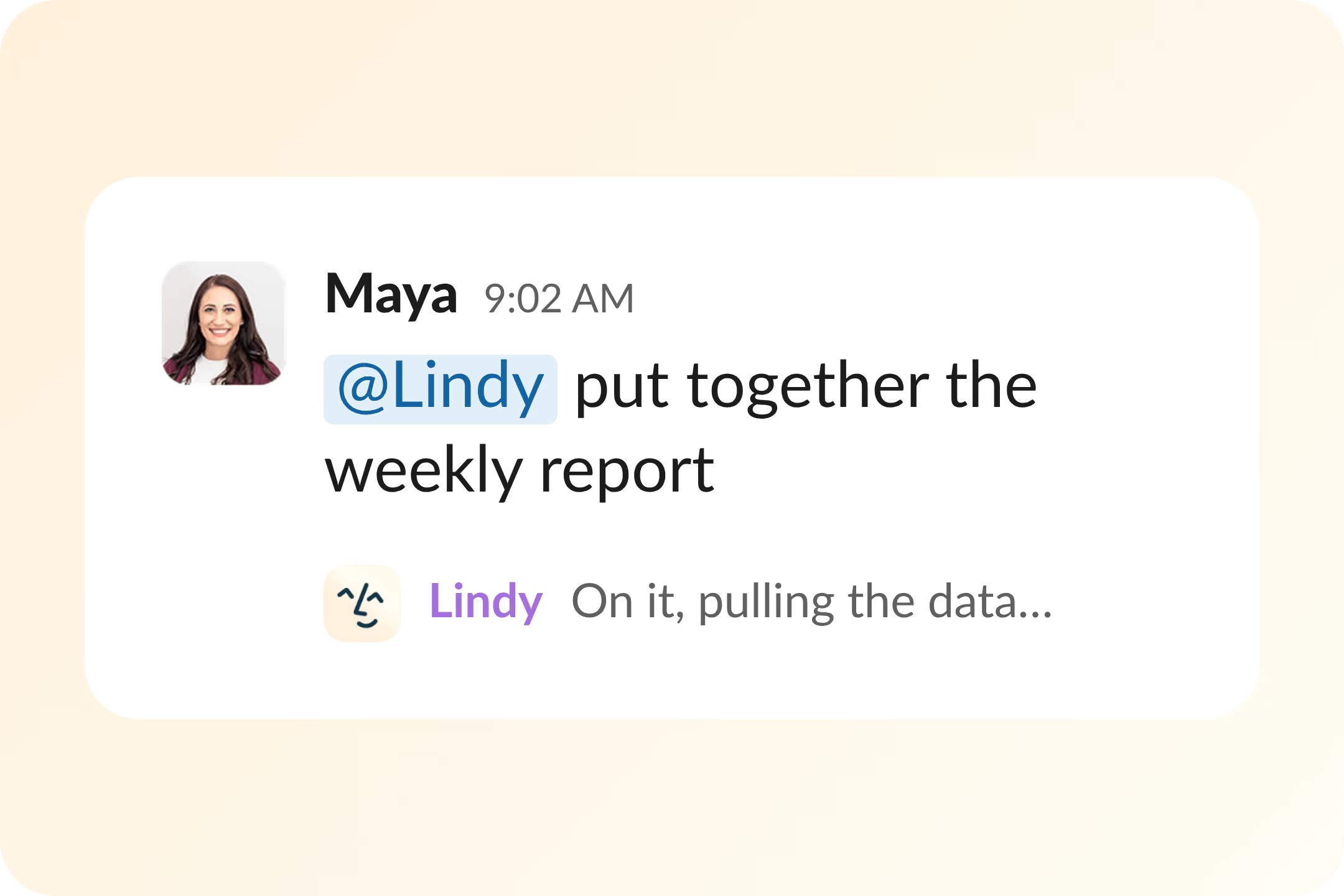
Lindy is an AI assistant you can text to handle your day-to-day admin. In practice, that looks like this: you text 'clear my inbox and prep me for the 2 p.m.,' Lindy triages the overnight mail, drafts replies for you to approve or tweak, and sends you a one-line brief before the call. It also schedules meetings, takes notes, and sends follow-ups afterward.
It plugs into Gmail, Google Calendar, Slack, Notion, HubSpot, Salesforce, and more, and runs on the instructions and preferences you set.
For teams, the Enterprise plan adds SOC 2 Type II, GDPR, and HIPAA compliance with a signed BAA. If you want to see how people set it up, the Lindy Academy has short walkthroughs.
Key benefits:
- A year on the entry plan runs about $600, less than half of one week of the average EA's pay
- Connect your inbox and calendar in about 60 seconds, without a recruiting pipeline or months of onboarding
- Email gets triaged overnight, and Lindy texts you when something needs your attention
Try Lindy free for 7 days and see how it compares to hiring.
{{cta}}
Frequently asked questions
What is the average executive assistant salary?
The average executive assistant salary in the US is $73,151 per year, according to Indeed (July 2026). Pay climbs in expensive markets, with Glassdoor's New York City median sitting at $95K, so budget for where your executives live.
How do I hire an executive assistant?
You hire an executive assistant by deciding what the job actually covers (calendar-only or full operational support), writing the job description around that, sourcing candidates through job boards or a staffing agency, and interviewing for discretion and prioritization over raw years of experience. Expect the search to take weeks and the ramp-up to take months.
Is it worth hiring an executive assistant?
Hiring an executive assistant is worth it when your workload is heavy with stakeholder management, travel, and sensitive calls that require someone to use their own judgment. If your admin is largely inbox and calendar work, an AI alternative covers it for a fraction of the cost.
What is the difference between an executive assistant and an AI assistant?
An executive assistant is an employee who brings human judgment and can represent you to other people. An AI assistant is software that handles digital admin like email, scheduling, and follow-ups around the clock.
Many executives use both, with the EA taking the relationship work and the AI sorting through the everyday admin.
How much do AI executive assistant alternatives cost?
AI executive assistant alternatives cost far less than a hire, typically $20 to $200 per month. Lindy starts at $49.99/month, ChatGPT Plus runs $20/month, and scheduling tools like Motion and Reclaim sit around $19/seat/month to $12/seat/month. Even the priciest tier costs a fraction of an EA's salary.