Virtual Assistant for Executives: 6 Options and What They Cost


The first executive assistant service I looked at quoted me $3,600 a month on a 90-day commitment, before I had met a single candidate. Three months and thousands of dollars for someone I hadn't even spoken to yet.
Deciding you need help and actually getting it aren't the same thing. With a human VA service, the time between them goes to matching, interviews, and onboarding. With an AI virtual assistant, you can often start handing off work the same day.
I compared both approaches to see which ones are worth the cost and who each one actually fits. Here's the short version:
The 6 best virtual assistants for executives
- BELAY: Founders who want a US-based assistant matched by a real person
- Boldly: Executives who want senior, W-2 employed talent on subscription
- Assist World: Executives who want a broader remote team beyond a single assistant hire
- Athena: Executives who want full-time offshore support with delegation coaching
- Prialto: Teams that need guaranteed continuity if an assistant is out
- Lindy: Executives who want AI support they can start using the same day
What is a virtual assistant for executives?
A virtual assistant for executives is remote support focused on the work around an executive’s day, including calendar management, inbox triage, travel, meetings, and follow-ups.
Executive support usually falls into two models:
- Human executive assistants: A staffing service matches you with a dedicated assistant who can handle ongoing work, use judgment, and learn how you operate. This usually comes with onboarding and a monthly commitment.
- AI executive assistants: These connect to your calendar, inbox, and work apps, then start handling tasks much faster. They cost less and are easier to start, though they rely more on rules, permissions, and connected context.
This is different from a general virtual assistant, who may focus more on one-off admin tasks. If you’re still deciding what level of support you need, this guide on whether you need a virtual assistant is a useful place to start.
Some providers now combine both models, giving executives human support backed by AI automation.
How I picked these options
I filtered for options built around executive support, then compared what happens before, during, and after you hire. Here’s what I looked at each stage:
- Before hiring, I checked pricing, location, contracts, and how selective the vetting process is.
- During matching, I looked at who chooses your assistant, how much input you get, and how long the process takes.
- After matching, I paid attention to ownership, judgment, working hours, and what happens if the pairing doesn't work.
- For the AI option, I connected it to Gmail and Slack and checked how much of the same work it picked up on day one, and where it still needed me.
I weighted the vetting and rematch policy most heavily. A bad match costs more in wasted months than a slightly higher monthly fee ever does.
How the options compare: Side-by-side
| Tool | Best for | Key strength | Starting price |
|---|---|---|---|
| BELAY | Founders and small business owners who want a hands-on matching process | Personal matching with a 93% first-match success rate | No public pricing |
| Boldly | Executives who want a senior, U.S.-based assistant they can meet before committing | Meet-first model with transparent pricing | $2,600/month (40 hrs) |
| Assist World | Executives who want access to a broader remote team beyond one assistant | Choose your own match from a network of 5,000+ professionals | No public pricing |
| Athena | Executives who want a full-time dedicated assistant with delegation coaching | Structured coaching built into onboarding | $3,000/month (12-mo term); $3,600 monthly |
| Prialto | Teams that need reliable coverage when their primary assistant is unavailable | A trained backup assistant is included with every account | $1,600/unit/month (55 hrs) |
| Lindy | Executives who want fast support with scheduling, email, and follow-ups | Drafts replies, books meetings, and answers questions in Slack | $29.99/month per user |
1. BELAY
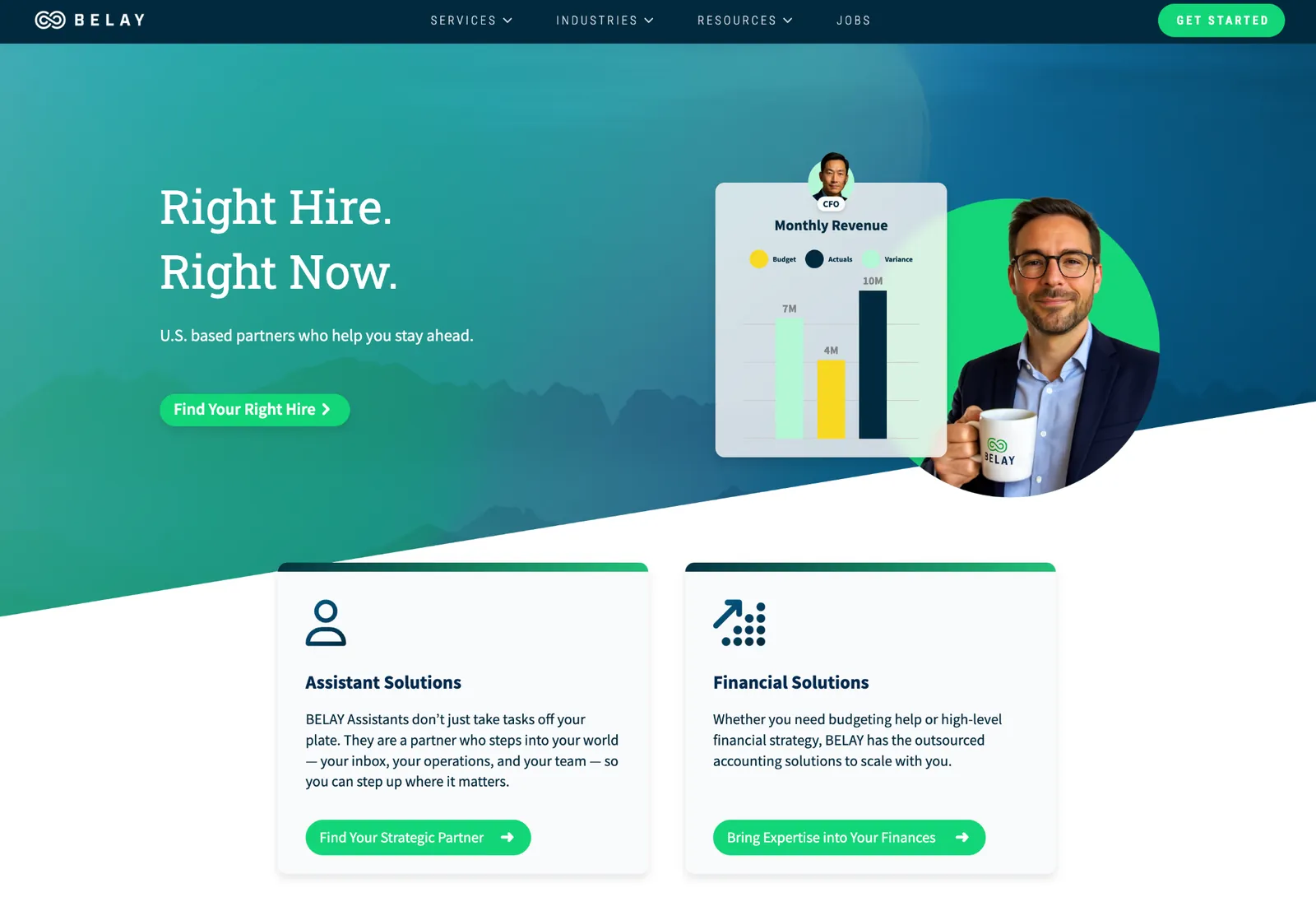
What it does: BELAY pairs business leaders with a dedicated U.S.-based assistant for inbox, calendar, meeting prep, travel, and daily admin. A Client Success Consultant handles the matching process personally, giving it a more hands-on approach than algorithm-based matching.
Best for: Founders and small business owners who want a U.S.-based assistant with a more personal, hands-on matching process.
Pricing: BELAY doesn't publish its pricing. Rates depend on the type of support needed, hours required, and service tier.
Key highlights
- A dedicated Client Success Consultant leads the entire matching process
- Right-Fit Guarantee, with a free rematch if the assistant isn't a good fit
- Seven assistant specialties beyond executive support, including marketing, operations, and financial client services
- A separate Financial Solutions line for bookkeeping, payroll, and fractional CFO work
- No long-term contract lock-in
What stood out to me
The personal matching process is what stood out most, more than any single feature. Handing the scoping conversation to a real person instead of filling out a form and hoping an algorithm gets it right feels like the right amount of friction for something this personal.
I'd rather spend 30 minutes on a call upfront than spend a month finding an assistant, and I don't work the same way, which is likely why BELAY reports a 93% first-match success rate.
Where it falls short
Pricing isn't public, and that's what would frustrate me most when shopping around. I understand why a service this customized doesn't want to post a single number, but it also means you can't rule BELAY in or out before investing time in a sales call, which is exactly the kind of friction a busy executive is trying to avoid.
And since the assistant technically works for BELAY, not you, there's a layer of management and margin sitting between you and the person doing the actual work.
What users say
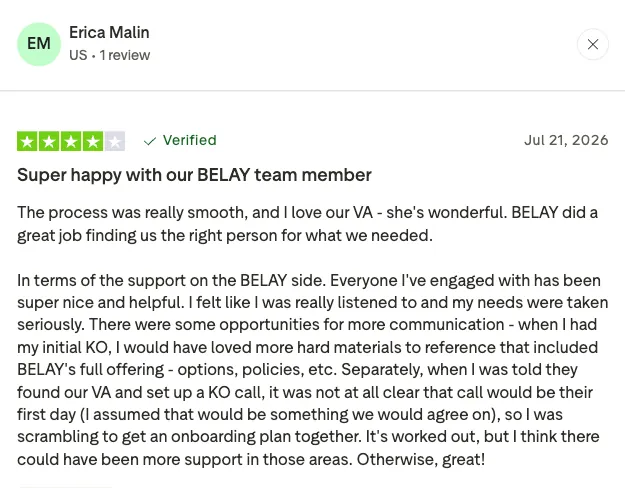
- Pro: “The process was really smooth, and I love our VA” - Erica Malin, Trustpilot review
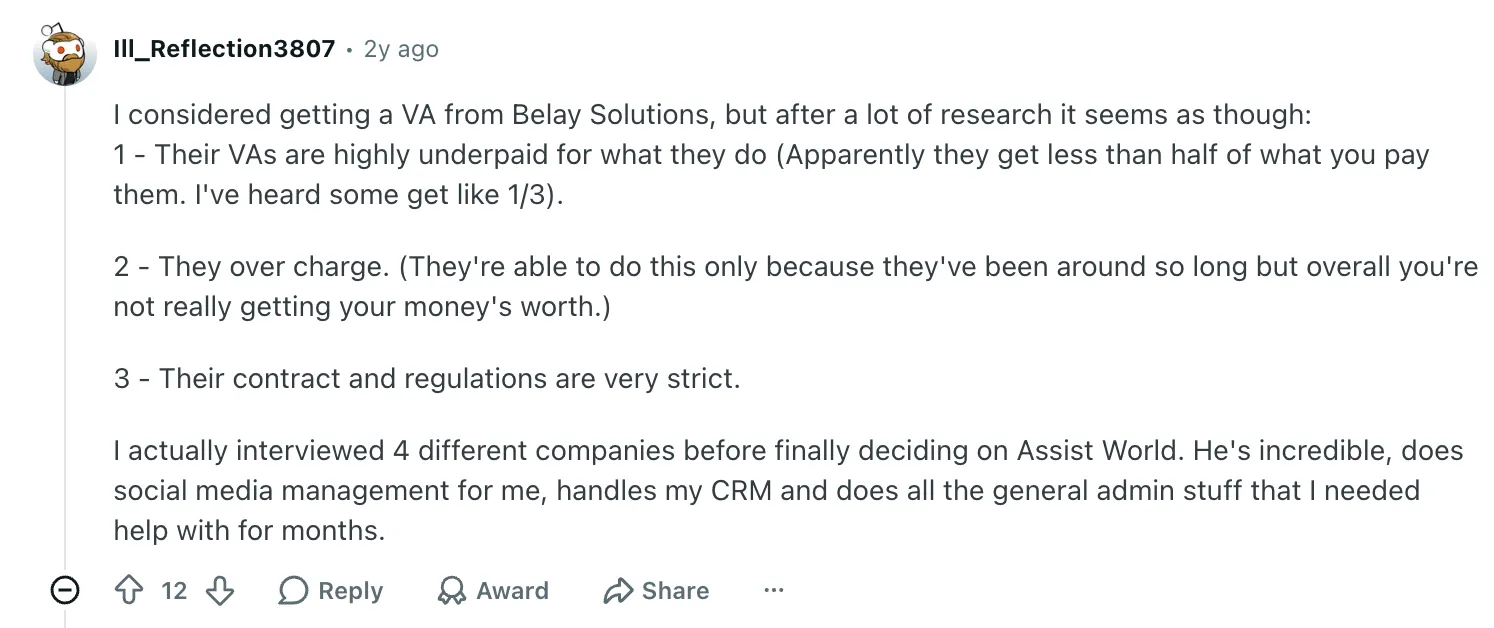
- Con: “I considered getting a VA from Belay Solutions, but after a lot of research it seems as though their VAs are highly underpaid for what they do (Apparently they get less than half of what you pay them. I've heard some get like 1/3).” - u/III_Reflection3807, Reddit review
2. Boldly
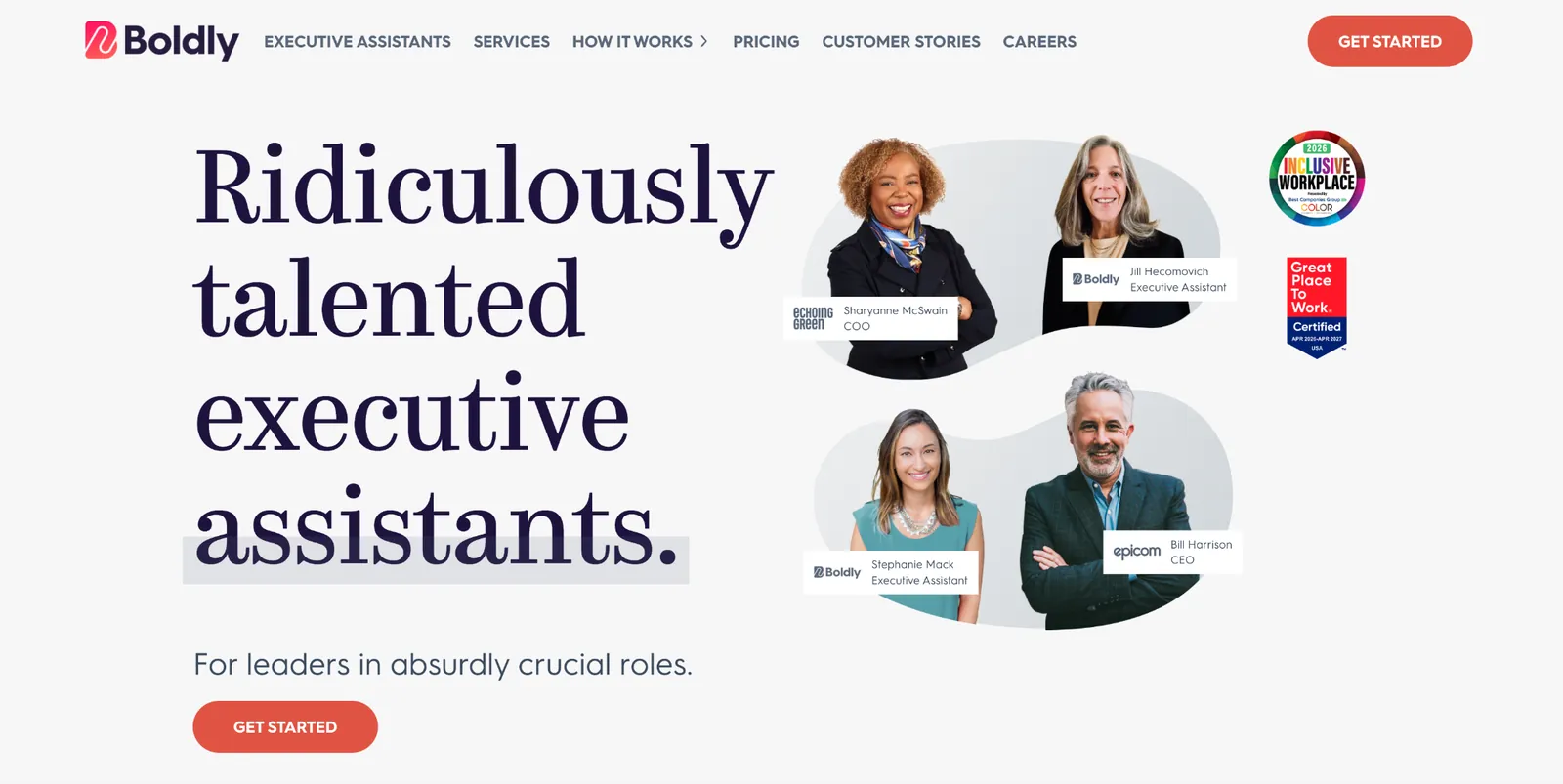
What it does: Boldly matches leaders with a premium, US-based executive assistant who is a W-2 staff member, using a "meet first" model that lets you approve the match before you pay anything.
Best for: Executives who want a senior, US-based assistant and want to meet them before committing to anything
Pricing: Boldly starts at $2,600/month for 40 hours, scaling to $3,900/month for 60 hours, $5,200/month for 80 hours, and $6,500/month for 100 hours. Custom pricing available for plans up to 160 hours.
Key highlights
- Assistants average 10 to 15 years of experience, screened for business experience and long-term fit
- A "meet first" model: you speak with your matched EA and approve the fit before paying anything
- W-2 employment instead of contractors, with no 1099 compliance risk
- Includes a trained backup assistant to keep work covered during vacations or sick days
- Multilingual support available in French, German, Spanish, and more
What stood out to me
You actually speak with the person who will be supporting you before committing, which removes much of the uncertainty that usually comes with executive assistant services.
In a category where the working relationship matters as much as the resume, that feels like a much better way to make the decision.
Schedule Assist was the other feature that caught my attention. Boldly claims it can make scheduling 55% faster, giving you something concrete to evaluate beyond the usual promises of saving time or boosting productivity.
Where it falls short
The jump between tiers is steep: $1,300 more for each extra 20 hours, so going from 40 to 60 hours costs as much as adding a second junior hire elsewhere on this list.
Specialist work, like design or web development, is also billed separately at $79/hour, which is easy to miss when comparing the headline monthly price against competitors that bundle more into a flat rate.
What users say
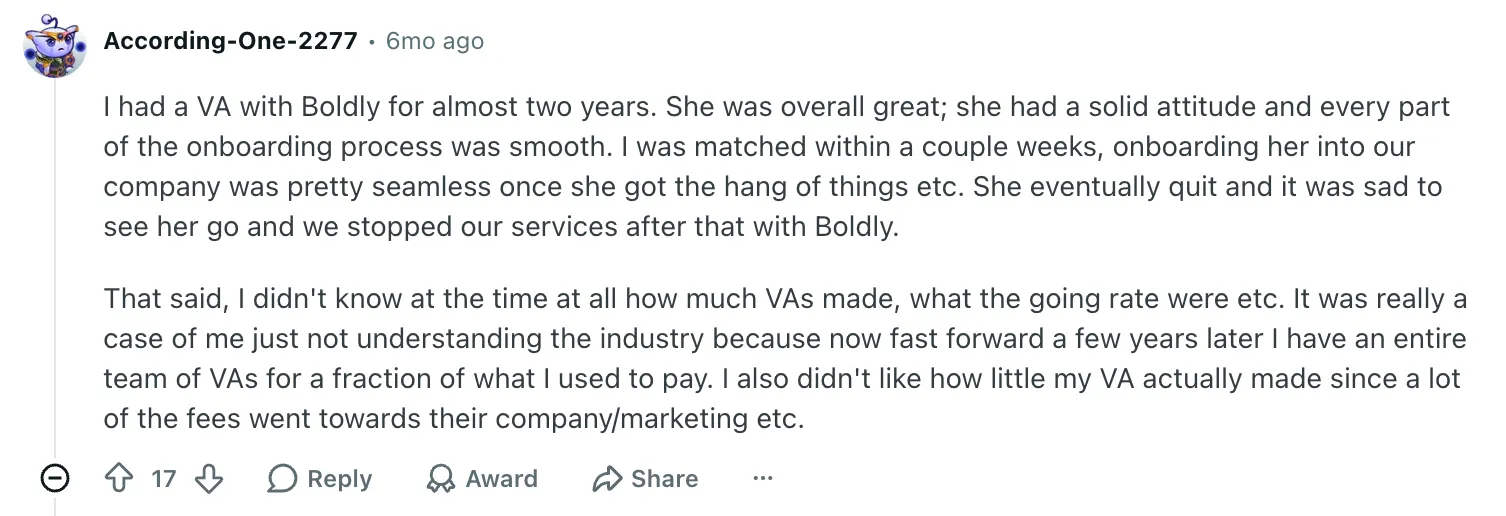
- Pro: “I had a VA with Boldly for almost two years. She was overall great; she had a solid attitude, and every part of the onboarding process was smooth. I was matched within a couple of weeks; onboarding her into our company was pretty seamless once she got the hang of things, etc.” - u/According-One-2277, Reddit review
- Con: “I also didn't like how little my VA actually made since a lot of the fees went towards their company/marketing, etc.” - u/According-One-2277, Reddit review
3. Assist World
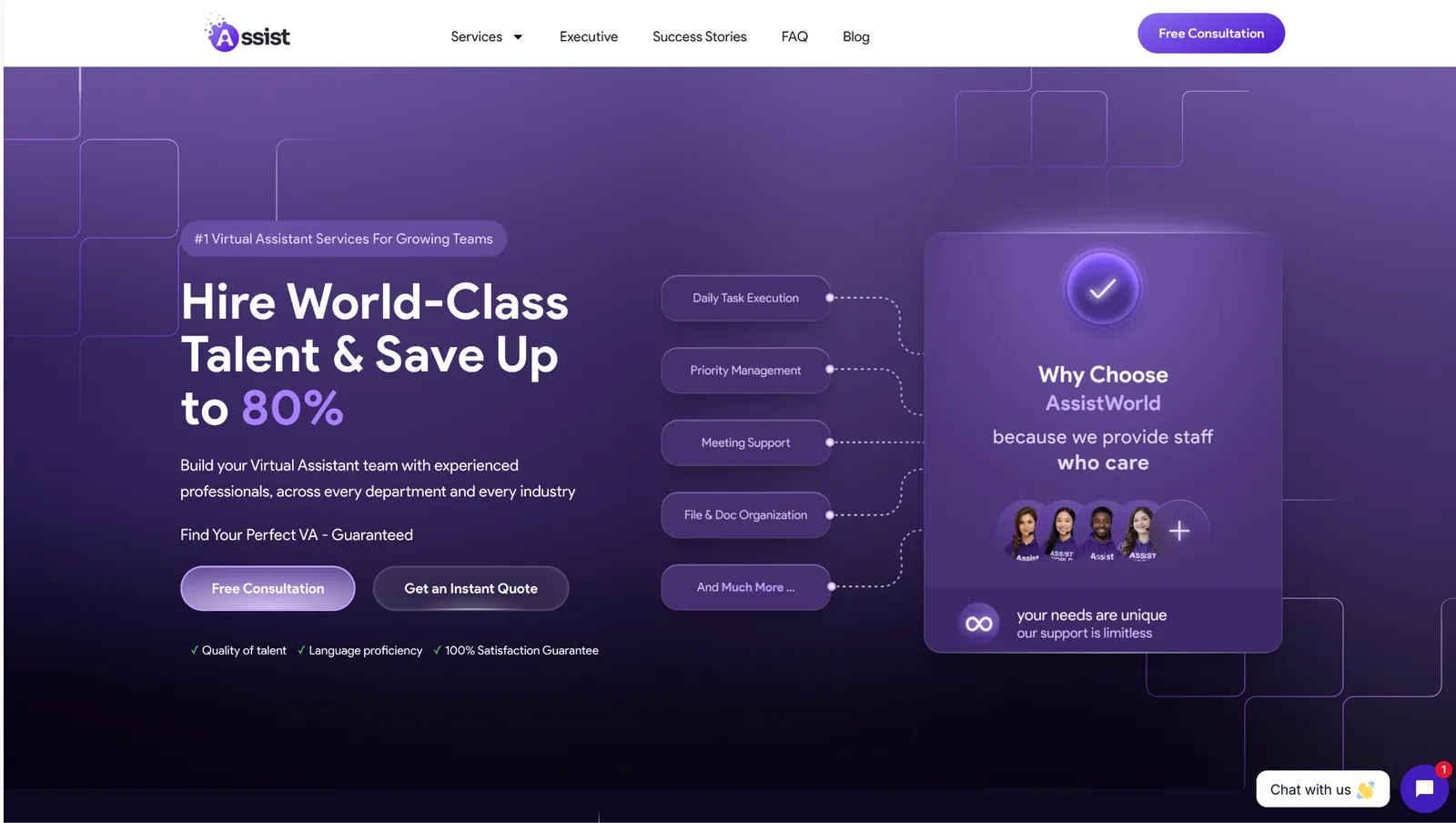
What it does: Assist World connects businesses with virtual assistants across a wide range of roles, from executive assistants and customer support to legal, real estate, and healthcare admin, drawing from a network of 5,000+ vetted professionals.
Best for: Executives who want to build a broader remote team beyond a single assistant hire
Pricing: No public pricing. A free consultation covers cost and fit questions.
Key highlights
- Clients interview and choose their own match from a shortlist, not a single assigned candidate
- No lock-in contracts, with the ability to scale or cancel anytime
- A dedicated account manager is included for ongoing support
- Part-time or full-time support depending on need
- Coverage across specialized areas like legal, real estate, accounting, and healthcare admin
What stood out to me
Getting to interview real candidates and choose the person myself was the biggest advantage for me. I had a much better sense of who I'd be working with before making a commitment.
The range of roles also stood out. One account manager can coordinate support across legal, accounting, and customer service, making the setup much easier when you need help in multiple areas.
Where it falls short
One drawback is the lack of public pricing. You only get a real number after booking a free consultation, which makes quick side-by-side comparisons harder.
The "100% VA Guarantee" is worth reading closely. Assist World's FAQ describes the remedy as a replacement, and its terms call all fees non-refundable. Reviews from earlier in 2026 mention refunds being offered, but that language came off the site in an August redesign, so ask what the guarantee covers now before you sign.
What users say
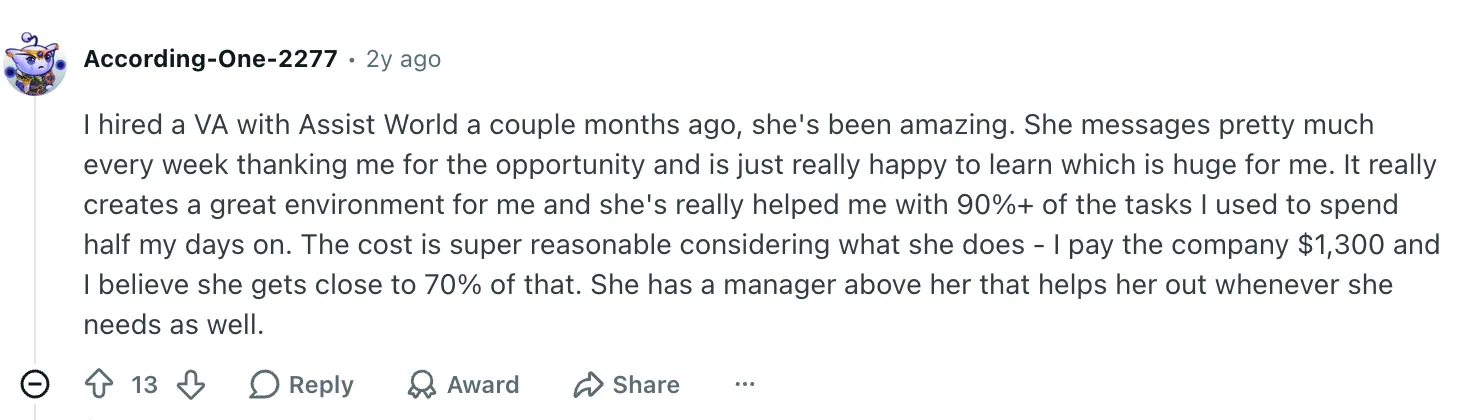
- Pro: “The cost is super reasonable considering what she does. I pay the company $1,300, and I believe she gets close to 70% of that. She has a manager above her that helps her out whenever she needs it as well.” - u/According-One-2277, Reddit review
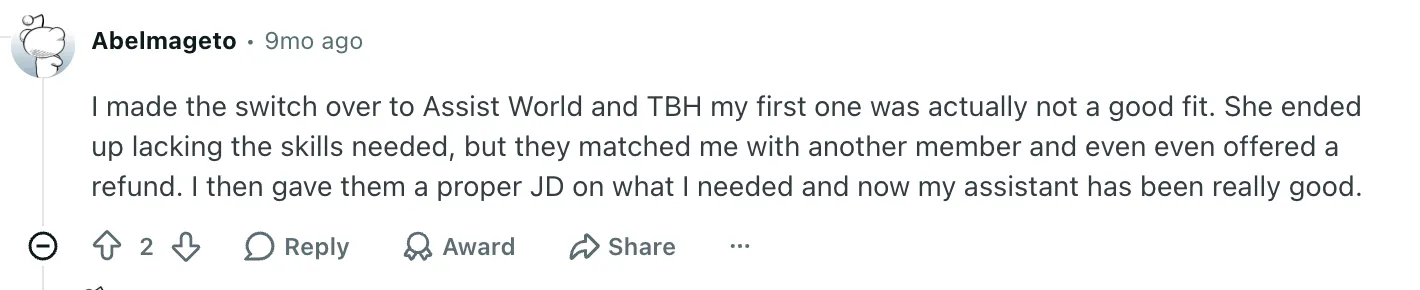
Con: “I made the switch over to Assist World, and TBH my first one was actually not a good fit. She ended up lacking the skills needed, but they matched me with another member and even offered a refund. I then gave them a proper JD on what I needed, and now my assistant has been really good.” - u/Abelmageto, Reddit review
4. Athena
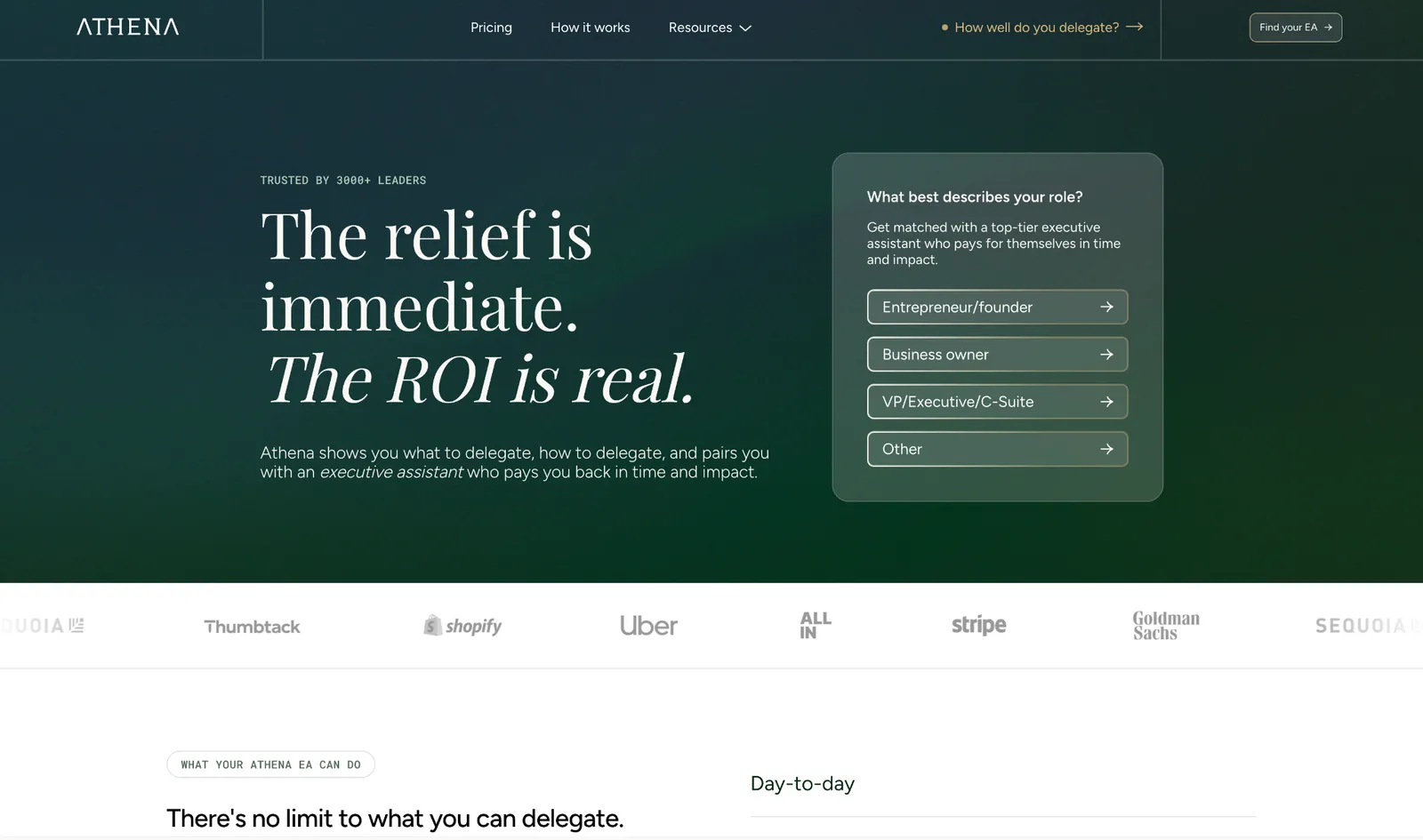
What it does: Athena provides a full-time, dedicated executive assistant, matched through an algorithmic process, paired with structured delegation coaching to help clients make the most of their time.
Best for: Executives who want a full-time dedicated assistant with structured delegation coaching built in
Pricing: Athena's Executive Assistant plan runs $3,600/month billed monthly after a 90-day commitment, or $3,000/month on a 12-month term.
Key highlights
- A dedicated full-time Executive Partner working in your time zone, never shared across clients
- Delegation training and an ongoing Delegation Training Library are included
- Algorithmic matching combined with a tailored onboarding process
- SOC 2 Type II certified, with company-issued, monitored devices for every EA
- Selected from 30,000 to 60,000 monthly applicants, with roughly 1% accepted
- Onboarding is designed to take one to two weeks from intake to kickoff
What stood out to me
Delegation coaching is what makes Athena stand out, especially for executives working with an assistant for the first time. Knowing what to hand off, how much context to give, and when to step back takes practice.
Athena builds that skill into onboarding, which can shorten the awkward first few months when an executive is still figuring out how to delegate well.
Where it falls short
The 90-day commitment is what makes me pause. You’re committing for three months before you know whether the match works, which puts real trust in Athena's vetting process and gives you less room to judge the fit yourself.
Athena does offer rematching if things don’t improve, but its FAQ doesn’t make it clear whether a new match also restarts the 90-day commitment. That’s something I’d confirm before signing up.
What users say

Pro: “I actually looked into Athena a while ago. Their graphics and marketing are top-notch.” - u/EquivalentNet1607, Reddit review
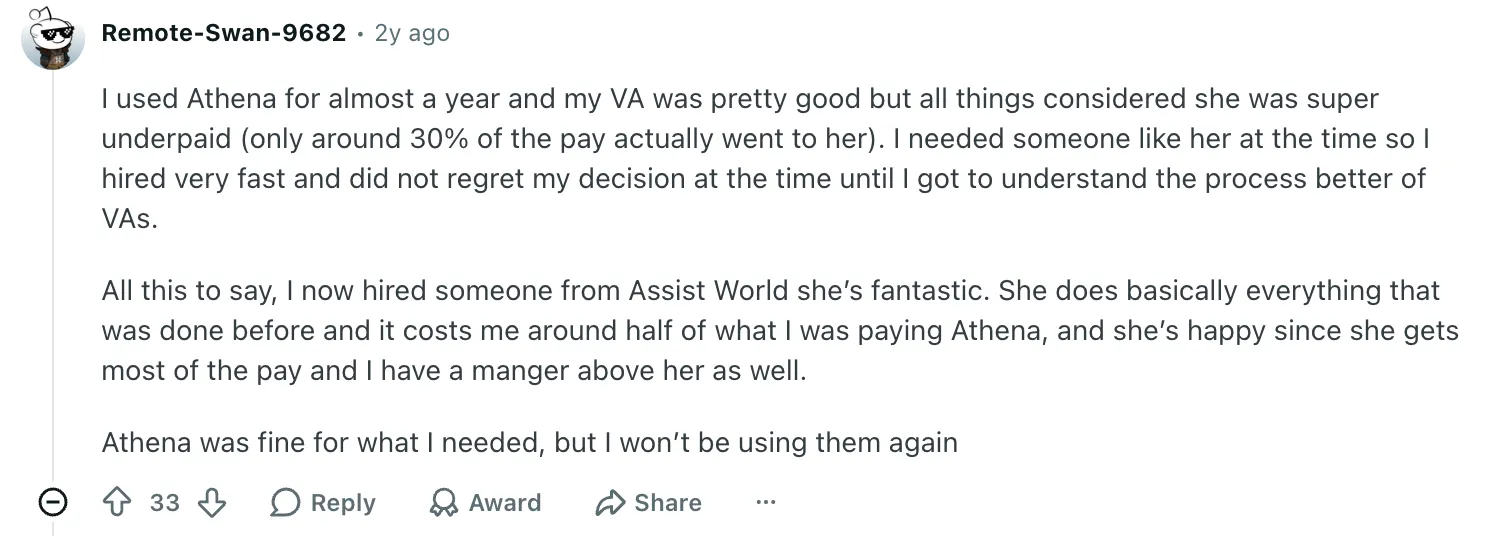
Con: “I used Athena for almost a year, and my VA was pretty good, but all things considered, she was super underpaid (only around 30% of the pay actually went to her). Athena was fine for what I needed, but I won’t be using them again.” - u/Remote-Swan-9682, Reddit review
5. Prialto
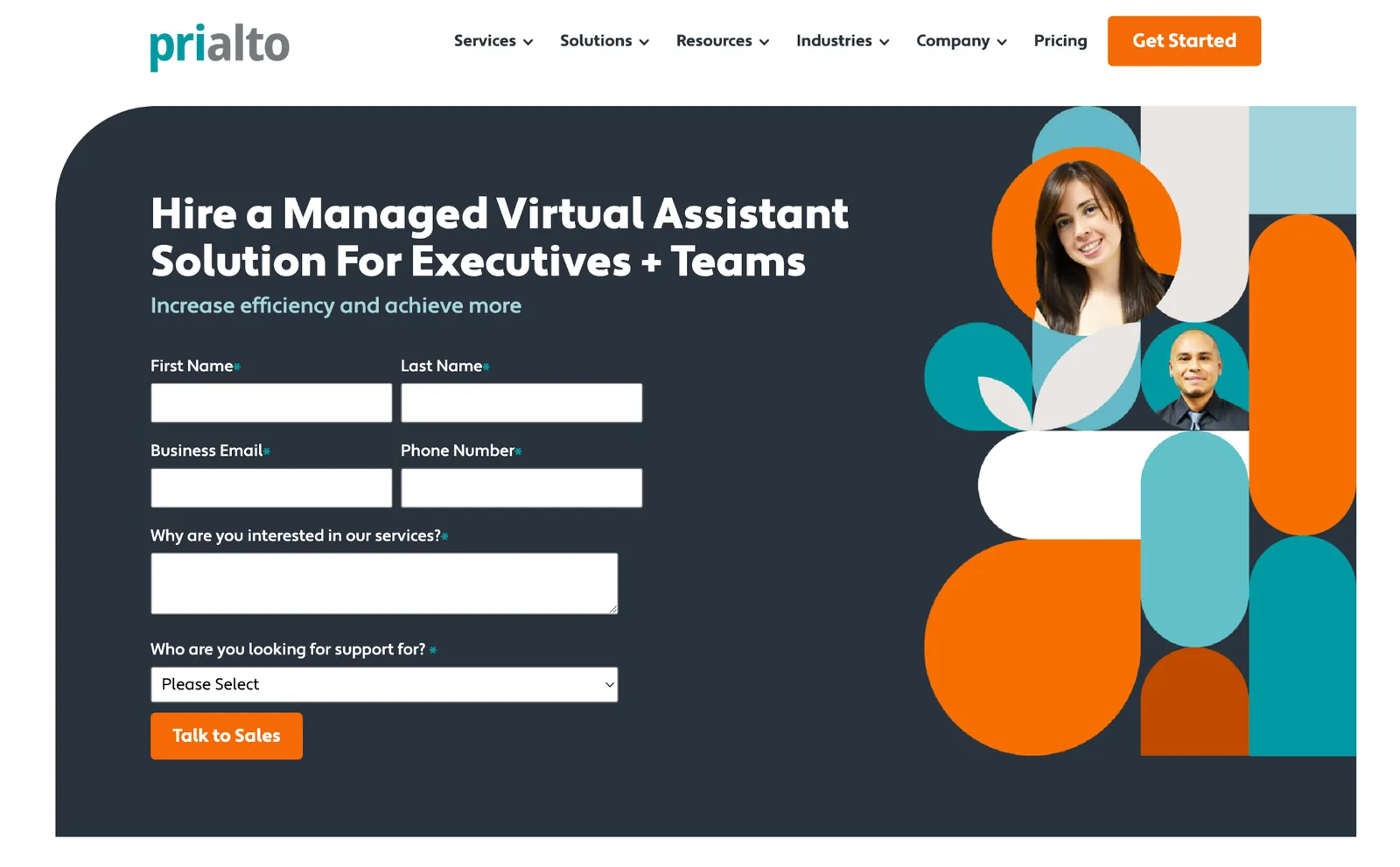
What it does: Prialto provides managed virtual assistant support built around a team model, pairing a primary assistant with a trained backup and an engagement manager who oversees quality and process.
Best for: Teams and executives who want continuity guaranteed, even if their primary assistant is unavailable
Pricing: Plans start at $1,600/unit/month for 55 hours on a 90-day minimum per unit, plus a $250 setup fee (waived on a 1-year agreement). Units are monthly blocks of hours.
Key features
- A primary assistant plus a trained backup on every account, so coverage doesn't stop for vacation or illness
- A dedicated engagement manager who oversees the relationship and process quality
- Assistants work 9am to 6pm Monday through Friday, US and UK time zones
- Team plans available for multiple assistants across a leadership group
- Support for CRM upkeep and sales pipeline tasks, beyond general admin
- SOC 2 Type 2 compliant, with a month-long training program for every new assistant
What stood out to me
The backup-assistant model is what makes Prialto feel different. Your primary assistant comes with a trained backup who can step in when they’re unavailable, providing more continuity than a one-person arrangement. It’s the kind of feature you barely notice until the week your assistant is out and work still needs to move.
The engagement manager is the other piece worth noting. Someone outside the assistant relationship owns process quality, which is the part most VA services leave to you.
Where it falls short
Prialto starts at $1,600 per unit per month, plus the $250 setup fee, which is a sizable commitment for a solo executive or a smaller team. Full-time support starts at $3,600/month, and enterprise pricing requires a custom quote.
The model is also fairly structured. Prialto leans heavily on documented processes, ongoing training, and team-based backup, which can feel rigid if you prefer a more flexible relationship with a single dedicated assistant.
If you want something easier to start or less process-heavy, these Prialto alternatives are worth comparing.
What users say
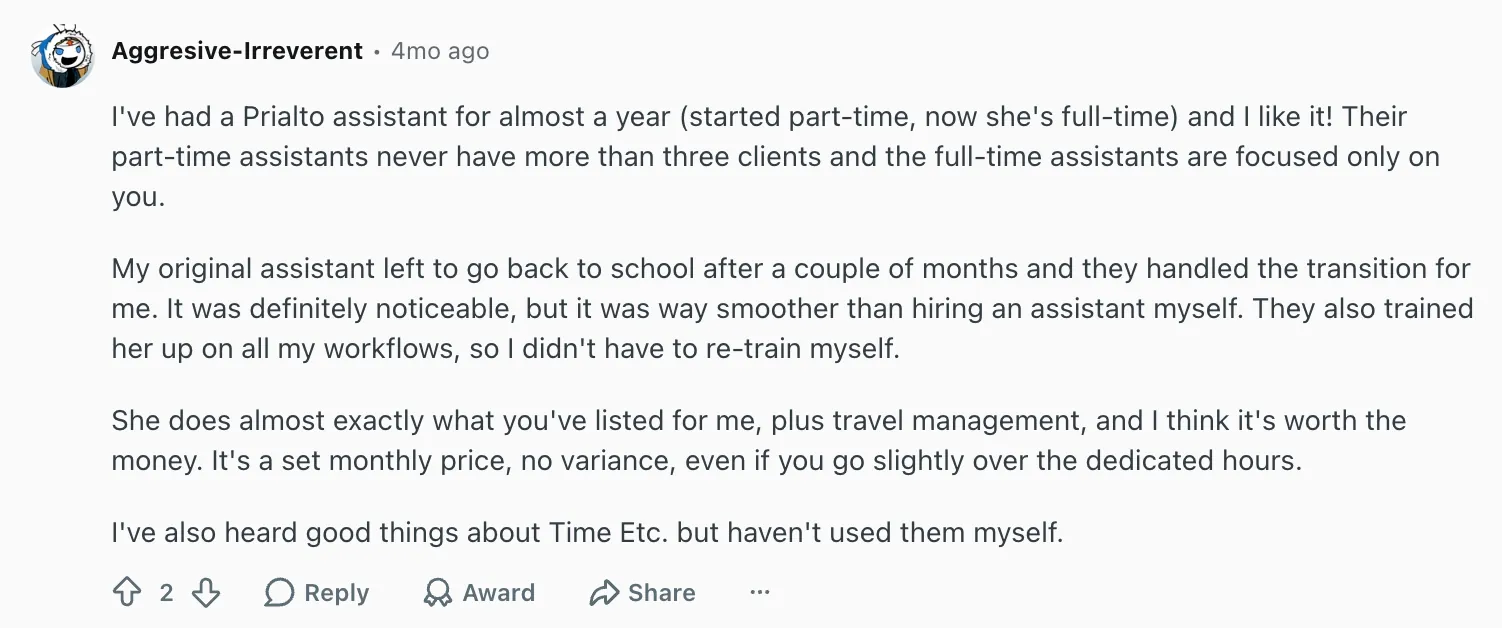
Pro: “I've had a Prialto assistant for almost a year (started part-time, now she's full-time) and I like it! Their part-time assistants never have more than three clients, and the full-time assistants are focused only on you.” - u/Aggresive-Irreverent, Reddit review
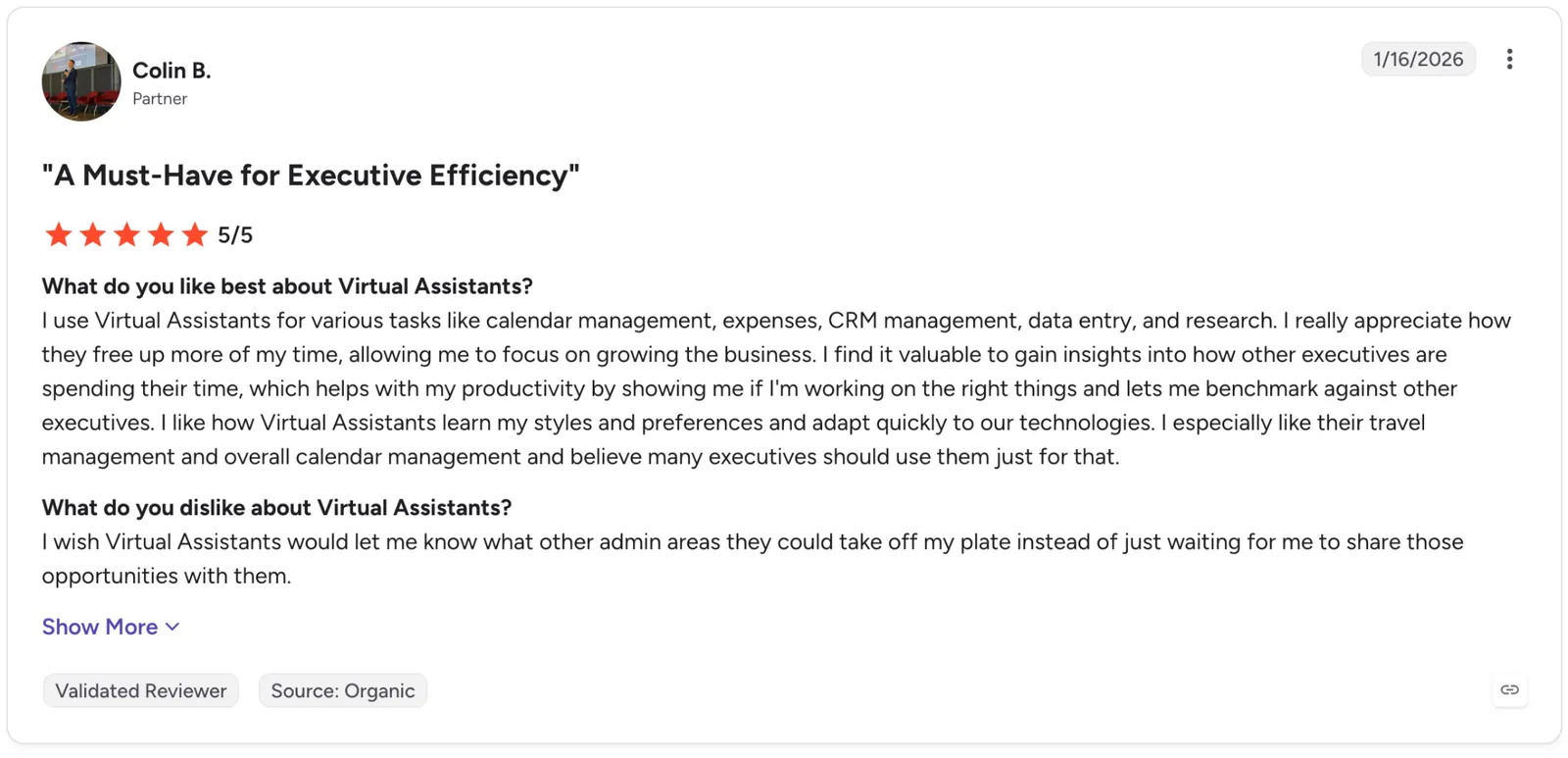
Con: “I wish Virtual Assistants would let me know what other admin areas they could take off my plate instead of just waiting for me to share those opportunities with them.” - Colin B., G2 review
AI alternatives to a human executive assistant
Every option above follows the same shape. There's a discovery call, a matching or coaching process, and a monthly commitment before support starts. An AI executive assistant starts from the other end: you connect it to your inbox and calendar and hand off work the same day.
6. Lindy
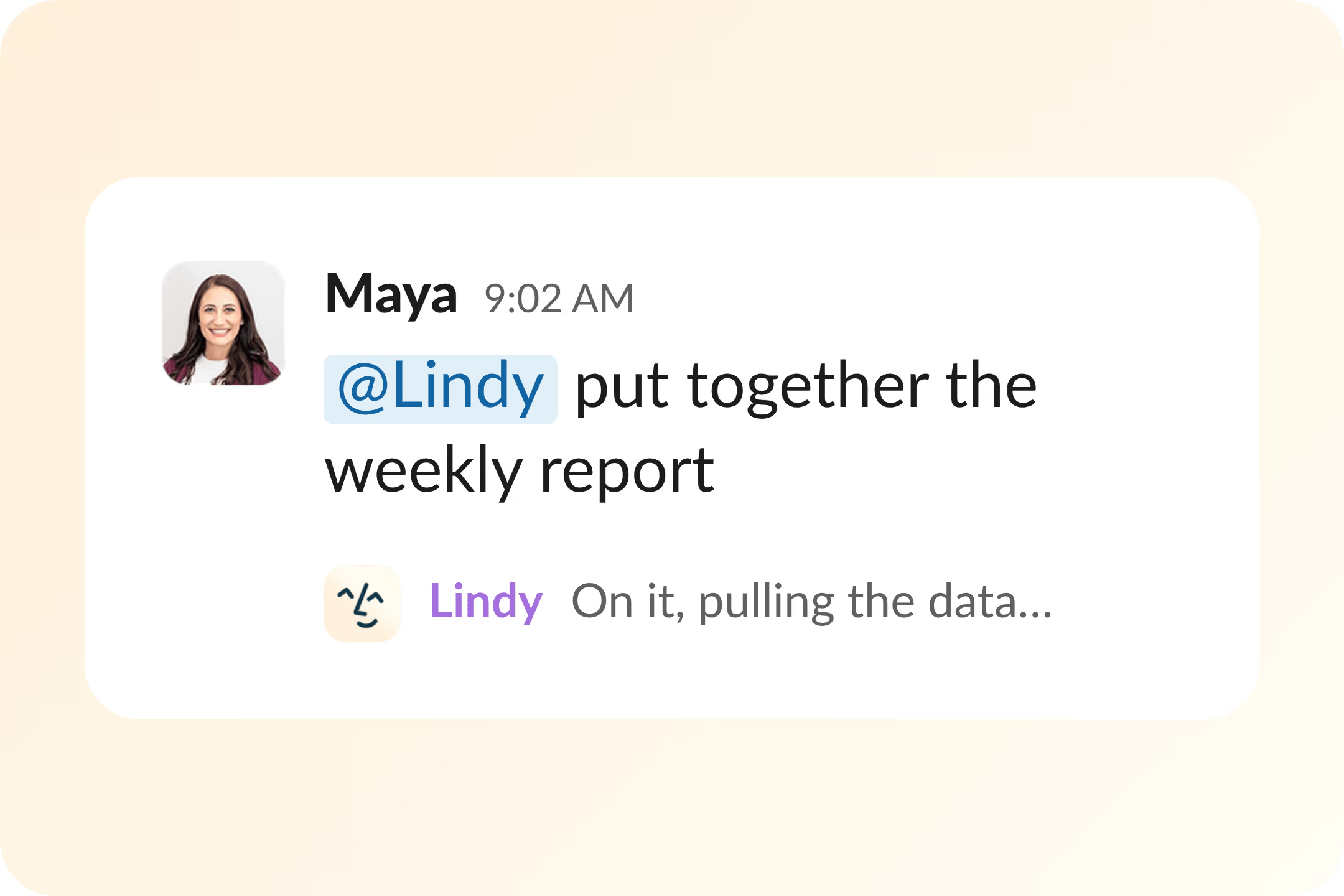
What it does: Lindy is an AI teammate that lives in your company's Slack. An admin connects it once, and from there, anyone on the team can @mention it in a channel or message it privately. DM it, and it works like your own assistant, connected to your Gmail, calendar, and the tools you already use.
Best for: Executives who want same-day support for scheduling, email, and follow-ups
Pricing: Plans start at $29.99/month per user (Plus, 3,000 credits), with Pro at $99.99/month and Max at $199.99/month. A 7-day free trial is available.
Key features
- Drafts replies in Gmail that follow the tone and instructions you set, ready for review before sending
- Lives in Slack, where @mentioning it in a channel gets team context and DMing it privately gets your own assistant
- Books meetings end-to-end once a time is agreed on in a thread
- Answers questions with citations, searching every connected tool, meeting, and file your team has approved
- SOC 2 Type II, GDPR and PIPEDA compliant, with a signed BAA for HIPAA on Enterprise plans
What stood out to me
What stood out against the other options was how quickly I could start. I connected Gmail and Slack in a few minutes, and drafts started showing up that same afternoon in the tone I had set.
Compared with weeks of onboarding a human assistant, a 90-day commitment, or a $3,600 monthly bill, the barrier to trying Lindy felt much lower.
Where it falls short
It can't replace the judgment calls an experienced human EA makes on the fly, such as reading the room, negotiating a scheduling conflict with another executive's assistant, or deciding that something needs to be escalated before being asked. AI tools on the market today still fall short on that kind of relationship work, this one included.
For those hours, I'd keep a part-time human alongside it, rather than expecting Lindy to cover them.
What users say
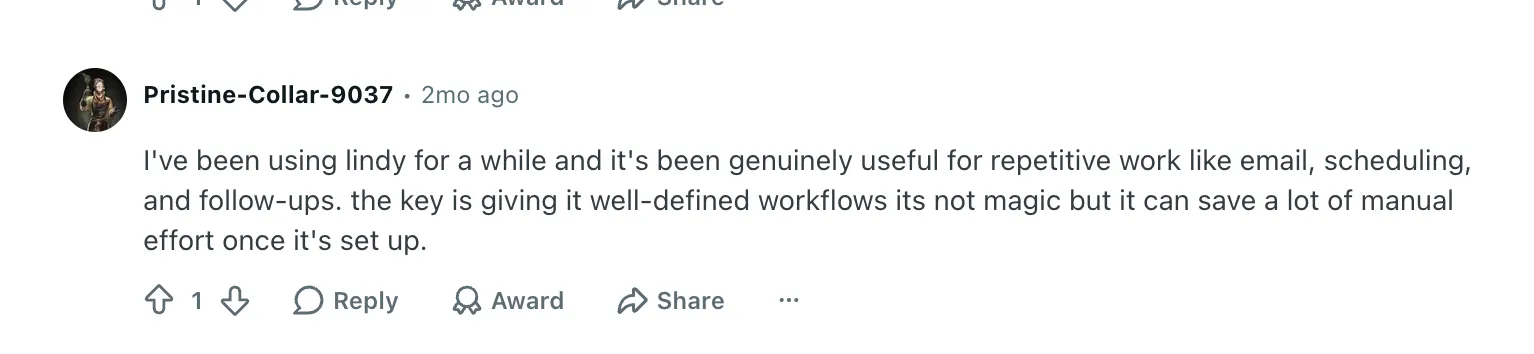
Pro: “I've been using Lindy for a while, and it's been genuinely useful for repetitive work like email, scheduling, and follow-ups. The key is giving it well-defined workflows; it’s not magic, but it can save a lot of manual effort once it's set up.” - u/Pristine-Collar-9037, Reddit review
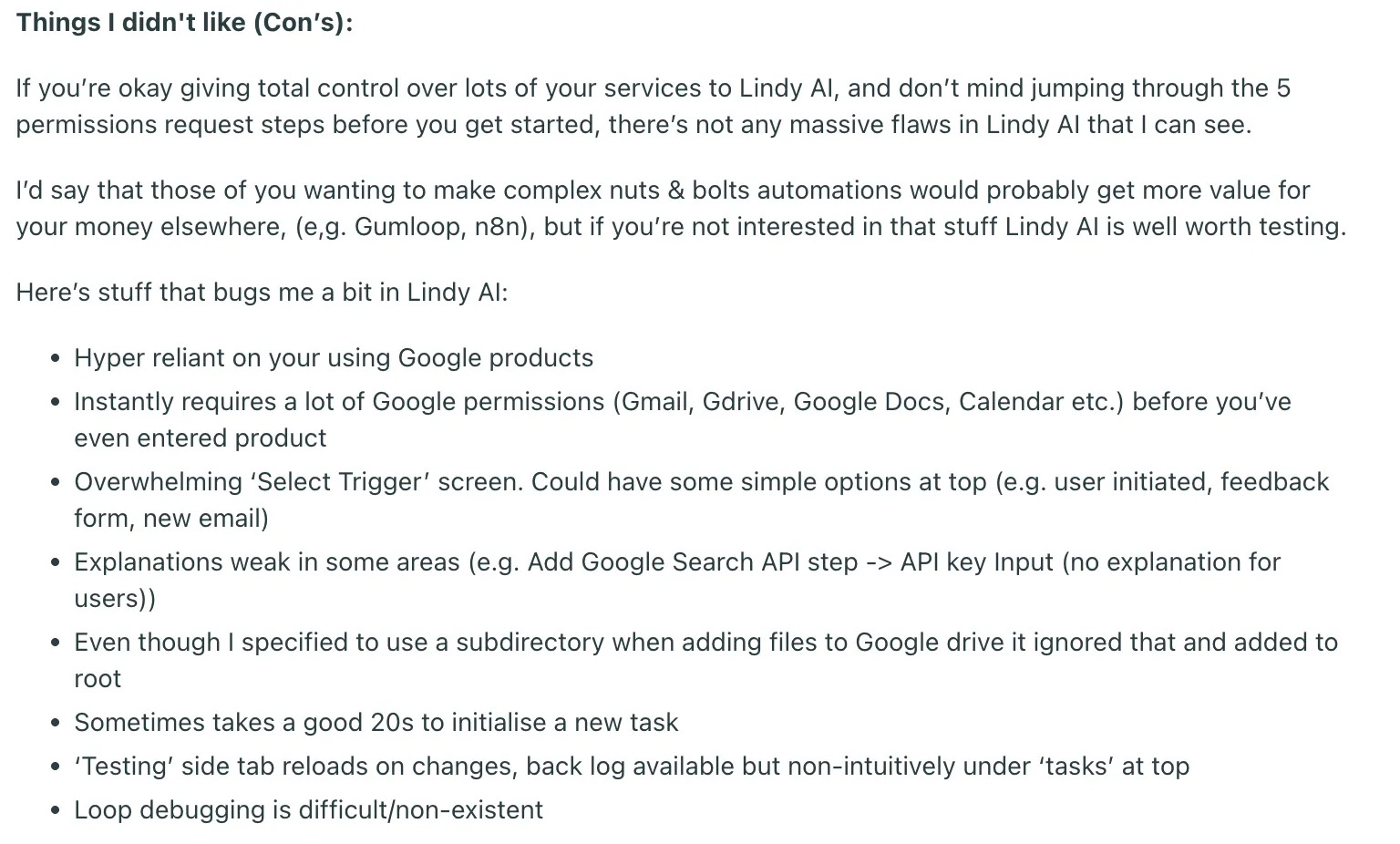
Con: “Instantly requires a lot of Google permissions (Gmail, GDrive, Google Docs, Calendar, etc.) before you’ve even entered the product. Overwhelming ‘Select Trigger’ screen. Could have some simple options at top (e.g. user initiated, feedback form, new email)” - u/woodss, Reddit review
{{templates}}
How to choose the right VA for executives
If I were choosing this for myself, I’d start with the work I keep putting off or pulling back onto my own plate.
Ask what a person really needs
Some executive work depends on judgment, timing, and reading the situation. Negotiating with another assistant, handling a sensitive message, or knowing when to escalate fits that bucket.
Booking meetings, drafting replies, pulling information, and chasing routine follow-ups usually don’t. The more of your week that falls into the second group, the more an AI assistant starts to make sense.
Work out what your time is costing you
I wouldn’t compare a $1,500 or $2,500 monthly service only against another subscription. I’d compare it to the hours I spend on inbox cleanup, scheduling, coordination, and admin work, which keep pushing higher-value work later in the day.
Look closely at how hard it is to change your mind
This mattered more to me than I expected. Some services require a multi-month commitment before you have much time to judge whether they're a good fit.
Others let you meet the assistant first or start with a short trial. If you already feel hesitant about delegating, that difference can make the first decision much easier.
My rule would be simple: choose the option that removes the most recurring work with the least friction.
If you want someone to learn your preferences and make judgment calls, lean human. If you mainly want routine admin work off your plate, an AI assistant can start handling it much faster.
Mistakes to avoid when choosing a virtual assistant
I’ve seen a few of these mistakes play out firsthand, and they usually look harmless at the beginning. A few weeks later, they can mean wasted onboarding, extra management, or paying for support that barely gets used.
| Mistake | What happens | How to avoid it |
|---|---|---|
| Comparing monthly prices without comparing scope | You pick the cheaper option and still end up doing the judgment calls and exceptions yourself. | Compare how much work each option takes off your plate and how much oversight each still requires. |
| Committing before confirming the fit | A poor match can cost weeks of onboarding before a rematch even begins. | Check the trial, guarantee, cancellation, and rematch terms before signing. |
| Assuming a lower price means lower quality | Lower-cost services can still have strong vetting, training, and backup coverage. | Look at the vetting process, continuity, and support model alongside price. |
| Underestimating how much delegation has to be learned | You can end up paying for support while still doing too much yourself. | Look for clear onboarding, delegation guidance, and repeatable workflows that make handing work over easier. |
| Ignoring what happens when support disappears | An assistant leaving or an account closing can take context and working knowledge with it. | Ask about backup coverage, handoffs, saved history, and knowledge retention before committing. |
A good virtual assistant for executives should make the day feel lighter within the first few weeks. If you’re still chasing tasks, repeating instructions, or managing the assistant as closely as the work itself, the setup probably needs to change.
{{cta}}
Final verdict
Six options in, one thing kept showing up that I didn't expect: how often the assistant's own pay came up in reviews.
BELAY, Boldly, and Athena all had at least one review mentioning that the person doing the actual work gets a fraction of what the client pays, sometimes a third, sometimes less. None of that rules any of them out, but an underpaid assistant is more likely to leave, and losing an assistant mid-engagement resets everything built with them.
A real person choosing the match beats an algorithm on this list every time it shows up in reviews. Boldly lets you meet the candidate before paying, and backs that up with a posted price list, a rarity in this category. BELAY gets you a person instead of a form: a consultant runs the scoping call and picks the match, with a free rematch if it misses.
Assist World runs a similar pitch with more range, letting a client interview a shortlist across roles beyond a single EA, and it's the only option here whose negative review is about fit rather than how little the assistant is paid.
Athena and Prialto solve different problems. Athena bakes delegation coaching into onboarding for someone who's never worked with an assistant before, on the same 90-day minimum Prialto asks for. Prialto solves for continuity specifically, with a trained backup built into every account, which counts for more on a team than for a solo founder.
Lindy skips the commitment question entirely. No discovery call, no 90-day lock-in, and a fraction of the monthly cost of any human option here. It can't read a room or negotiate with another executive's assistant, but for the routine half of the job that handles drafting replies, booking meetings, chasing follow-ups, it starts working the same day.
Start with the problem taking the most time from your week. Judgment-heavy work and relationship management usually call for a human assistant. If most of it is repetitive admin, the right virtual assistant for executives may be an AI one you can start using today.
FAQs
1. What is a virtual assistant for executives?
A virtual assistant for executives handles calendar, inbox, travel, and meeting coordination for a business leader. It's typically sold as a managed service with a dedicated, vetted assistant, a different job from that of a general virtual assistant handling one-off tasks.
2. How much does a virtual assistant for executives cost?
Human executive assistant services with public pricing cost between $1,600 and $6,500 per month, depending on hours and vetting level. A few providers, like BELAY and Assist World, skip flat rates entirely and quote only after a call.
3. Is an AI executive assistant better than a human one?
An AI executive assistant isn't better across the board, but it starts working immediately and costs a fraction of a human service. A human assistant still handles judgment calls, relationship management, and ambiguous requests that an AI can't, which is why many executives use both together.
4. What is the difference between a virtual assistant and a virtual executive assistant?
The main difference between a virtual assistant and a virtual executive assistant is scope and ownership. A virtual assistant typically executes defined tasks, while a virtual executive assistant owns outcomes, such as a calendar or inbox, with less direct instruction.
5. Can I use AI and a human virtual assistant together?
Yes, pairing an AI tool for repeatable work with a part-time human assistant for judgment calls is a common combination. Some executive assistant services now build this pairing into their own service model.