DeepSeek Pricing in 2026: API Rates and Monthly Costs


I was midway through scoping an agentic coding pipeline when a colleague forwarded me DeepSeek’s rate card. The numbers looked almost suspiciously low compared to what we were paying elsewhere.
So I spent a few days checking the actual pricing page, the August and September changelogs, the caching documentation, and a third-party endpoint to see what the bill would actually look like at different usage levels.
DeepSeek pricing starts at $0.15 per million uncached input tokens and $0.60 per million output tokens for Flash during off-peak hours. Peak rates are double. Pro costs more, while the consumer app is free to download and use. API usage is billed separately.
DeepSeek pricing in 2026: TL;DR
All rates come from DeepSeek’s pricing page. Flash and Pro are the two models compared below. Developers select Flash using deepseek-flash and Pro using deepseek-v4-pro. These names currently connect to DeepSeek-V4.1-Flash-1017 and DeepSeek-V4-Pro-0813, respectively.
The listed token rate doesn’t tell you what a complete task will cost. A coding session may send the same background information several times and generate multiple responses, each adding to the bill. Reusing cached input can reduce input charges, while running the same usage off-peak halves its model-token cost. Your choice of provider can also change the total.
How I researched this DeepSeek pricing guide
I checked DeepSeek’s live rate card, release history, caching documentation, and US app listings, then compared a current third-party endpoint with the direct API. Cost examples below are calculations from published rates, not measured invoices or hands-on performance tests.
Benchmark findings are attributed to DeepSeek and do not establish how either model will perform on your tasks.
What is the DeepSeek API, and how does billing work?
DeepSeek’s API lets software send requests to its models and receive responses. The bill separates input tokens, which represent material sent to the model, from output tokens, which represent generated material. Reused input that qualifies for a cache hit has a lower rate than uncached input.
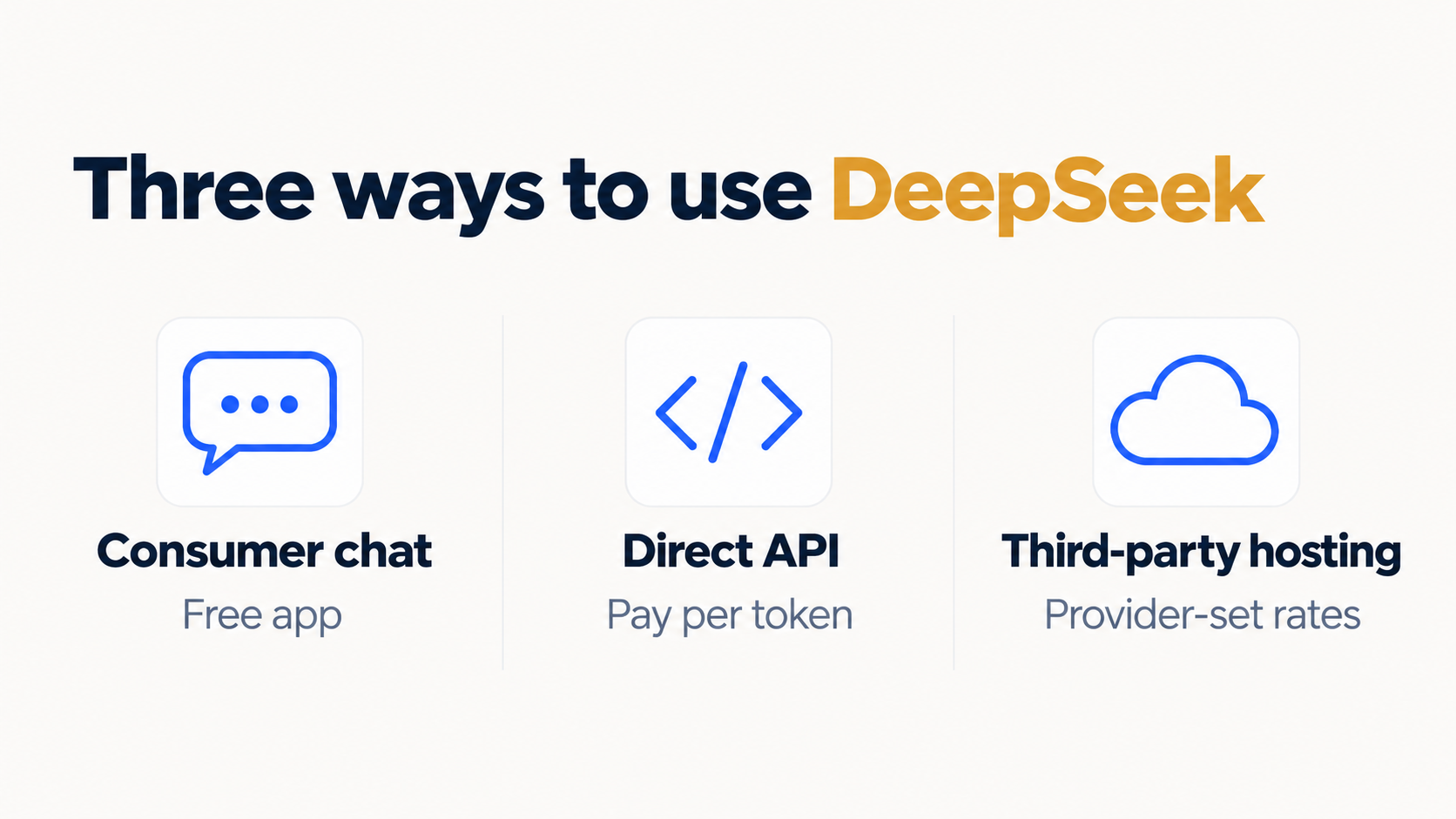
There are three separate cost categories to keep straight:
- Consumer chat: The official app is advertised as free. This is the route for someone who wants to ask questions directly, rather than connect a model to their own software. Its availability does not create a free allowance for an API account or establish a promise of unlimited use.
- Direct API: DeepSeek publishes usage rates for Flash and Pro, with separate peak and off-peak prices. The model name in the request determines which rate card applies. A monthly estimate therefore needs token volumes, the input cache-hit share, and the share of usage billed during each pricing window.
- Third-party hosting: Another provider can host DeepSeek models under its own prices and service conditions. Compare the exact model version, cached-input rate, output rate, and service tier. A cheaper endpoint for an older model does not establish the cheapest way to use the current version, particularly during a temporary promotion.
Is DeepSeek free?
Yes, DeepSeek’s consumer app is free to download and use, according to its US App Store listing. Its API is a separate paid service, and the current rate card lists no standing free model-token tier. Free consumer access should not be treated as free API access or a guarantee that pricing will never change.
The Google Play listing also provides the official Android app. Google Play notes in-app purchases, but neither store listing describes a paid subscription.
If you only need to use DeepSeek conversationally, start with consumer chat. If you want to connect it to a coding tool or your own application, budget for the API. Any granted credits should be treated separately from an ongoing free tier.
For a comparison with subscription-based chat access, see ChatGPT plans and pricing. Those app subscriptions answer a different buying question from per-token API rates.
When do DeepSeek’s peak and off-peak prices apply?
Peak hours cost twice as much as off-peak hours. DeepSeek uses UTC to determine the pricing window, including which day counts as a weekday.
For US Eastern readers, the two peak windows convert as follows. Every other hour is off-peak, subject to the UTC weekday and holiday rules above.
Check the day in UTC, not your local time. Monday’s 01:00 UTC peak window starts on Sunday evening in US Eastern time. Friday at 9 p.m. EDT is already Saturday at 01:00 UTC, so it receives off-peak pricing. US holidays do not change the schedule.
Schedule flexible jobs using UTC. If a workload spans both pricing windows, calculate the tokens used in each window separately.
What changes when the input is cached?
One million uncached input tokens plus one million output tokens costs $0.75 on Flash and $2.64 on Pro, off-peak. If all of that input is cached, the totals fall to $0.603 for Flash and $2.002 for Pro. Output still carries its normal output rate. Caching does not turn the whole request into a cache-priced request.
Here’s what three monthly usage levels cost without input caching, at off-peak and peak rates.
Example budgets using published token rates. Totals are rounded to the nearest cent.
Your output volume matters even when input is cheap. Long responses, repeated attempts, and multi-step coding sessions can consume more tokens than a single prompt suggests.
How to estimate your own bill?
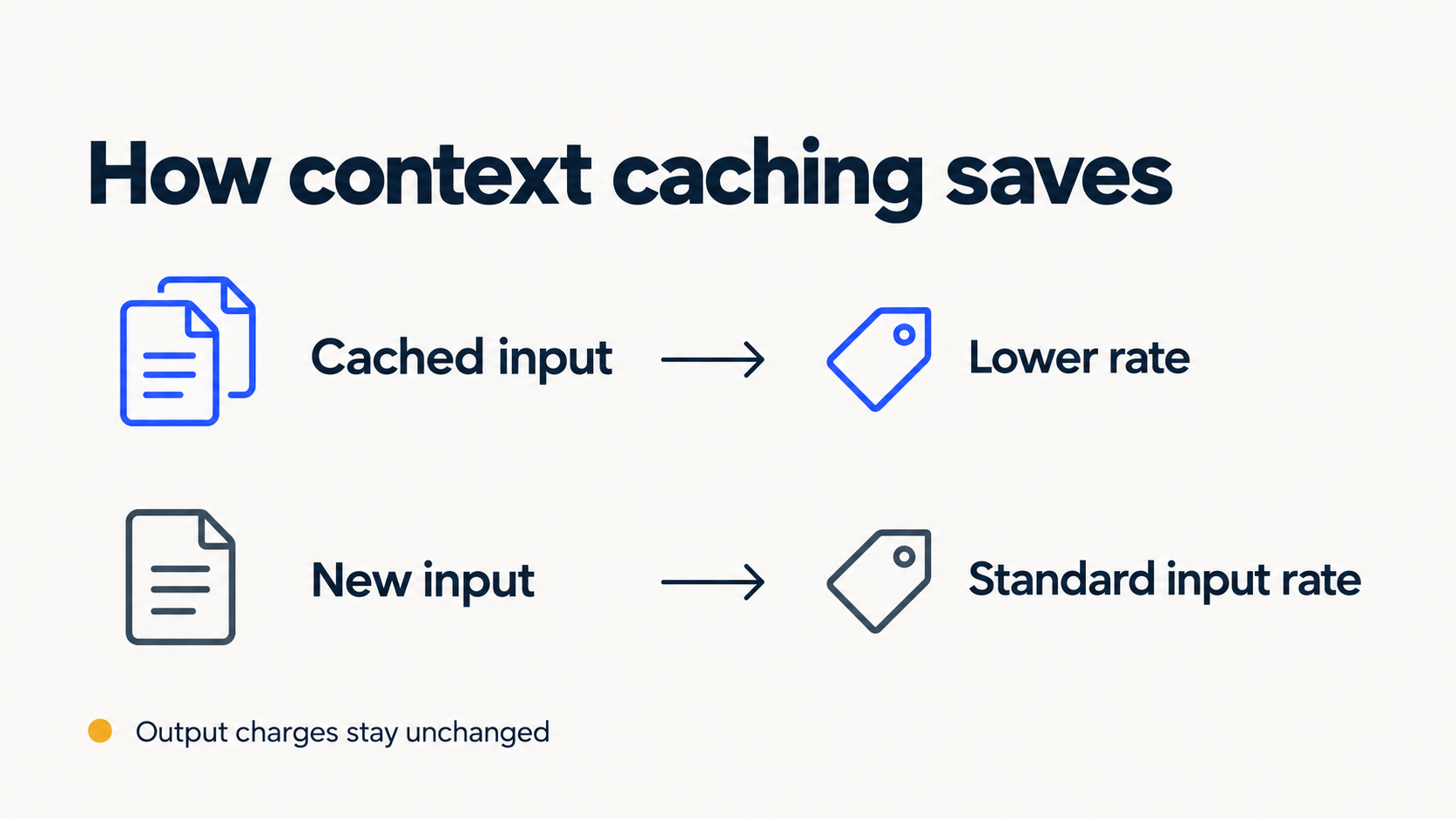
DeepSeek’s automatic context caching reduces input costs by reusing matching prefixes already stored in its cache. Qualifying tokens receive the lower cache-hit rate. Other input receives the cache-miss rate, and output charges remain unchanged. Caching is enabled by default, but repeated text does not guarantee a hit. Check the response’s usage data to confirm savings.
Use this formula separately for each model and pricing window to estimate your bill:
Model cost = (cache-hit input ÷ 1M × hit rate) + (cache-miss input ÷ 1M × miss rate) + (output ÷ 1M × output rate).
Then add any billable tool requests and provider-specific fees. Use the token usage reported by your API responses rather than estimating the whole bill from the length of the final answer.
Suppose Flash processes 10 million input tokens and 2 million output tokens, all off-peak.
If 80% of the input qualifies for caching, the bill breaks down as follows:
- Cached input: 8 million tokens × $0.003 per million = $0.024.
- Uncached input: 2 million tokens × $0.15 per million = $0.30.
- Output: 2 million tokens × $0.60 per million = $1.20.
Total with caching: about $1.52, compared with $2.70 without caching. Output costs stay the same; the savings come entirely from cached input.
Check prompt_cache_hit_tokens and prompt_cache_miss_tokens in the response’s usage data. Those fields show how the input was classified. DeepSeek’s current documentation describes matching complete persisted prefix units, so avoid assuming every repeated paragraph will immediately be billed as a hit.
{{templates}}
Are Search and Fetch included in the token price?
No, DeepSeek lists Search and Fetch as separate APIs, each priced at $0.75 per 1,000 successful requests. A billable Search request must return results, and a billable Fetch request must return page content. Failed requests, empty search results, and timeouts are not billed under the published tool-billing rules.
DeepSeek’s October 17 announcement made server-side Search and Fetch calls through DeepSeek Harness, Claude Code, and Codex free for API users. The pricing page sets the end of that offer on October 31, 2026, at 16:00 UTC (noon EDT, or 00:00 Beijing time on November 1).
At the listed rates, 10,000 billable searches plus 10,000 billable fetches add $15 to a workload. That hypothetical tool charge can exceed the model-token bill for a light application, so include tool volume when estimating costs.
Did DeepSeek prices go up in 2026?
DeepSeek changed its API pricing in August 2026, then cut Flash rates in September. October’s Flash-1017 update left model-token prices unchanged. Whether your costs increased depends on the model, token category, and dates being compared.
Here’s how the pricing changed:
- August 16: Peak/off-peak pricing began. DeepSeek’s new rate card took effect at 16:00 UTC. Flash’s uncached input cost $0.22 off-peak and $0.44 peak per million tokens. Output cost was $0.66 and $1.32, respectively. These historical rates explain why August discussions show higher Flash prices than the current table.
- September 10: Flash prices fell. The V4.1-Flash release lowered off-peak uncached input to $0.15 per million tokens, down about 31.8%. Output fell to $0.60, down about 9.1%. Peak rates fell proportionally. DeepSeek first said deepseek-v4-pro requests would route to Flash from September 14. It then reversed that plan and kept V4 Pro running at its own, unchanged rates.
- October 17: Token rates stayed unchanged. DeepSeek upgraded Flash to V4.1-Flash-1017 without changing its API calling method or model-token pricing, according to the changelog. The release also opened Search and Fetch to everyone. Those APIs have separate request-based charges, so applications using them need to budget beyond model tokens.
Flash vs. Pro: which should you pay for?
Flash is the better starting point for cost-conscious users. Pro charges 4.4 times more for uncached input and 3.3 times more for output within the same pricing window. DeepSeek’s September benchmarks favor Flash on the coding tests below, while Pro leads on GPQA Diamond. Choose Pro when your own evaluation shows enough improvement to justify the premium.
Benchmark figures come from DeepSeek’s September comparison, not independent testing. They describe the September versions, rather than the newer Flash-1017 endpoint. Token-price differences do not establish cost per successful task.
For specifications and model history, see DeepSeek V4 Flash: specs, pricing, and what V4.1 changed.
Is DeepInfra cheaper than DeepSeek direct?
Yes, for now. DeepInfra’s promotional Flex tier has lower listed token rates than DeepSeek direct for V4.1-Flash-1017. It charges $0.0784 per million uncached input tokens, $0.0024 per million cached input tokens, and $0.2352 per million output tokens.
The live DeepInfra model page shows a 51% promotion already applied to these rates:
The comparison covers DeepSeek direct and DeepInfra, checked on October 21, 2026. All rates are per million tokens.
The tradeoff is scheduling. DeepInfra’s Flex documentation describes slower, best-effort service. A request can wait up to ten minutes for capacity before running or returning HTTP 429. That can suit work you can retry, but it is a poor default for a user waiting for an immediate answer.
The live page does not establish how long the promotion will last. Its displayed undiscounted Standard rates are $0.20 input, $0.006 cached input, and $0.60 output. At those rates, DeepSeek direct off-peak would have cheaper input and matching output.
Recheck the promotion before choosing a provider for a long-term budget.
What about R1, V3, and older Flash prices?
DeepSeek’s current direct rate card lists Flash and Pro. Historical R1 or V3 prices don’t describe the current direct service. Third-party hosts may offer older versions, but those require a separate quote for the exact hosted model.
The legacy API names deepseek-v4-flash and deepseek-v4-flash-vision-exp are still accepted by DeepSeek. Its pricing page says they now run on Flash-1017 and receive the current Flash price. Using an older alias does not preserve the older tariff.
How does DeepSeek pricing compare with GPT-6, Claude, and Gemini?
DeepSeek’s direct Flash and Pro rates are lower than the selected flagship API rates below. This is a price comparison for uncached text input and output. The table uses standard processing for competitors, with time-limited rates identified beside the relevant model.
Sources: OpenAI’s GPT-6 Astra model page, Claude’s API pricing, and Gemini’s API pricing.
GPT-6 Astra’s displayed base rates apply to prompts up to 272K input tokens. Above that threshold, the full request carries higher rates. Gemini lists Argon at $4 input and $20 output starting December 1, 2026.
Caching, batch processing, tools, and other service options can change each provider’s bill and are excluded from this simple comparison.
Other models within these families can cost less than the flagship examples. For more comparison paths, see the Kimi K3 pricing guide.
{{cta}}
What should you check before funding your API account?
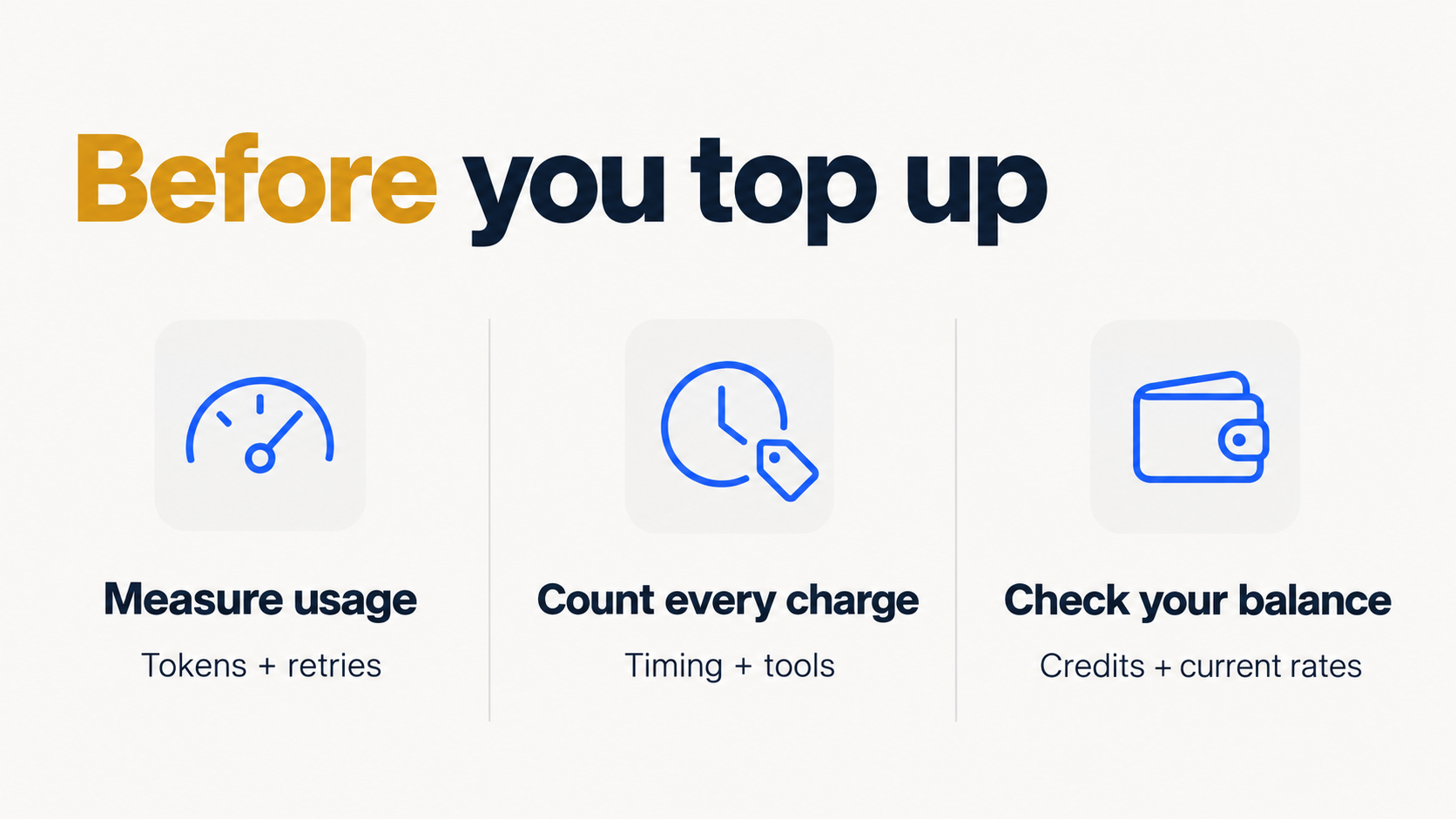
Before funding your DeepSeek API account, estimate the cost of a representative workload and compare it with recorded usage. Account for caching, pricing windows, and separate tool charges. Check available credits and current rates before deciding how much to add.
Use these three checks before topping up:
- Measure a representative workload: Run a small sample of the tasks you expect to perform regularly. Record the model version, cached and uncached input tokens, and output volume. Include repeated attempts so your estimate reflects the cost of completing the work, rather than the cost of a single request.
- Include timing and tool charges: Calculate usage separately for peak and off-peak windows. Add billable Search and Fetch requests if your application uses them. If you choose a third-party provider, check its service tier and promotional conditions. A temporary discount should not become the assumed rate for your long-term budget.
- Check balances before adding funds: Compare your estimate with the usage recorded in your account. DeepSeek uses granted balance before topped-up balance when both are available, so separate credit consumption from cash spending. Recheck the live rate card and any provider promotion before committing to a larger volume.
FAQs
What is DeepSeek?
DeepSeek builds large language models. It makes them available through a free consumer app and a paid API. The app lets anyone chat for free. The API charges per token and is built for developers running automated workloads. Its flagship models, Flash and Pro, cost significantly less than comparable US-based alternatives.
What other AI models should I compare with DeepSeek?
Compare DeepSeek with Kimi K3 and Qwen 3.8 based on the tasks you need to complete. The Kimi K3 overview covers capabilities and use cases, while the Qwen 3.8 guide explains model sizes and local setup options. Compare the cost of completing the same task, including retries and output volume, rather than token prices alone.
How much does DeepSeek cost for a typical workload?
One million uncached input tokens plus one million output tokens costs $0.75 with Flash off-peak or $1.50 at peak rates. The same usage costs $2.64 with Pro off-peak or $5.28 at peak rates. These are model-token charges before any additional tool usage or other applicable charges.
Can I use DeepSeek API credits to pay for Search and Fetch requests?
Yes. Search and Fetch charges are deducted from the same account balance as model-token charges. DeepSeek draws from granted balance first, then the topped-up balance. The rates are separate ($0.75 per 1,000 successful requests for each), but they pull from the same pool, so a single top-up covers both. Budget for tool requests alongside model tokens when estimating how much to fund.
Does DeepSeek charge differently for thinking mode versus non-thinking mode?
No. Flash and Pro use the same per-token rates regardless of mode. The cost difference is in output volume: thinking mode generates more tokens because the model works through its reasoning before answering. At scale, sample a few representative requests to estimate output before committing to a budget.