Delegation Matrix: How to Decide What to Delegate First
Jack researched delegation frameworks, interviewed founders, and analyzed real-world workloads to build a practical system for deciding what to delegate, automate, or keep.


A few months back, I was on a call with a founder who told me he hadn't taken a real weekend off in six months. He had a team of seven, including a project manager and two assistants. He was still the one scheduling discovery calls, answering routine client queries, and reviewing every piece of content before it went out.
He had no system for deciding what work belonged to him and what didn't. Most professionals are in the same spot. They carry tasks that never needed to be theirs, burn hours on low-stakes work, and watch their most important projects stay stuck. A delegation matrix is the tool that makes that visible and fixable.
What is a delegation matrix?
A delegation matrix is a 2×2 grid that helps you sort your tasks based on two things. The first is how much value they create for your business. The second is how much energy they cost you personally. Where a task falls on that grid tells you exactly what to do with it. Keep it, delegate it, replace it with a system, or protect it as a priority.
If you've ever ended a packed week feeling like nothing important moved, this is the tool that explains that. It turns a vague sense of being stretched thin into a clear decision for every task on your plate.
The delegation matrix has four quadrants, including Delegate, Replacement, Investment, and Production. Together they form the DRIP model. Each quadrant maps a different combination of value and energy cost to a specific action.
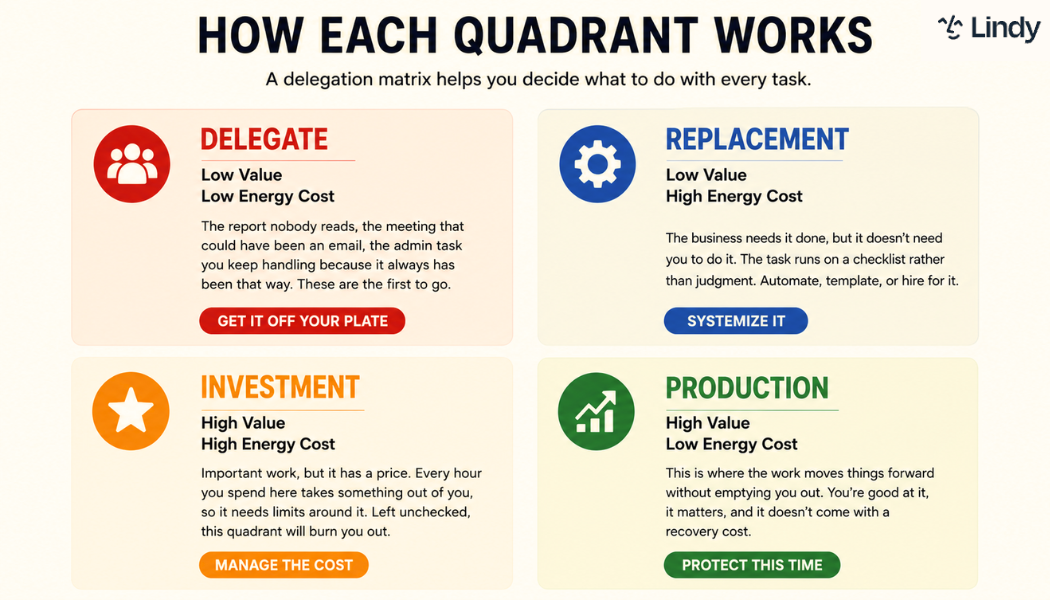
Here's how each one works:
- Delegate: The report nobody reads, the meeting that could have been an email, the admin task you keep handling because it always has been. These are the things eating your time without returning anything meaningful, and they're the first to go.
- Replacement: The business needs it done, but it doesn't need you to do it. The task runs on a checklist rather than judgment, which makes it a clear candidate for automation, templating, or a junior hire. Get it off your plate without overthinking the handoff.
- Investment: Important work, but it has a price. Every hour you spend here takes something out of you, so it needs limits. Left unchecked, this quadrant will burn you out on things that count.
- Production: This is where the work moves things forward without draining you. You're good at it, it matters, and it doesn't come with a recovery cost. Everything else in the DRIP model exists to protect this time.
How to build your delegation matrix
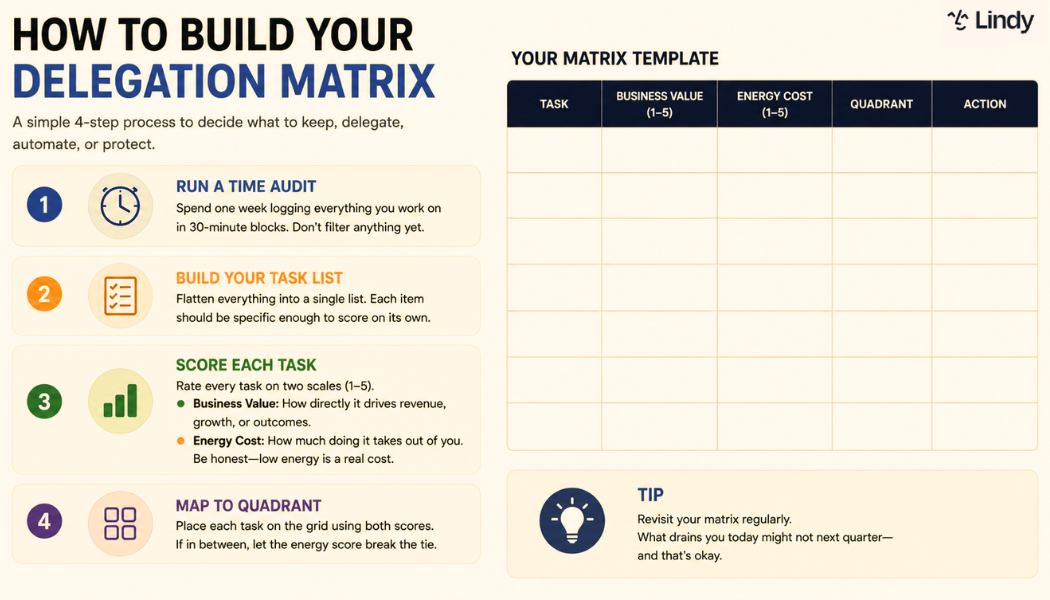
Building a delegation matrix comes down to four steps: running a time audit, putting together a complete task list, scoring each task on value and energy, and mapping everything to a quadrant.
Here's how it looks in action:
- Run a time audit: Spend one week logging everything you work on in 30-minute blocks. Don't filter anything yet. Calendar records, task managers, and email threads all work as source material.
- Build your task list: Take everything from the audit and flatten it into a single list. Each item needs to be specific enough to score on its own. "Marketing" is too broad. "Writing the weekly newsletter" is the right level.
- Score each task: Give every task two scores on a scale of 1 to 5. The first is business value, meaning how directly the task contributes to revenue, growth, or outcomes that matter. The second is energy cost, meaning how much it takes out of you. The energy score is the one people underestimate. Low engagement, post-task fatigue, and a tendency to procrastinate are all signals that the cost is higher than it appears.
- Map to quadrant: With both scores in hand, place each task on the grid. The combination tells you which quadrant it belongs in. If a task sits between two, let the energy score break the tie.
Once everything is mapped, your matrix template should have these columns:
| Task | Business Value (1-5) | Energy Cost (1–5) | Quadrant | Action |
|---|---|---|---|---|
| | | | | |
| | | | | |
| | | | | |
What to delegate first
Knowing which tasks to pass on first is a different question, and it's usually where people stall. The filter comes down to two things. First, how much the task is costing you right now in hours and mental load. Second, how much effort it will take to pass it on, factoring in training time, documentation, and the risk if something goes wrong. That combination tells you when to move.
| Cost to you | Effort to transfer | When to act | Example tasks |
|---|---|---|---|
| High | Low | Now | Inbox triage, meeting scheduling, data entry |
| High | High | 90-day plan | Complex client processes, specialized reporting |
| Low | Low | Batch or automate | Templated responses, simple research |
| Low | High | Leave for now | High-context decisions, niche technical work |
Start at the top of that table. Tasks that cost you the most and are easiest to pass on should move first. The time comes back quickly because the ramp-up is minimal. The bottom rows aren't urgent. Either the cost is low enough that keeping them doesn't hurt, or the transfer effort isn't worth it yet.
Delegation matrix in context:
- In project management, teams use a framework called RACI to answer the same question at a team level. It maps who is Responsible, who is Accountable, who needs to be Consulted, and who only needs to be kept Informed. The delegation matrix and RACI are solving the same problem from different angles. One is personal, the other is structural.
- Many tasks in the Delegate quadrant don't require a person at all. Email triage, meeting scheduling, CRM updates, follow-up reminders. These are exactly the jobs AI tools are built to handle. Routing them to software instead of a hire means you get the time back without adding to your payroll.
- In agile teams, this logic shows up in sprint planning. When a team assigns tasks for the week, they're making the same call: who has the skills, the capacity, and the context to own this? The delegation matrix gives individual contributors a personal version of that conversation, one they can run on their own without a planning meeting.
{{templates}}
5 delegation mistakes and how to avoid them
The most common delegation mistakes are passing tasks on without context, checking in too much after delegating, and delegating only when you're already underwater. Two more round out the list. One is keeping all the decisions even after handing off the work. The other is treating delegation as a one-time fix instead of an ongoing habit.
Here's what each one looks like in practice:
| Mistake | What it looks like | Fix |
|---|---|---|
| Passing tasks on without context | You give someone the task but not the "why," so every edge case comes back to you as a question | Spend two minutes explaining the outcome you need and the standard you're measuring against before the work moves |
| Checking in too much after passing work on | The task is off your plate, but you're hovering so closely that it would have been faster to do it yourself | Set a single check-in point upfront and let the person reach it before you ask for an update |
| Delegating reactively | You only think about it when you're already underwater, so whoever gets the work receives it in a rush with no proper transfer | Build a monthly review into your calendar to catch delegation candidates before they become a crisis |
| Keeping the decisions while giving away the work | Every output still needs your approval before it moves, which makes you the bottleneck anyway | Define which decisions the person can make independently before the work starts |
| Treating it as a one-time event | You map your matrix once and never revisit it, so tasks that should have moved months ago are still with you | Review your matrix quarterly, because what belongs in your Production quadrant today may not belong there next year |
The mistakes above all share the same root cause. Delegation is treated as something you do to people, rather than a system you build around your work. Once the matrix is in place and the habits are there, it can run on software.
Try Lindy: The AI assistant you can text to get work done
Once you map your delegation matrix, the Delegate quadrant fills up fast. Inbox triage, meeting scheduling, follow-up emails, research tasks. These are exactly the jobs that drain your time without needing your judgment, and they're the first place Lindy earns its place.
Lindy is an AI assistant you text to get things done. You stay in the loop on anything that needs your approval, and everything else moves without you.
Here’s what that looks like in practice:
- Get answers instantly: Text Lindy to pull information from your email, calendar, or CRM without shuffling through tabs.
- Send emails and follow-ups automatically: Ask Lindy to draft, personalize, and send outreach and handle replies.
- Take meeting notes and share summaries: Lindy joins meetings, writes structured notes, and follows up afterward.
- Update your CRM without manual entry: After a call, Lindy logs notes and automatically fills in missing fields.
- Find and qualify leads in minutes: Tell Lindy your ideal customer profile and get curated lead lists ready for outreach.
- Hundreds of app integrations: Lindy connects with the tools you already use, so everything stays in sync.
{{cta}}
FAQ
1. How is it different from the Eisenhower matrix?
The main difference is what each one measures. The Eisenhower matrix uses urgency and importance. The delegation matrix uses business value and personal energy cost. Eisenhower helps you decide what to do today. The delegation matrix helps you decide what should be yours. They work well together, but they're answering different questions.
2. What should never be delegated?
Anything that requires your specific judgment, relationships, or accountability. Firing a team member, making a final call on company strategy, handling a client relationship that runs on personal trust. These stay with you not because they're too important, but because the outcome is tied to you specifically.
3. How often should I revisit mine?
Once a quarter is a good baseline. Your role changes, your team changes, and tasks that belonged in your Production quadrant six months ago may now belong in someone else's hands. A quarterly review takes about 20 minutes and keeps the matrix from going stale.
4. Can a delegation matrix work for a solo founder?
Yes, and it's often more useful for solo founders than for anyone else. Without a team to delegate to, the matrix helps you identify what to automate, what to outsource to a contractor, and what to stop doing entirely. The quadrants still apply. The destination for each task just looks different.