


How to Write a Character Letter for Court: Format and Example


Someone you care about is facing a court hearing, and their attorney has asked you to write a character letter. You said yes, of course. Now you're staring at a blank page, and nothing you type feels right.
That's where most people get stuck. They know the person well, but they don't know what a judge needs to hear in a letter like this. There's a real difference between a letter that moves the needle and one that gets a polite nod and no real effect.
This guide breaks down the format defense attorneys ask for, the specifics judges say separate useful letters from noise, and the mistakes that quietly sink well-intentioned ones.
By the end, you'll have everything you need to write one that actually helps.
How to write a character letter for court: TL;DR
What is a character letter for court?
A character letter for court is a written statement from someone who knows the defendant personally, submitted to a judge before or during sentencing to give the court a fuller picture of who that person is.
Leave the legal arguments and claims of innocence to the attorney. Your job is simpler: tell the judge, "Here is what I know about this person, beyond the case file."
So if someone's facing sentencing for a DUI, a financial offense, or a drug-related charge, a character letter from their employer of eight years carries real weight. A line like "I've watched this person show up, work hard, and support their team through two company crises" gives the judge something to consider alongside the charge itself.
These letters go by a few different names. You'll see them called sentencing letters, support letters, or character reference letters. They're used in criminal sentencing (including DUI cases), child custody disputes, and other proceedings like bail hearings and expungement requests.
One important thing to get right from the start. The letter always goes to the defense attorney first. Never mail it directly to the judge or the court. The attorney reviews it, flags anything that could hurt the case, and submits it as part of the sentencing package. Skipping that step is one of the most common errors writers make.
How to write a character letter for court (step by step)
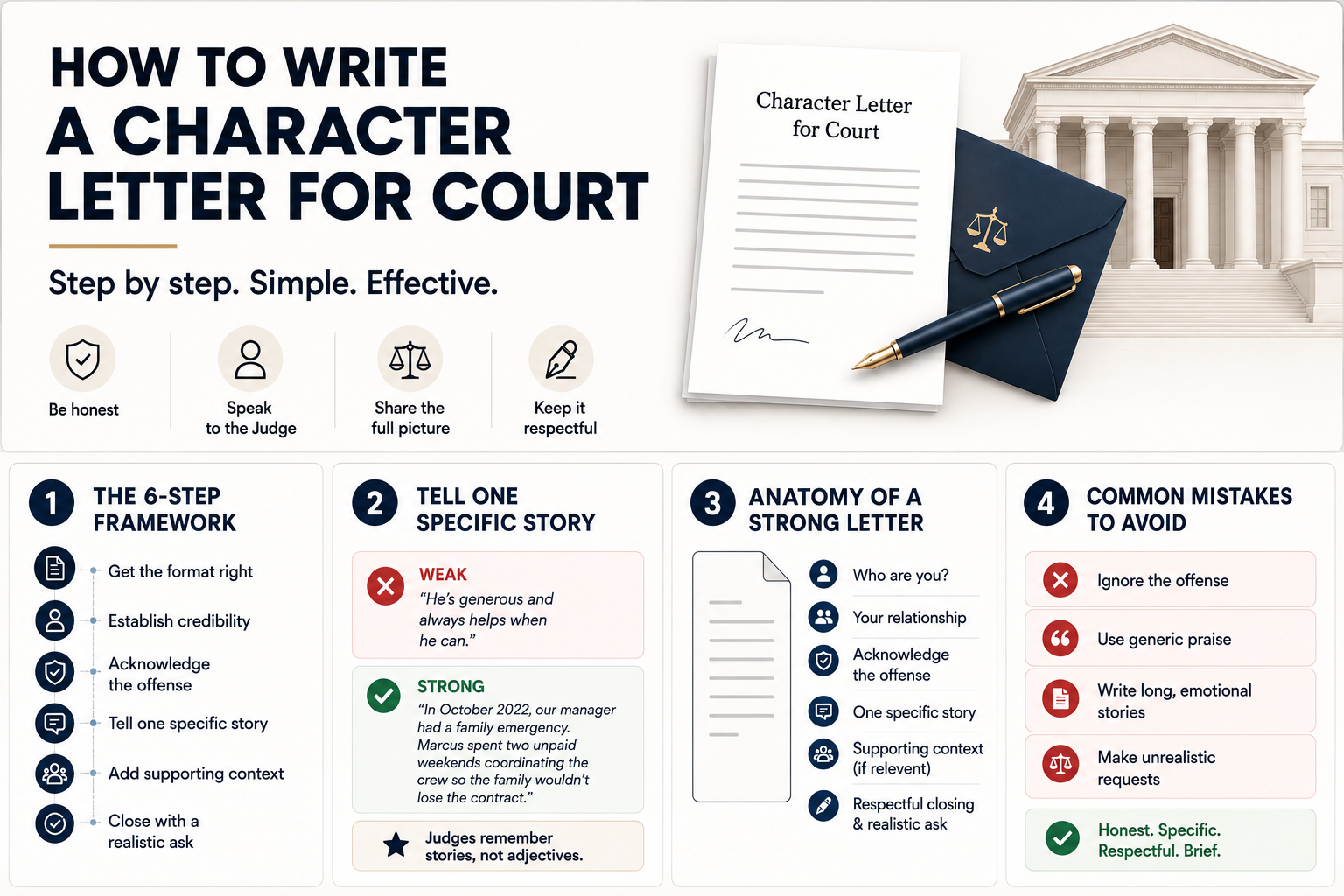
Writing a character letter for court comes down to six steps. Each one has a clear job.
Step 1: Get the format right before you start writing
Before you write a single sentence, make sure the basics are in place. Type the letter on standard 8.5 x 11-inch paper, 12pt font, with normal margins. Keep it to one or two pages. A tight, honest one-pager will do more than a meandering two-pager.
At the top, include your full name, mailing address, phone number, and email. Judges' offices can and do verify letters. If yours has no contact information, it carries less weight. That's a simple problem to avoid.
For the salutation, address the judge as "The Honorable [First Name Last Name]" in the header, and "Dear Judge [Last Name]" when you open the letter. Don't combine both in one salutation: "Dear Honorable Judge" is redundant. Use "The Honorable [Name]" in the header and "Dear Judge [Last Name]" to open.
The one exception is a young child writing. A handwritten letter is acceptable and can carry its own kind of weight.
Step 2: Open by establishing your credibility
The first paragraph has one job: tell the judge who you are and why your perspective matters. Include your name, your connection to the defendant, how long you've known them, and the nature of that relationship. Be specific.
Weak: "I've known Marcus for a long time and consider him a close friend."
Strong: "My name is James Webb. I've worked alongside Marcus as his direct supervisor at Meridian Construction for nine years. We worked side by side on three major projects, and I saw him every working day."
The second version earns the judge's attention before you've even made a point. The first doesn't. The judge needs to understand why your words earn their place before you start spending them. Professional relationships often land with extra credibility here. An employer, supervisor, or professional colleague has no family loyalty to protect. When they vouch for someone, it reads differently.
Step 3: Acknowledge the offense
Naming the offense is the hardest paragraph to write, and skipping it reads as evasion. Don't pretend the offense didn't happen. The judge knows it did. Say something that accidentally hurts the case, or say nothing, and you've lost the letter before it starts.
Don't say "this isn't like him" or "he only pleaded guilty for a better outcome." Both phrases signal that the writer doesn't fully accept the court's finding, which is not the impression you want to leave at sentencing.
What to do instead: acknowledge it briefly, separate it from the person's whole character, and signal that you respect the court's role.
Here's one way to phrase it. "I'm aware of what Marcus has pleaded guilty to. I'm not writing to minimize that. I'm writing to offer some context about who he is, because I believe the case file alone can't show the full picture."
That's it. One paragraph. Direct and honest, without making the letter about the charge rather than the person.
Step 4: Tell one specific story
This is the most important step in the whole letter. Everything else is scaffolding around it. Judges have read thousands of character letters. They know within the first paragraph whether someone is writing from genuine, specific knowledge or just performing loyalty.
Judges skim right past generic praise like "she's a wonderful mother" or "he's always been there for his community." A real, firsthand story is what they remember: one specific thing that happened, and what the person did.
Think of it as three beats: [What happened] + [what the person did] + [why it mattered].
Weak: "Marcus has always been generous and giving. He helps people whenever he can."
Strong: "In October 2022, our building manager had a family emergency and left midway through a critical project. Marcus spent two unpaid weekends coordinating the crew so the family wouldn't lose the contract. He never mentioned it to management. I found out months later, from the manager."
The second version does something the first can't: it makes the judge see a real person making a real choice. That's the whole point.
A few rules for the story section:
- Keep it firsthand: Only write about what you personally witnessed or experienced.
- Stay specific: Name the situation, the timeline, the outcome.
- Don't lead with traits: Phrases like "he's generous" sound vague. Let the story deliver them.
The test is simple. Would the judge finish reading and think "I wish I'd known this person before this case"?
Step 5: Add supporting context (optional but useful)
This step isn't always necessary, but it can add meaningful depth when it's relevant and true.
If the person has dependents (children, elderly parents, a spouse who relies on them), mention it. If they've been involved in their community, their church, a volunteer organization, include that. If there are personal hardships, mental health challenges, or recovery efforts that provide genuine context for the situation, and you witnessed them firsthand, this is where they go.
The keyword is factual. Don't over-dramatize. Courts have seen every version of this, and they can tell the difference between honest context and an appeal designed to manipulate. Stick to what you actually know.
Step 6: Close with a realistic ask
The closing paragraph has one job: ask for something the court can actually grant.
Before you write the closing paragraph, check with the defense attorney. Know what sentences are realistic given the charge and the guidelines. If prison time is almost certain, asking the judge to "keep him out of prison" reads as uninformed, and it undercuts the credibility you spent the whole letter building.
Reasonable asks include:
- A sentence at the low end of the guidelines
- Requesting community supervision if it's available
- Simply asking the court to consider the letters alongside everything else.
A clean example: "I respectfully ask that you consider Marcus's character, his relationships, and his contributions to our community as you make your decision. I believe he has the support systems in place to meet whatever conditions the court imposes."
That's a request that respects the court's role without overstepping it. That's what you're going for.
{{templates}}
Who should write a character letter?
Not everyone who wants to write one should. The most effective letters come from people with direct, firsthand, ongoing knowledge of the defendant. Good intentions alone don't make a letter credible.
There are three types of writers, and each brings something different to the picture:
Think of the letters as a set. That's what defense attorneys rarely explain to families. A strong letter set covers all three categories. One from each gives the judge a three-dimensional picture of the person. Five letters from siblings is one data point, repeated five times. The judge learns nothing new from the fourth and fifth.
If you're coordinating letters on someone's behalf, make sure the attorney is guiding the selection. They'll know which types of letters carry the most weight given the specific case and charge.
What does a judge look for in a character letter?
Judges read these letters to see whether the person described on paper matches the offense in front of them, and whether there's a full human being worth weighing in the sentencing decision. Praise alone tells them nothing they can use.
Here's what a letter needs to do to land:
- Think of it as a quick test a judge runs in the first paragraph: Do I know who this writer is? Do they accept what happened? Can I verify them? Everything in the six steps exists to pass that test.
- Include contact information: Courts verify letters, and an anonymous one is easy to discount.
- Make a realistic ask: An unrealistic ask signals that the writer doesn't fully grasp the situation, which undermines their credibility across the whole letter.
A judge who has read thousands of these letters knows the difference in the first paragraph. Write like someone who understands that.
Common mistakes that sink character letters
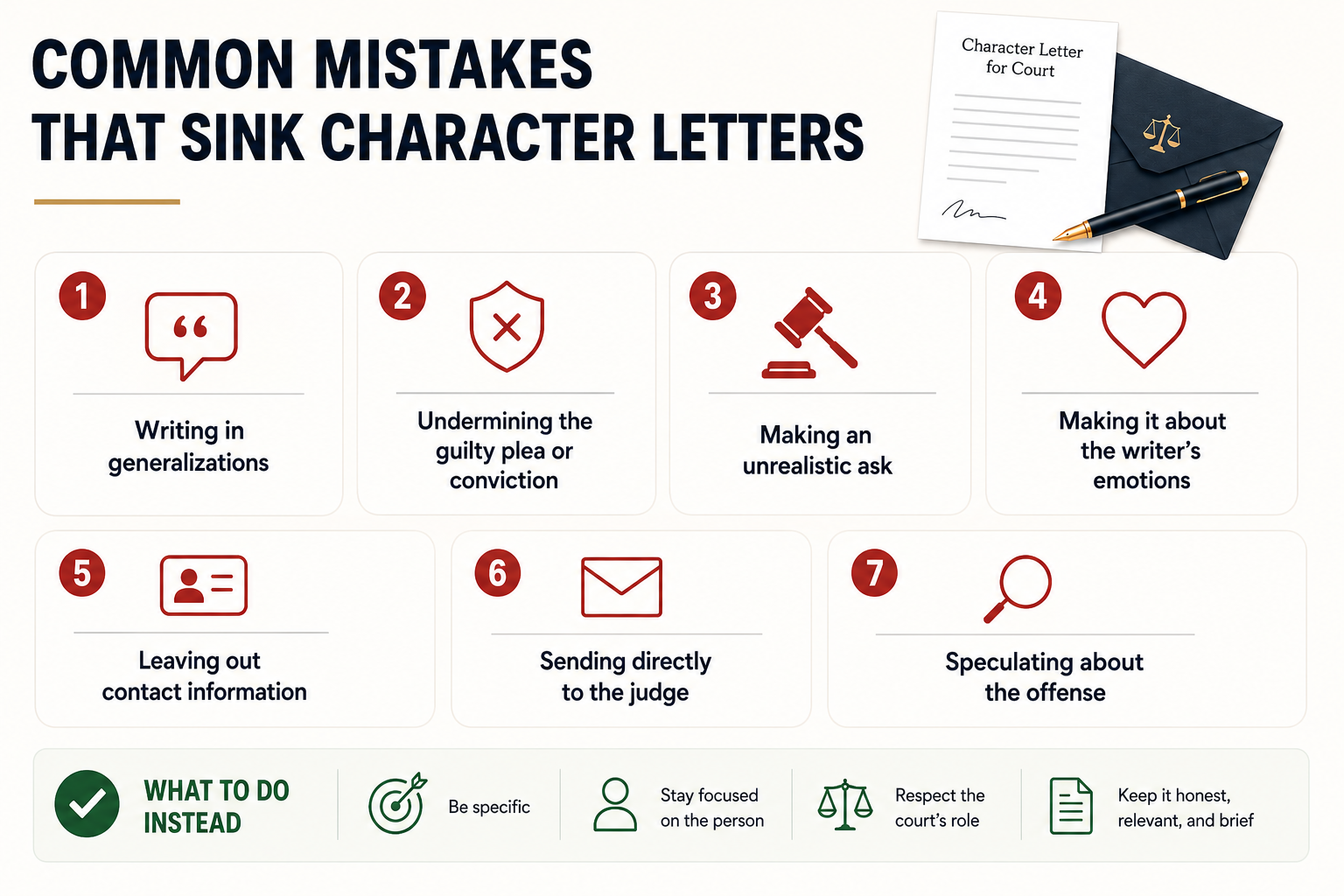
Writers who care still sink their own letters, usually through a handful of patterns that are easy to avoid once you know them.
Here's what to avoid:
- Writing in generalizations: "She's a wonderful mother" is true of most of the country. Tell the judge something specific that only you could have witnessed.
- Undermining the guilty plea or conviction: Writing "I can't believe he did this" or "this isn't who he is" signals to the judge that you don't accept the court's finding. That's not the impression you want to leave at sentencing. Acknowledge the charge, then move past it.
- Making an unrealistic ask: Asking for something that isn't possible given the sentencing guidelines tanks your credibility at exactly the moment you're trying to use it. Check with the defense attorney before you write the closing paragraph.
- Making it about the writer's emotions: "I can't sleep, I can't eat, this has been devastating for our family" tells the judge about your suffering. The court isn't ruling on how the letter writer is coping. Keep the focus on the person you're writing about.
- Sending directly to the judge: This is one of the most common procedural mistakes. It can go to the wrong file, miss the attorney's review, or flag a procedure issue at a sensitive time. Always send to the defense attorney first. Always.
- Speculating about the offense: Don't analyze what happened, offer your theory of the events, or second-guess the investigation. That's not your role in this letter. The judge doesn't need your read on the case.
Character letter format and sample
The formatting rules from Step 1 apply here: typed, one to two pages. Remember: the finished letter goes to the defense attorney.
[Your full name]
[Your title, if relevant]
[Mailing address]
[Phone number]
[Email address]
[Date]
The Honorable [Judge's First Name Last Name]
[Court name and address (get this from the defense attorney)]
Dear Judge [Last Name],
[Body of letter (see six steps above)]
Respectfully,
[Your signature]
[Your printed name]
Sample character letter (annotated)
Below is a complete example for a DUI case. Each paragraph is labeled with the step it corresponds to so you can see the structure in action.
Jane Doe
Operations Manager,
[Company Name]
[Your Address]
[Your Phone]
[Your Email]
[Date]
The Honorable [Judge's Full Name]
[Court Name] [Court Address]
Dear Judge [Last Name],
[Step 2: Establish credibility] My name is Jane Doe. I am the Operations Manager at [Company Name] and have worked directly with John Doe for six years. John reported to me for the first four of those years before moving into a senior coordinator role. We worked side by side on daily operations, and I saw him in a professional capacity nearly every day during that time.
[Step 3: Acknowledge the offense] I am aware that John has pleaded guilty to driving under the influence. I am not writing to minimize what happened or to suggest the charge should be treated lightly. I am writing because I believe the case file, on its own, cannot tell you who John Doe is as a person, and I think that picture is worth the court's consideration.
[Step 4: Tell a specific story] In the spring of 2023, we lost two team members in the same month due to unrelated personal circumstances. The timing was difficult. A major client shipment was at risk, and our team was stretched thin. John volunteered to take on the coordination work himself, coming in early and staying late for three weeks without being asked and without any additional compensation. The client never knew there had been a staffing gap. I found out later from one of the remaining team members that John had been quietly covering shifts that weren't even his to cover. He didn't mention it to me. He just handled it.
[Step 5: Supporting context] John has two young children, ages four and seven. His wife works part-time while managing most of their childcare. He is, by every account from the people around him, a present and engaged father. I also know that following this charge, he enrolled in a substance awareness program and completed it several months ago. I am not sharing this to argue for special treatment. I am sharing it because it reflects the same pattern I have seen from him professionally: he identifies a problem and he addresses it.
[Step 6: Realistic ask] I respectfully ask that you take John's character, his role in his family, and his record over six years of employment into account as you make your decision. I believe he has the support and the self-awareness to meet whatever conditions the court imposes. If you have any questions or would like to speak with me directly, please do not hesitate to reach out.
Respectfully,
Jane Doe
Operations Manager, [Company Name]
If the paperwork around a court case is piling up, an AI assistant like Lindy can help you draft, organize, and keep track of the admin work.
{{cta}}
FAQs
Can a character letter change a judge's mind?
No, a character letter won't change a verdict, but it can influence the sentence. Judges weigh character letters when deciding where within a sentencing range to land, and in some cases they factor them into decisions around community supervision or downward departures. A strong set of letters won't override the charge, but it can make a real difference in how the charge is sentenced.
Who is the best person to write a character letter?
Anyone with direct, firsthand, ongoing knowledge of the defendant and something specific to say is the best person to write a character letter. Professional relationships (employers, supervisors) often carry extra credibility because the writer has no personal stake. But a personal or community letter that includes a specific, well-told story can be just as impactful.
Can I submit a character letter for a custody case?
Yes, you can submit a character letter for a custody case. The same principles apply. Be specific, write from firsthand experience, acknowledge the situation without excusing anything, and focus on what you've personally observed about the person as a parent or caregiver. Send it through the attorney handling the case.
What if I don't know the judge's name?
The defense attorney can give you the name, and it's worth asking. If for some reason it isn't available, "Your Honor" in the salutation is acceptable. But using the judge's actual name is always better. It signals that the letter was written with care and attention to the specific proceeding.
Should I submit the letter directly to the court?
No. Always send it to the defense attorney first. They review it, flag anything that could create a problem, and submit it as part of the broader sentencing package. Sending directly to the court can cause it to go to the wrong file, miss the attorney's review, or create a procedural issue at a sensitive time.











Blog
Related Articles
.png)
.png)
%20(1).png)
.avif)

%20(1).png)
.png)
The AI assistant that runs your work life
Lindy saves you two hours a day by proactively managing your inbox, meetings, and calendar, so you can focus on what actually matters.
