Perplexity Pricing: Plans, Credits, and the Real Cost


Perplexity's pricing page shows one clean cost per plan. That number doesn't say how far it stretches, or what happens once you use up your allowance.
I went through every tier live on Perplexity this week, including the checkout flow. Perplexity pricing covers individual plans (Free, Pro, Max, and the discounted Education Pro), two Enterprise tiers, and a separate API platform for developers.
By the end, you'll know which tier actually fits how you use Perplexity, what Computer credits cost before you run through them, and where the API's rates land for your own usage.
Perplexity Pricing: TL;DR
- Perplexity's free plan costs $0/month, with no signup and no card required, though Pro Searches are capped at three a day.
- Perplexity Pro costs $20/month ($17/month, billed annually), a common pick for individual research.
- Perplexity Max runs $200/month ($167/month, billed annually), built for people who lean on Deep Research and heavy Computer use daily.
- Enterprise Pro starts at $40/seat/month ($34/seat/month, billed annually), and Enterprise Max runs $325/seat/month ($271/seat/month, billed annually). Both are built for teams needing admin controls and shared projects.
- API pricing is pay-as-you-go, billed per token and per tool call, starting at $0.0005 per call.
- Quoted prices can vary by account and region, since Perplexity runs targeted retention offers and lets web signups lock a billing currency at checkout.
Perplexity pricing plans: At a glance
Perplexity's seven pricing options are a free plan, a discounted student plan, two consumer paid plans, two per-seat business plans, and a usage-based API.
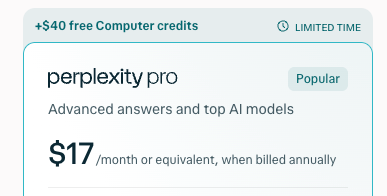
Credit pricing, allowances, and costs can vary by promotion, region, or plan. The currency you pick at checkout also locks in for every renewal. Perplexity’s plans page currently adds $40 in free Computer credits to Pro’s 4,000-credit bonus, and $450 to Max’s 35,000-credit bonus.
Perplexity pricing plans breakdown
Free
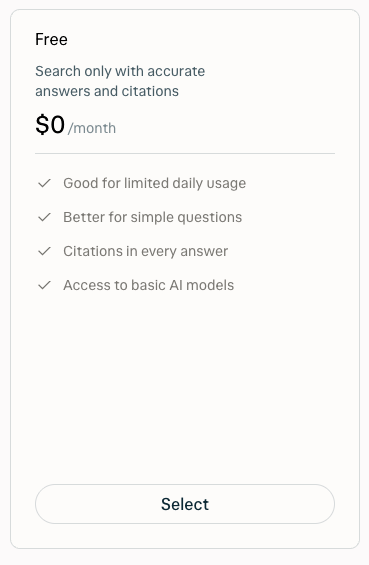
Perplexity's Free plan never asks for a credit card to keep using it.
What's included: Citations on every answer, access to Perplexity's basic AI models, and three Pro Searches a day. Ask-based searches, the plain question-and-answer kind, never use Computer credits. Basic searches on Free are practically unlimited.
Best for: Someone checking facts a few times a week, or anyone who wants to try Perplexity's search and citations before paying for anything.
Pros:
- Always free: Costs nothing, permanently, with no trial clock running out
- Citations included: Every answer ships with citations, even on the free tier. Both logged-out test searches came back fully cited
- No signup wall: Basic search needs no signup. A sign-up prompt appeared after the first test search, but dismissing it let the next one run anyway
Cons:
- Daily search cap: Only three Pro Searches a day before you're back on Perplexity's basic model
- No Computer access: File and app creation aren't available, though Free includes one Deep Research query a month
Education Pro: $10/month

Education Pro, Perplexity's discounted Pro plan for verified students and educators, is priced at $10/month, gated behind a SheerID identity check.
What's included: Everything in Pro, including Computer access, Learn Mode, unlimited Pro Searches, and file and image uploads. It also includes premium models, plus education-specific study tips layered on top.
Best for: A current student or faculty member who wants Pro-level access at half the standalone price.
Pros:
- Half the price: Same feature set as Pro at roughly half the cost
- Unlimited, with a catch: Perplexity's own copy calls this tier's Pro Searches unlimited, which is more generous wording than Pro's "extended access." Its comparison table, though, puts both tiers under the same weekly cap
- Built-in study tools: Learn Mode and study-specific nudges come layered on top of the full Pro feature set
Cons:
- ID verification required: A SheerID identity check comes first, which rules it out for anyone who can't prove active student or educator status
- Bonus credit can be lost: The one-time 4,000-credit Computer bonus doesn’t carry over if you add the Education discount after you’re already a paying Pro subscriber
Pro: $20/month ($17/month, billed annually)
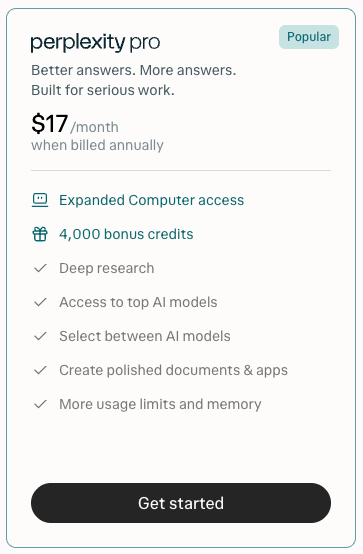
Pro is Perplexity's popular pick for individual research and writing, priced at $20/month ($17/month, billed annually). The annual option runs $200 for the year, billed in one payment.
What's included: Higher search limits than Free, the ability to pick which AI model answers a query, Deep Research, image and video generation, and up to 50 file uploads per project. Pro also adds a one-time 4,000-credit Computer bonus that expires in 30 days, plus a weekly allowance of Computer usage that's rolling out account by account.
Best for: Anyone doing research, writing, or file analysis often enough that Free's daily cap on Pro Searches gets in the way. It also fits anyone who wants to choose a specific top-tier model, including Anthropic's Claude. If you don't choose, Perplexity's default routing picks the model for you.
If Claude itself is on your shortlist, a complete Claude pricing breakdown covers its own plans, usage limits, and API rates.
Computer credits run out fast. A data-dashboard build alone can run 2,400 to 9,800 credits.
The full breakdown by task type is in the Computer credits section below. Pro's one-time bonus of 4,000 credits covers plenty of quick-fact tasks, but a single data-dashboard build can burn through most or all of it in one run. Turn on auto-refill, and Perplexity buys more credits automatically once your balance drops below 500 credits.
Users commonly complain that the app nudges you toward Computer even when you're out of credits to spare. Model routing has also gotten harder to predict lately, since you can ask for a specific model and still not get it.
Pros:
- Premium research sources: Deep Research and premium data sources like PitchBook and Statista are included
- Computer trial bonus: A 4,000-credit Computer bonus gives you room to try the feature before deciding if it's worth paying more for ongoing use
- Model Council access: Pro adds Model Council (not available on Free), which runs one question across several AI models and merges the answers
Cons:
- Credits run out fast: Anything past a quick fact or definition burns through Computer credits, which also keeps nudging you to use it whether you have credits or not
- No standard free trial: Only the separate Free plan or a promotional trial through select offers is available, so you're often committing to a month or a year before confirming Computer's credit system fits how you'd use it
Max: $200/month ($167/month, billed annually)
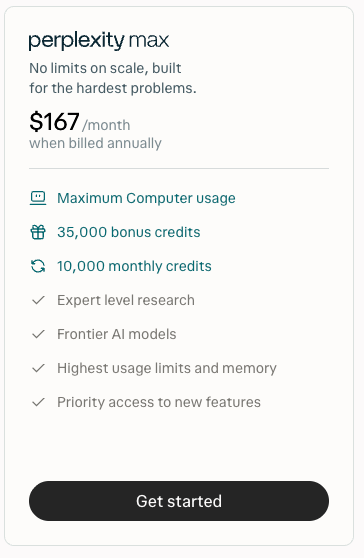
Perplexity doesn’t advertise a free trial for Max. The plan runs $200/month ($167/month, billed annually), with the annual total at $2,000, charged once for the year.
What's included: Everything in Pro, plus the highest access to Perplexity's full model lineup and extended limits on file and app creation. It includes early access to new features.
Max also carries 10,000 monthly Computer credits on top of a one-time 35,000-credit signup bonus and priority support. It adds Brain, a self-improving memory system for Computer, free during its current preview.
Best for: Someone who runs Deep Research and Computer tasks often enough that Pro's weekly allowance and 4,000-credit bonus don't cover it. This tier also suits anyone who wants the highest model access Perplexity offers to an individual subscriber.
Max's 10,000 monthly credits can cover several research reports a month, but they still aren't unlimited.
What keeps Max spending in check:
- A monthly spending cap on credit charges, set to $200 by default and adjustable up to $5,000
- Auto-refill, if you've turned it on, which kicks in once your balance drops below 2,500 credits
Credits can disappear fast: One documented case burned through $100 in an hour on a complex task involving research and dashboard building. The jump from Pro to Max pays off mainly through daily Computer and Deep Research use.
Pros:
- Massive credit allowance: 10,000 monthly Computer credits plus a 35,000-credit signup bonus
- Best models available: Highest access to top-tier models, plus the Brain preview at no added cost
- Spending cap included: An adjustable, built-in cap stops credit charges from running away unnoticed
Cons:
- Expensive at $200/month: The price only pays for itself with daily Computer and Deep Research use
- Heavy builds add up: A data-dashboard build, or an entire app or multi-day build, can still run through thousands of credits in a single run
Enterprise plans are built around company-wide admin controls, single sign-on (SSO, logging in through the company's own existing login system), and seat management. They also include shared file connectors. One person testing alone can't fully represent that kind of setup, even where a self-serve signup technically exists.
Enterprise Pro: $40/seat/month ($34/seat/month, billed annually)
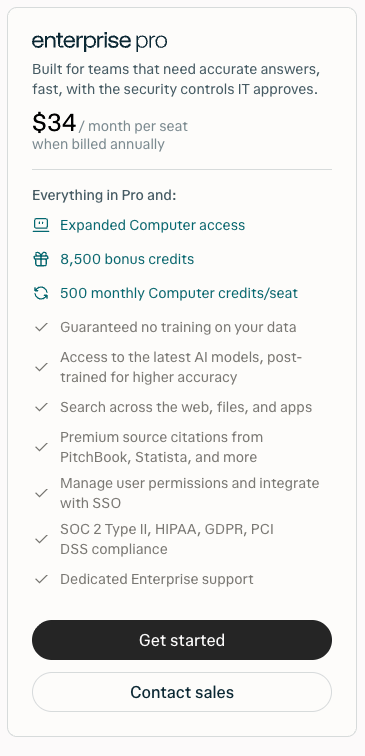
Enterprise Pro costs $40/seat/month ($34/seat/month, billed annually). Eligible schools, nonprofits, and government agencies get 25% off Enterprise Pro and Enterprise Max seats once Perplexity verifies the organization.
What's included: Everything in Pro, plus strict data privacy, central file connectors, and shared Projects. Admin controls cover sign-up domains and available models.
Each seat also carries 500 Computer credits a month, an 8,000-credit new-seat bonus that lasts 30 days (per Perplexity), and dedicated support. The plan also caps out at 400 Pro Searches a week and 50 Deep Research queries a month.
Projects are Perplexity's feature for searching your own uploaded documents alongside the live web. Each Project holds up to 10,000 files and 5 GB, the same limit on every plan. Session uploads cap at 30 files per upload, up to 100 a week on this tier, a tenth of Enterprise Max’s weekly limit
Best for: A company with roughly five to 50 people. It fits a team that needs collaboration, security controls, and admin oversight on top of what Pro already offers.
Pros:
- Compliance built in: SOC 2 Type II, HIPAA, GDPR, and PCI DSS compliance comes standard, along with a no-training-data policy for enterprise data
- Granular admin controls: A security team can restrict sign-ups, manage available models, and set up single sign-on, though audit logs need 50 or more Enterprise seats, or at least one Enterprise Max seat
- One persistent project space: Shared Projects give a team a single place for research, files, and context, instead of starting over in a fresh chat each time
Cons:
- Lower weekly upload cap: Session uploads top out at 100 files a week on this tier, a tenth of Enterprise Max's weekly limit, even though Project storage itself is the same on every plan
- No free trial: Pricing also scales directly with headcount, since it's billed per seat regardless of how much any one person uses it
Enterprise Max: $325/seat/month ($271/seat/month, billed annually)
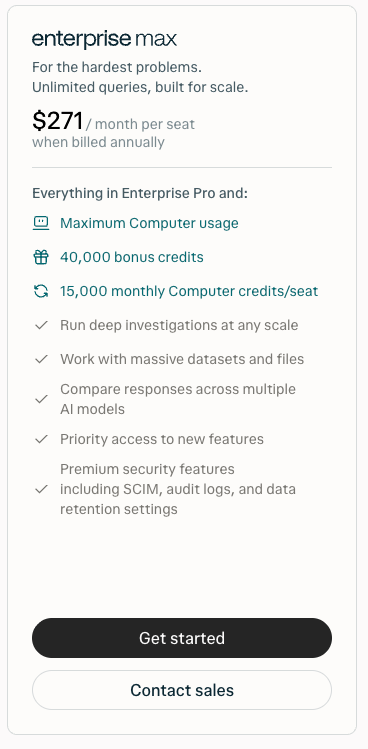
Enterprise Max is built for larger organizations and comes in at $325/seat/month ($271/seat/month, billed annually).
What's included: Everything in Enterprise Pro, plus higher limits across Deep Research, Create Files and Apps, and file uploads. Pro Searches scale up to 4,000 a week and Deep Research up to 500 a month.
Each seat also carries 15,000 Computer credits a month, a 40,000-credit onboarding bonus good for the first 30 days, expanded audit logs that capture the full AI answer alongside the original prompt, and custom data retention policies. Enterprise Max's support also responds faster than Enterprise Pro's dedicated support.
Best for: Larger or more regulated organizations that need the highest usage ceilings. They also need deeper governance, audit, and retention controls than Enterprise Pro provides.
Pros:
- Biggest credit allowance: 15,000 monthly Computer credits per seat, 30 times Enterprise Pro's allowance
- Deeper audit trail: Expanded audit logs and configurable data retention give compliance teams a paper trail to review
- Top reasoning models: Perplexity Search on this tier gets the highest access to advanced reasoning models, including GPT-6 Astra and Claude Opus 5.5, with usage limits built for heavy analysis
Cons:
- Only for scaled teams: At $325/seat/month, this tier only makes sense once an organization has outgrown Enterprise Pro's limits. It's a poor starting point otherwise
- Video generation capped: 15 videos a month on Enterprise Max, each limited to eight seconds, so even this top tier has a ceiling on heavy creative use
Perplexity Computer credits
Computer is Perplexity's AI assistant for multi-step work. It builds a report, generates a deck, or pulls data from several sources into one finished output. Basic Ask searches never touch this system, so everyday questions don't cost credits. By the numbers, 100 credits equal $1, and cost scales with how complex the task is:
What you start with depends on your plan. Pro and Education Pro get a weekly block of included usage with no fixed monthly allowance, plus a one-time 4,000-credit signup bonus that expires in 30 days (Education Pro's bonus doesn't repeat if added later via a student discount).
Max starts with 10,000 credits a month plus a 35,000-credit one-time bonus that also expires in 30 days. Turning on auto-refill buys more credits automatically once your balance drops below 500 credits on Pro or 2,500 on Max, charged to whatever payment method is on file. It's off by default, so nobody's charged without opting in.
Tasks that underdeliver are the main source of friction. Computer may need more than one try to get a complex task right. If a task fails due to an error on Perplexity's side, you can request a credit refund by contacting support with a link to the task. Refunds aren't automatic, and a task that finishes with a disappointing result doesn't qualify.
Perplexity API pricing
This section is for developers who build with Perplexity's API, a different audience than the subscription plans covered above. An API lets one piece of software plug into another. It's how a company builds Perplexity's search and models directly into its own app. The interaction happens inside that company's product.
Perplexity’s developer platform charges per use, starting as low as $0.0005 per call, with no flat monthly fee. The structure has also changed recently. Sonar, the API that made Perplexity's search-backed answers available to developers, is now retired and has migrated to the Agent API.
Perplexity’s Agent API runs on six effort levels (fast, low, medium, high, xhigh, and ultra), each tuned to task intensity. Integrations that previously used the extended Sonar models (sonar-pro, sonar-reasoning-pro, sonar-deep-research) now point toward the fast, low, and high effort levels. The base Sonar model itself still exists as a separate, selectable Agent API entry, billed at its own token rate.
The current API pricing structure breaks into a few pieces:
Agent API tool pricing:
Agent API
Perplexity bills Agent API model usage per token, at each underlying model's own published rate. The Agent API connects to third-party models from OpenAI, Anthropic, Google, xAI, and others. Perplexity's own Sonar model is also available as a separate, selectable entry, billed the same way.
Here's one cost example. A single Agent API request using a mid-tier model with 500 input tokens, 200 output tokens, and one web search comes out to roughly $0.0059 total. That splits across input tokens, output tokens, and the search call itself.
If you're already using Sonar in production, Perplexity's own migration guide maps old model names to new presets. Sonar and sonar-pro map to fast, sonar-reasoning-pro maps to low, and sonar-deep-research maps to high.
Orchestrator API
This is a separate option, currently in private preview, built around one OpenAI-compatible endpoint for the open-weight models that Perplexity itself hosts. Perplexity's own search and tool layer sits outside it.
An Orchestrator API call costs the requested model's own published token rate. It fits a team that's already chosen one of Perplexity's hosted open-weight models and wants a single endpoint to call it through. That team skips a separate integration build for that model.
Search API
This is a separate, standalone API from the Agent API's own web-search tool call covered above. Standard search costs $5.00 per 1,000 requests, or $1.00 per 1,000 requests with Fast Search. It's billed per successful request. One request can carry up to five queries and still counts as one.
Embeddings API
Embeddings pricing starts at $0.004 per million tokens for the smallest standard model. It runs up to $0.05 per million tokens for the largest contextualized model. Which rate applies depends on the embedding model and dimension size you choose.
Which Perplexity plan should you pick?
Choose Free if you:
- Ask a handful of questions a week and don't need more than three Pro Searches a day
- Want to try Perplexity's citations and search quality before paying for anything
Choose Pro if you:
- Research, write, or analyze files often enough that Free's daily cap slows you down
- Want control over which top-tier AI model answers your query
- Plan to try Computer every so often, well short of daily use
Choose Max if you:
- Run Deep Research or Computer tasks most days, well past occasional use
- Have hit Pro's credit limits more than once and want a monthly allowance to rely on
Choose Education Pro if you:
- Can verify active student or educator status through SheerID
- Want Pro's full feature set at roughly half the standalone price
Choose Enterprise Pro if you:
- Need shared Projects, admin controls, and document search across a team of roughly five to 50 people
- Want centralized billing and the ability to restrict sign-ups to your own company's email domain
Choose Enterprise Max if you:
- Have already outgrown Enterprise Pro's usage caps or need deeper audit and retention controls for compliance
- Need faster, dedicated-tier support and the highest Research, Create Files and Apps, and video-generation limits Perplexity offers
Choose the API if you:
- Are building Perplexity's search or model access directly into your own product, where a flat monthly plan doesn't match your actual usage
- Want to pay per token and per tool call, with no fixed monthly seat price to commit to
If none of these fit and research is only part of what you need, a broader research-and-automation tool might serve better. A tested and ranked list of Genspark alternatives covers that wider category, Perplexity included.
Perplexity is built to answer questions and do multi-step research. Computer can route some of what it finds through connected tools like Slack and GitHub, but acting on everyday follow-ups (drafting an email, logging a note) still usually falls to you. If that's your gap, something like Lindy lets you message an assistant directly, turning a summary into a drafted email or a logged CRM note.
Is Perplexity worth the cost?
Free covers light, occasional use well. Basic Ask searches never touch the credit system that trips people up on paid tiers. Past that, the decision comes down to one question: will you use Computer and Deep Research enough to justify the jump from $0 to $20, or $20 to $200?
Perplexity is worth it if you:
- Value citations on every answer enough that checking sources yourself would otherwise cost you time
Skip Perplexity, or stay on Free, if you:
- Want an assistant you message directly for routine follow-up work, like drafting emails or logging CRM notes
- Only need basic search and a few Pro Searches a day, which Free already covers
Still weighing the wider field before you commit to one subscription? A broader roundup of AI chat alternatives covers tools beyond the big three chatbots.
Perplexity alternatives and pricing comparison
How the headline prices compare:
Perplexity Pro, ChatGPT Plus, and Claude Pro all land in the same narrow band, at $20/month each. Google AI Pro is one cent cheaper, at $19.99.
Lindy sits well above that band, since it's built to act on what research finds rather than just deliver it. Each tool has a different strength. Perplexity leans hardest into citations and source-backed answers.
ChatGPT also offers Go and Pro options beyond the Plus plan shown here. A full breakdown of ChatGPT's plans and pricing covers all six side by side.
Lindy vs Perplexity: Which should you choose?
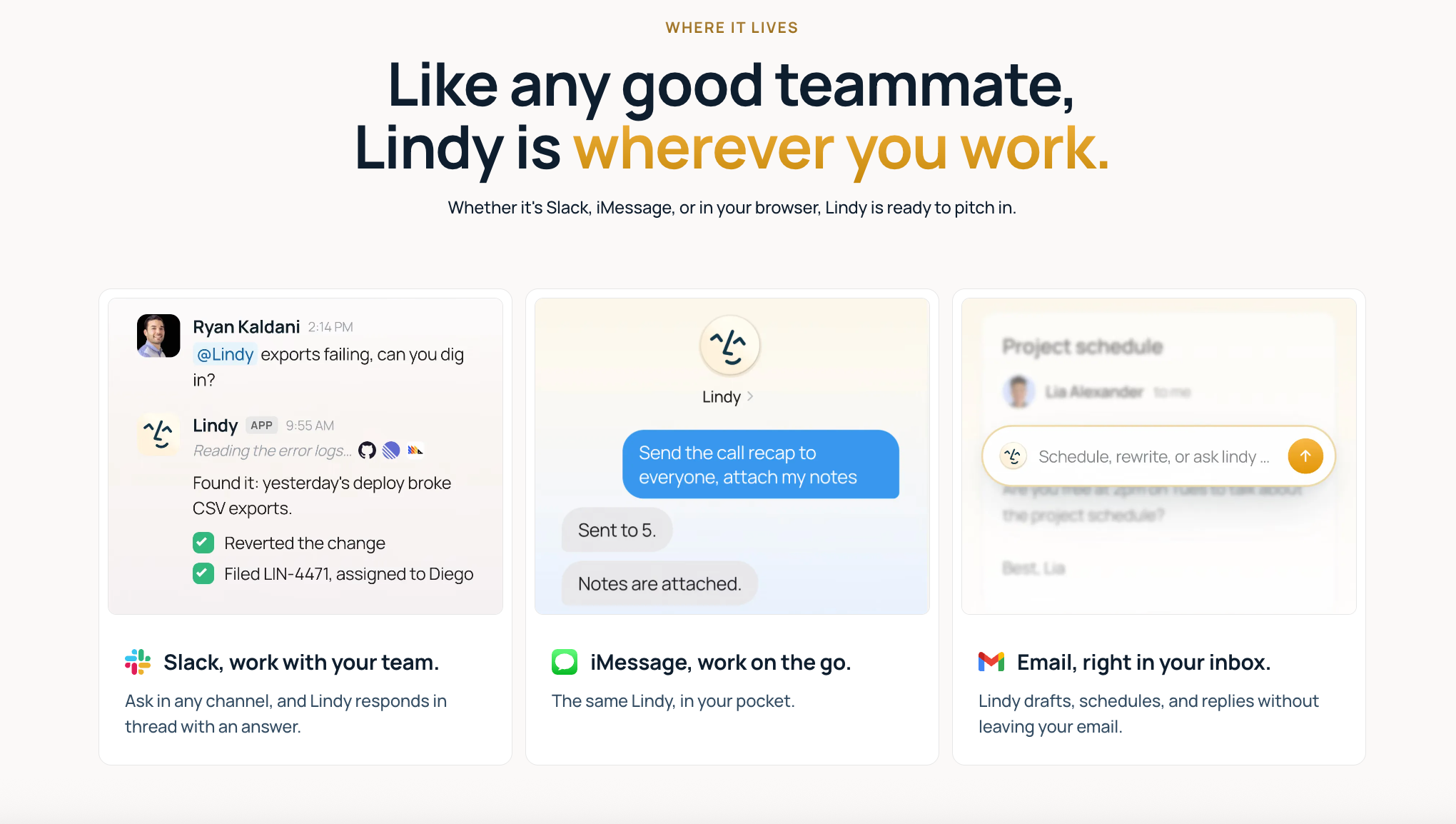
Lindy is better for: Research turned into action. Text Lindy what you need. It drafts a follow-up email, logs a CRM note, or files a summary where it belongs.
Perplexity is better for: The research itself. Its citations on every answer and Deep Research mode exist to get you from a question to an answer. That answer is sourced and verifiable. What happens after that answer is still up to you, though Computer can route some of it through connected tools.
Use both if: You already lean on Perplexity for research and still handle what it finds manually. Hand that output to Lindy. It drafts an email, updates a CRM record, or notifies the right person the moment the research is done.
If that's the gap you're running into, Lindy starts at $49.99/user/month. It offers $50 in free credits for a seven-day trial, no card required.
{{templates}}
My bottom line on Perplexity pricing
Perplexity pricing comes down to three tiers for most individual users: Free, Pro, and Max.
Free is the right starting point for almost anyone curious about Perplexity. It covers basic search with no published cap, at zero cost and with no sign-up.
Pro at $20/month earns its price the moment you're regularly hitting Free's daily Pro Search cap. It's also priced the same as ChatGPT Plus and Claude Pro. The pick is about which tool's output you trust more, since the price is already a tie.
I'd slow down before upgrading to Max. At $200/month, it only pays for itself if Computer and Deep Research are something you'd use every day. If you'd only use it once in a while, the price isn't worth it.
The credit system is the part most worth understanding before you pay for anything past Free. A single data-dashboard or app-building task can use up more of your available credits than the sticker price suggests.
{{cta}}
Frequently asked questions
Is Perplexity free?
Perplexity is free to use for basic search, with no signup and no credit card required at any point. The Free plan includes citations on every answer and three Pro Searches a day. Computer, Perplexity's multi-step research assistant, isn't available until you upgrade to a paid plan.
Is Perplexity cheaper than ChatGPT?
Not at the Pro/Plus tier most people compare. Perplexity Pro and ChatGPT Plus cost the same, $20/month each. ChatGPT's cheaper Go tier undercuts Perplexity Pro's price, though at a different capability level. Both also offer a free plan at no cost.
Is Perplexity worth it?
Yes, Perplexity is worth paying for if you'd use the extra searches, model choice, and Computer access that come with the paid tiers. Pro earns its $20/month once Free's daily Pro Search cap starts limiting you. Max's $200/month only makes sense for someone running Computer and Deep Research every day.
Why is Perplexity so expensive?
Perplexity's top tiers cost more because of Computer, its multi-step research and build assistant. Computer runs on credits tied to compute cost. Max and Enterprise Max carry thousands of those credits a month. A single data-dashboard build can use up to 9,800 credits, and an entire app or multi-day build can run 15,000 credits or more. That volume drives the higher-tier prices.
Which is better, ChatGPT or Perplexity?
Perplexity is stronger for research you need to verify, since every answer ships with sources attached. ChatGPT is broader, covering general writing, coding, and problem-solving without leaning as heavily on live citations.
What is Perplexity Max's price compared to Pro's?
Perplexity Max costs $200/month ($167/month, billed annually), 10 times Pro's $20/month price. That jump buys 10,000 Computer credits every month plus a 35,000-credit one-time bonus. Pro has no monthly credits, just a 4,000-credit one-time bonus and weekly included Computer use.