Claude Pricing in 2026: Plans, API Costs & Claude Code


Claude pricing starts at $0, with Pro at $20/month and Max at $100 or $200/month. Team seats cost $25 to $125 monthly, Enterprise starts at $20/seat/month billed annually plus usage, and API rates begin at $1 per million input tokens.
The prices look simple until you run into Claude’s usage limits. Pro, Max, and Team plans have five-hour and weekly caps, while Claude Code draws from the same allowance as chat.
I learned this halfway through a 30-file refactor. Claude Code hit Pro’s usage limit at 10:40 am on a Tuesday, and I upgraded from Pro to Max 5x before lunch. By the end of the cycle, I had used less than half of Max’s allowance. A few usage credits would have cost less than the $80 upgrade.
I checked Anthropic's current plan and API rates, then worked out the cost of three common jobs. Here's what Claude costs by plan, model, token, and finished task.
Claude pricing at a glance
Claude has a free plan, three paid individual plans, and two workspace plans for teams and companies. Pro and Team can be billed monthly or annually, Enterprise is annual only, and Max is monthly only.
Here's every Claude plan side by side, with monthly and annual prices:
The monthly fee covers access, but every plan has five-hour usage limits, and paid plans add weekly limits on top. Pro, Max, and both Team seat types include Claude Code, which shares the same usage allowance as chat.
Claude API prices at a glance
API charges depend on the model and the number of input and output tokens processed. Haiku 4.5 starts at $1 per million input tokens and $5 per million output tokens, while Fable 5.1 costs $10 and $50, respectively.
These rates were checked in Claude’s plan pricing, the Max plan details, and Anthropic’s API pricing documentation on October 6, 2026. Prices are in US dollars before tax, and mobile app stores may charge different subscription rates.
Subscriptions and API usage are billed separately. A paid Claude plan gives you chat and Claude Code access, while API calls run through a Console account and generate their own token charges.
Claude Free, Pro, and Max pricing
Claude offers four individual options across three plan families. Pro unlocks most of the paid features, while Max mainly gives you more room to use them before the five-hour or weekly limit kicks in.
Pro is the only individual paid plan with an annual discount. You pay $200 once for the full year, which works out to about $17 a month, compared with $240 if you pay $20 every month. That saves you $40.
Usage depends on more than the number of messages you send. Longer prompts, large attachments, project files, model choice, and Claude Code activity can all use the allowance faster. Max 5x means five times Pro's usage per five-hour session, plus priority access when traffic is high.
Claude Free at $0 per month
What you get: Sonnet and Haiku, web search, memory, connectors, artifacts, file creation, code execution, and up to five projects.
Who it fits: Free gives occasional users enough room for a few questions, short drafts, and light document work. It is also a useful way to test Claude’s interface and writing style before paying.
What to consider: Opus 5.5, Claude Code, Research, Claude in Chrome, and Claude for Microsoft 365 require a paid plan. Longer conversations and file-heavy tasks can use the five-hour allowance quickly.
Claude Pro at $20 per month
What you get: Pro adds Opus 5.5, Claude Code, Research, Claude Design, Slides and Docs, Claude in Chrome, and Claude for Microsoft 365. It provides at least five times the Free plan's usage per session, while Fable 5.1 runs only on usage credits, billed at standard API rates.
Who it fits: Pro is the best starting point for most solo professionals who use Claude for daily writing, research, document work, or moderate coding. Annual billing reduces the effective price to $17/month.
What to consider: Chat and Claude Code share one usage pool. A long coding run across a large repository can leave less capacity for chat until the five-hour window resets.
Claude Max at $100 or $200 per month
What you get: Max 5x includes five times Pro’s usage for $100/month, while Max 20x raises the allowance to twenty times Pro for $200/month. Both include higher output limits, priority access, early feature access, and Fable 5.1 within up to 50% of the weekly allowance.
Who it fits: Max 5x suits developers, researchers, and other heavy users who reach Pro limits several times a week. Max 20x is aimed at people running long coding, research, or agent tasks throughout the workday.
What to consider: Max 5x costs $80 more than Pro each month, while Max 20x adds another $100. Check your usage page for a full week before upgrading.
How Claude usage limits and credits work
Claude measures subscription usage through rolling five-hour windows, with additional weekly limits on paid plans. Chat on the web, desktop, and mobile apps shares one allowance with Claude Code.
Anthropic doesn't promise a fixed number of messages. Long conversations, large files, model choice, project content, and tool use all affect how quickly you reach the limit. The weekly cap also applies across models, which means moving from Opus to Sonnet won't start a fresh allowance.
When you reach a limit, you can wait for the next reset, upgrade your plan, or enable usage credits. Credits let paid users continue at standard API rates after the included allowance runs out.
I’d use credits for occasional overages and consider a higher plan only when limits interrupt work several times a week. Checking the usage page before upgrading can save you from paying for capacity you rarely need.
Claude Team and Enterprise pricing
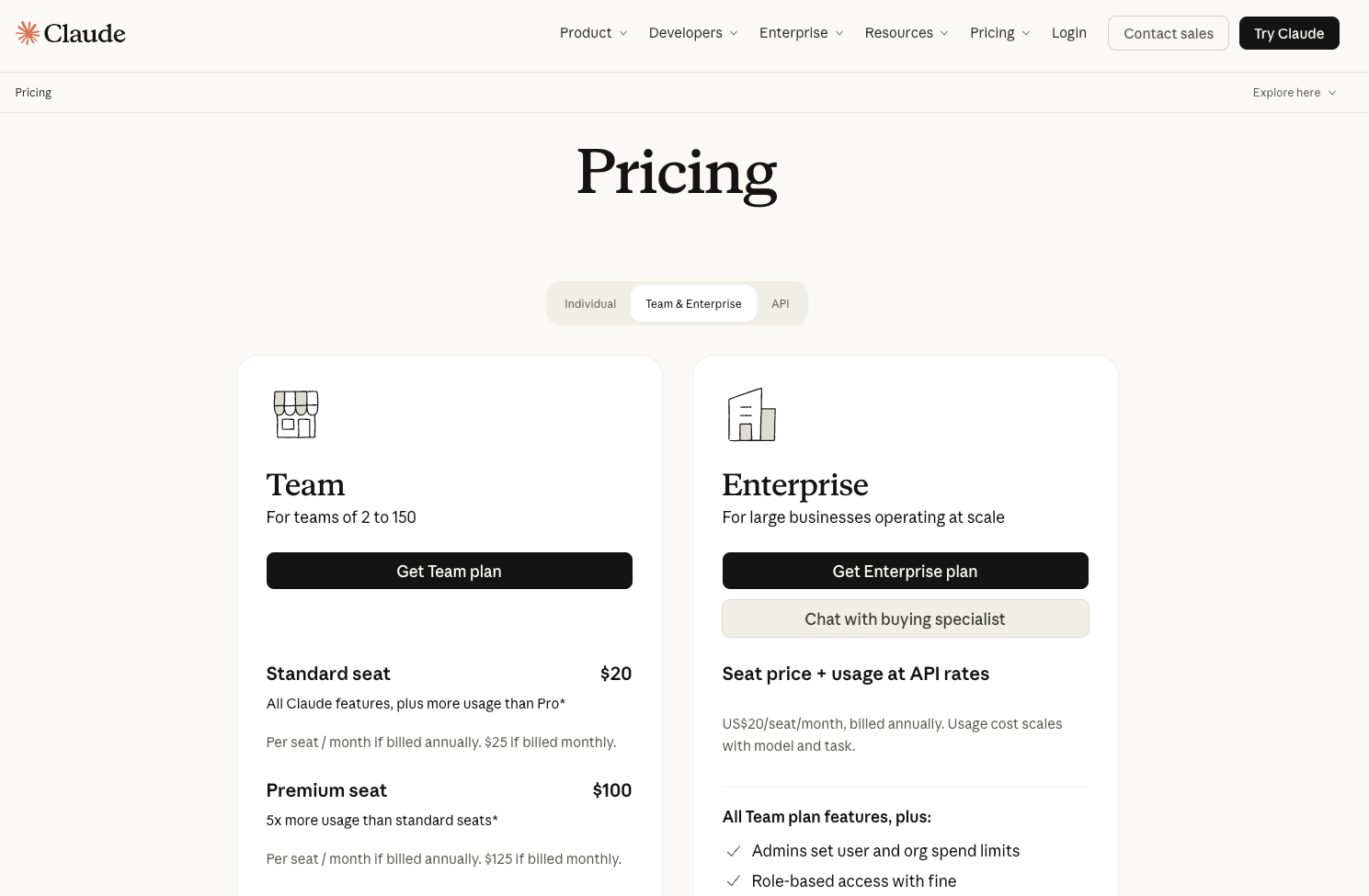
Claude Team starts at $25 per standard seat each month, while Enterprise costs $20 per seat each month billed annually, plus usage at API rates. Team uses plan-based allowances, while Enterprise billing changes with the models and tokens your organization consumes.
Claude Team pricing
Claude Team supports 2 to 150 people and lets administrators mix Standard and Premium seats within one workspace.
Both seat types include Claude Code, Claude Design, Slides and Docs, Microsoft 365, Claude Tag in Slack, and enterprise search across company knowledge. Teams also receive central billing, SSO, admin controls, and protection from model training on workspace content by default.
Premium seats add substantially more usage and include Fable 5.1 within up to 50% of the weekly allowance. Mixing seats can keep costs lower when only a few people run long coding, research, or agent tasks.
For example:
- Five Standard seats cost $125/month with monthly billing or $100/month billed annually, which comes to $1,200 per year.
- Eight Standard and two Premium seats cost $450/month with monthly billing or $360/month billed annually.
Team covers the features most small and midsize companies need, but it doesn't include SCIM, audit logs, role-based access, custom data retention, or the HIPAA-ready offering. Organizations needing those controls move to Enterprise.
Claude Enterprise pricing
Claude Enterprise costs $20 per seat each month billed annually, with model usage charged separately at API rates. The seat fee covers access to the workspace, while every task adds token charges based on the selected model.
A 50-person deployment has a base cost of $1,000/month, or $12,000 per year, before usage. The final bill depends on how often employees use Claude, which models they choose, and how much context each task processes.
Enterprise adds:
- Identity and access controls with SCIM, role-based access, and IP allowlisting
- Audit and compliance tools including audit logs, a Compliance API, and custom data retention
- Regulated-workload support through a HIPAA-ready offering
- Cost controls with user and organization spending limits
- Claude Security, currently in beta
Self-serve Enterprise uses annual billing and supports ACH payments. Organizations needing invoices or net payment terms can arrange a contract through Anthropic’s sales team.
Universities can also apply for Claude for Education, which covers students, faculty, and staff at discounted rates. Anthropic doesn't publish the discount, and its education program handles pricing through a direct quote.
Claude Code pricing by plan
Claude Code starts with Claude Pro at $20/month and comes with every higher paid plan. Free users cannot access it through a Claude subscription.
Annual billing lowers Pro to $17/month, Team Standard to $20/seat/month, and Team Premium to $100/seat/month.
Coding and chat share one usage pool. Usage credits can cover an occasional heavy day, and Console billing gives developers a pay-as-you-go option.
When Claude Pro is enough for Claude Code
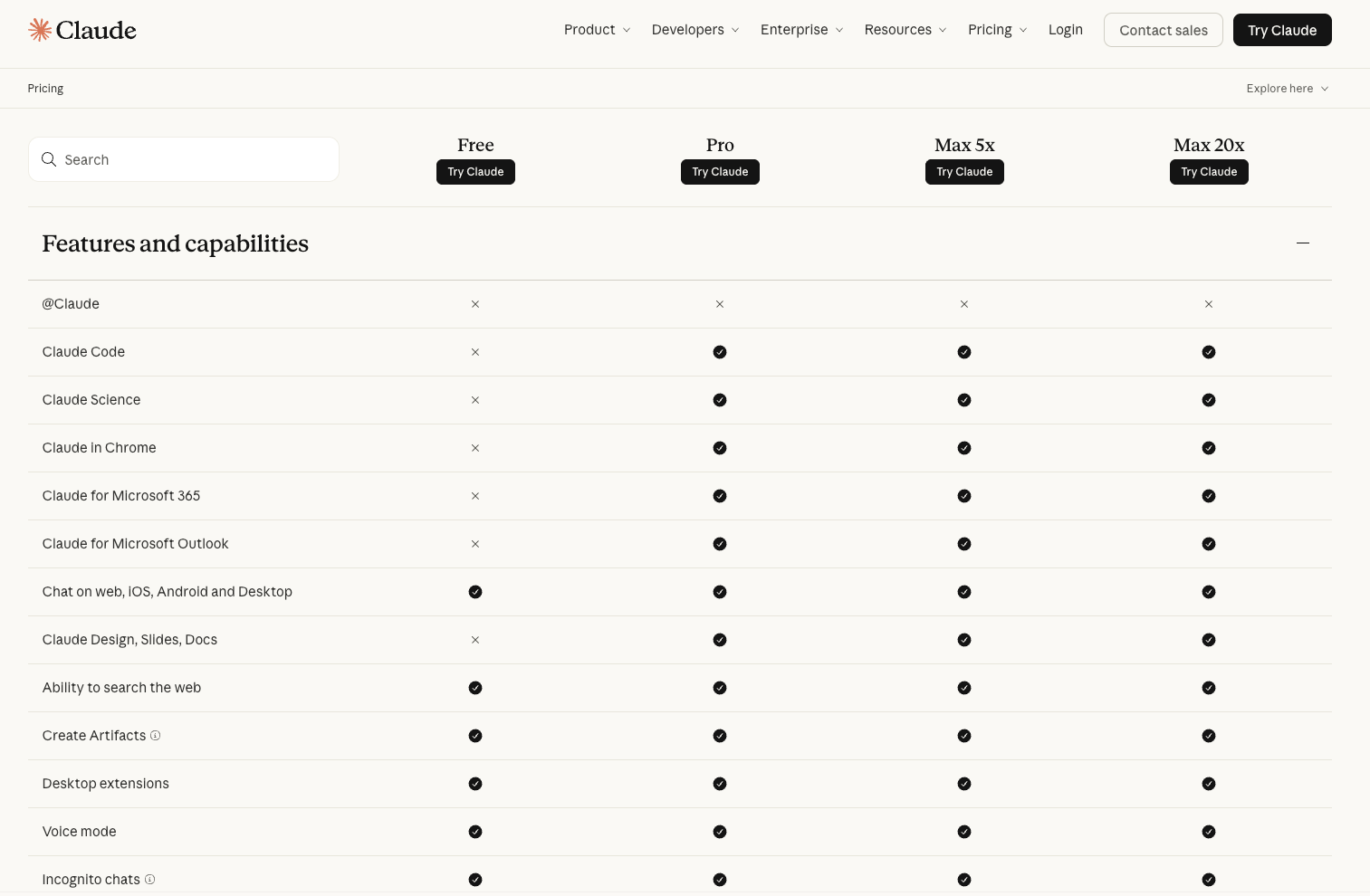
Claude Pro suits moderate coding use, especially if you also use Opus 5.5 for writing, research, or document work. It gives you at least five times the Free plan's usage and is the lowest-priced subscription with Claude Code.
The decision gets harder when long agentic runs touch large repositories. That's where my refactor hit the Pro limit.
Before paying another $80 each month, track how much working time the limits cost you. At an hourly value of $50, Max 5x needs to recover about 1.6 hours per month to cover the upgrade. If the interruptions are rare, usage credits can cost less. If they regularly stop billable coding sessions, Max becomes easier to justify.
{{templates}}
The cheapest ways to use Claude
The cheapest way to use Claude is the Free plan at $0, while Pro is the lowest paid option at $20/month or $17/month billed annually. Annual billing also reduces the price of both Team seat types.
Max is available only with monthly billing, while Enterprise requires an annual commitment. A two-person Team workspace with Standard seats costs $40/month billed annually, bringing the total to $480 per year.
For irregular bursts of heavy work, usage credits may cost less than moving to Max for an entire month. If Claude still feels expensive after comparing the plans, our guide to Claude alternatives covers tools with different limits and billing models.
Choosing the right way to pay for Claude
The right payment option depends on whether you need a personal assistant, a managed workspace, or Claude inside your own software. Here’s the quickest way to narrow it down:
Stay on Free if you:
- Want to test Claude’s writing, research, and file analysis
- Use it for a few short tasks each week
- Can work around the lower usage allowance
Choose Pro if you:
- Use Claude most days for writing, research, or moderate coding
- Need Opus 5.5, Claude Code, Research, or paid connectors
- Prefer a fixed subscription over tracking tokens
Choose Max if you:
- Reach Pro limits several times each week
- Run long coding, research, or agent sessions
- Lose more working time to resets than the $80 or $180 monthly upgrade costs
Choose Team if you:
- Need shared company features, central billing, SSO, and admin controls
- Want to mix Standard and Premium seats according to each person’s usage
Choose Enterprise if you:
- Need SCIM, audit logs, role-based access, custom retention, or HIPAA-ready controls
- Want organization-level usage limits and compliance tools
Choose the Claude API if you:
- Are adding Claude to a product, agent, or internal workflow
- Want spending tied directly to model and token usage
- Need detailed usage records for each workload
Choose a cloud marketplace if you:
- Already buy infrastructure through AWS, Google Cloud, or Microsoft
- Want Claude usage on the same cloud agreement and invoice
- Need procurement or security controls provided by your cloud platform
Claude API pricing by model and feature
Claude API pricing uses separate rates for input and output tokens, measured per million tokens. Output costs more because generating a response requires more compute than processing the prompt.
Token counts vary by language, formatting, code, and model generation. Newer Claude models can count about 30% more tokens for the same text, which makes the provider’s token counter more reliable than a word-based estimate.
Claude API rates by model
The table below covers the four current models and includes standard, cached, and Batch API rates, as listed in Anthropic's API pricing documentation.
All prices are per million tokens. The Batch API cuts standard input and output rates by 50%, making it useful for jobs that can wait for asynchronous processing.
Prompt caching charges more when you first store reusable context, then lowers the cost of reading it again. The savings are largest on repeated system prompts, long reference documents, and agent instructions used across many requests.
Opus 5.5 is also cheaper than Opus 5, which costs $5 per million input tokens and $25 per million output tokens. Anthropic still lists Opus 4.8 at $5/$25, Sonnet 4.6 at $3/$15, and Sonnet 5 at $2/$10.
Our Claude Opus 5.5 breakdown examines the flagship model in more detail, while Opus 5.5 vs Fable 5.1 compares their cost and performance.
Long-context pricing
Claude 4.6 and newer models keep the same per-token rate across their supported context window. A request using 900,000 tokens costs more in total than one using 9,000, but the price per token stays the same.
Fable 5.1, Opus 5.5, and Sonnet 5.5 support context windows up to one million tokens, while Haiku 4.5 supports 200,000 tokens. Large contexts can still raise costs quickly because the full prompt is billed each time unless caching reduces repeated input.
Additional Claude API charges
Token usage is only one part of some API bills. Search, execution, managed sessions, regional processing, and faster inference can add separate charges.
Code execution is free when used as part of web search or web fetch. Fast mode doubles the standard Opus 5.5 token rates in exchange for faster responses, which makes it most useful when latency matters enough to justify the extra cost.
Claude pricing through cloud platforms
Claude models are also available through Amazon Bedrock, Google Cloud Vertex AI, and Microsoft Foundry. Using one of these platforms can simplify procurement when your company already has a cloud agreement, security review, or committed spend with the provider.
Bedrock and Google Cloud publish their own regional availability and pricing, while Microsoft Foundry bills at Anthropic's standard API rates. Fast mode for Opus 5.5 is limited to Anthropic's API, which is worth checking before moving an existing workload.
4 ways to cut Claude API costs
Claude API costs fall fastest when you stop resending the same context at full price and keep expensive models away from simple work. These four changes are the ones I’d make first:
1. Cache prompts you send repeatedly
Prompt caching lowers the cost of text that stays the same across requests, such as a system prompt, tool definitions, policy documents, or a codebase. You pay more to create the cache once, then much less each time Claude reads it again.
Cache reads cost 10% of standard input on Sonnet and Haiku, 5% on Opus 5.5, and 2.5% on Fable 5.1. A five-minute cache write costs 1.25 times the normal input rate, while a one-hour cache write costs twice the normal rate.
Here is the effect on 50 Opus 5.5 requests using the same 100,000-token codebase:
- Without caching: Five million input tokens at $4 per million cost $20.
- With caching: The first cache write costs $0.50, and the next 49 reads cost about $0.98, bringing the total to roughly $1.48.
This calculation assumes every request arrives before the five-minute cache expires. Put stable content first and changing instructions last, since editing an earlier block invalidates everything cached after it.
2. Batch work that can wait
The Batch API reduces input and output rates by 50% when you can wait for the results. Opus 5.5 falls from $4/$20 to $2 per million input tokens and $10 per million output tokens.
Use Batch for overnight document processing, large classification jobs, evaluations, and report generation. Prompt caching can apply to batch requests too, which makes repeated high-volume work a strong candidate for both discounts.
3. Pay for Fast mode only when speed earns money
Fast mode gives Opus 5.5 faster output at twice the standard token price, raising the rate to $8 input and $40 output per million tokens. It runs through Anthropic’s API in research preview and cannot be combined with Batch.
The higher rate fits live coding help, interactive agents, and customer chat where every second affects the experience. Scheduled jobs and background processing can use standard or batch mode without paying the speed premium.
4. Give simple jobs to smaller models
Opus 5.5 uses medium effort by default, and its adaptive thinking is always on. Test the same task at low, medium, and high effort, then keep the lowest setting that still meets your quality bar.
Model choice can save even more. Sonnet 5.5 costs half as much as Opus 5.5, while Haiku 4.5 costs one quarter as much per token.
Use Haiku for extraction, formatting, routing, and quick lookups. Sonnet fits routine coding, summarization, and everyday agent work. Reserve Opus for difficult reasoning, long coding tasks, and requests where the stronger model produces a meaningfully better result.
{{templates}}
Claude API costs for 3 common jobs
The rate card gives you a price per token, but real jobs reuse context, call tools, and send conversation history back through the model. Cache hit rate, agent steps, and output length can move the total more than the initial prompt size.
Web search, code execution, retries, and other tool charges are excluded. Swap in your own model, token counts, and request volume to estimate your bill. Here are three common jobs with the assumptions and math laid out:
1. A coding agent fixing a feature-sized bug
Picture an agent working through a bug across roughly 100 steps. Over the full session, it processes six million input tokens and produces 80,000 output tokens, with 90% of the repeated codebase served from cache.
A 90% cache hit rate keeps the Opus session below $6. If frequent prompt changes lower the hit rate to 70%, the same work rises to about $11.44 because more of the codebase is written back to the cache at the higher rate.
For coding agents, cache structure deserves as much attention as model choice. Keep repository context and tool definitions stable, then append the current task and recent changes later in the prompt.
2. Ten questions about a 300-page report
Now take a 200,000-token report and ask Opus 5.5 ten questions over an afternoon. The questions arrive more than five minutes apart, making the one-hour cache the practical choice.
Cache duration drives the total here. If a five-minute cache expires before every question, each request writes the document again and the estimate rises to about $10.80. Without any caching, the same ten questions would cost about $8.80, so a cache that keeps expiring costs more than no cache.
Sonnet 5.5 completes the same cached workload for about $1.56. I’d begin with Sonnet for summarization and extraction, then send only the hardest analytical questions to Opus.
3. A daily chat assistant
Consider a personal assistant handling 50 Sonnet 5.5 messages each day. Every message sends 6,000 input tokens, with 80% read from cache, and returns an average of 1,500 output tokens.
At 50 messages a day, the assistant costs about $0.95 daily or $28 per month. Moving the same workload to Haiku 4.5 cuts the estimate to roughly $14 per month.
For personal chat, Claude Pro may offer better value at $20 if its limits cover your usage and you also want Opus 5.5 or Claude Code. API billing gives you more control when the assistant lives inside a product, needs custom tools, or must run beyond subscription limits.
{{cta}}
Claude pricing compared with ChatGPT, Gemini, and DeepSeek
Claude sits in the middle of this group on API price. Opus 5.5 costs twice as much as GPT-6.1 Sol, while Sonnet 5.5 matches it. Gemini 3.8 Flash and DeepSeek V4.1 Flash cost less per token, while GPT-6 Astra costs more.
Gemini 3.8 Flash rates are scheduled to double on January 1, 2027. The DeepSeek figure reflects peak-hour pricing, with off-peak rates at half the listed amount.
GPT-6 Astra and GPT-6.1 Sol charge more for prompts over 272,000 tokens, while Claude keeps one rate across its full context window.
Subscriptions are closer. Claude Pro and ChatGPT Plus both cost $20/month, and each company offers higher-use tiers at $100 and $200 per month. Our ChatGPT pricing guide compares those plans, while Claude vs ChatGPT covers writing, coding, speed, and daily use.
Price per token is only the opening estimate. Before moving production traffic, compare output quality, retries, cache behavior, latency, and the number of tokens each model needs to finish the same task.
When Lindy moved agent traffic to DeepSeek V4 Flash, inference costs on the migrated traffic fell by about 90%. Our guide to migrating from Claude to DeepSeek explains the process and the tradeoffs we found.
Is Claude worth the price?
Yes, Claude Pro is worth $20/month for people who use it most workdays. Opus 5.5, Claude Code, and long-context document work can cover the subscription by saving time on drafting, research, and coding.
The limits matter more than the feature list. Pro works well when an occasional five-hour reset does not derail your day. If you keep reaching the cap halfway through paid work, add the cost of those interruptions before deciding between usage credits and Max.
Claude is worth paying for if you:
- Write, research, or code most days and regularly outgrow the Free plan
- Work with long reports, large projects, or codebases where the 1M-token context window helps
- Use Claude Code enough to benefit from a subscription, while staying within Pro’s five-hour and weekly limits
- Prefer one monthly price for chat and coding over tracking every API token
A cheaper option may fit better if you:
- Ask only a few questions each week, since the Free plan may cover them
- Process large volumes of simple requests, where Haiku 4.5, Gemini 3.8 Flash, or DeepSeek can cost less
- Need predictable access throughout the day and cannot pause when a subscription limit resets
- Care more about the lowest token price than Claude’s writing, coding, or long-context performance
Before committing for a year, run your normal workload on Pro for a month and note where it saves time, where it hits limits, and which features you use. The right answer becomes clearer once you compare completed work and interruptions.
What I’d budget for Claude
For subscriptions, I’d start with Pro on monthly billing and track how often the limits interrupt real work. For the API, I’d watch cost per completed task, cache hit rate, and model choice before worrying about tiny differences in token prices.
A stable cache and sensible model routing can change the bill quickly. If your company uses an assistant such as Lindy to choose a model for each task, confirm which Claude models are available and send routine work to the least expensive one that still meets your quality bar.
FAQs
1. How much is Claude per month?
Claude costs $0 on Free, $20/month on Pro, $100/month on Max 5x, and $200/month on Max 20x. Annual billing lowers Pro to $17/month. Team costs $25 per Standard seat or $125 per Premium seat monthly, while Enterprise costs $20/seat/month billed annually plus API usage.
2. Is Claude Pro worth $20 a month?
Yes, Claude Pro is worth $20/month when it saves you even half an hour each week. Regular writers, researchers, and developers can recover the cost through fewer manual edits or faster first drafts, while the Free plan remains enough for occasional questions.
3. Is Claude Max worth it?
Yes, Claude Max is worth it when Pro limits interrupt your work several times a week. Max 5x costs $100/month and Max 20x costs $200/month. Track your Pro usage for a week before upgrading, since occasional overages may cost less through usage credits.
4. Does Claude have student pricing?
Claude doesn't offer a published discount for individual students. Students can use the Free plan, while universities can request discounted campus-wide pricing for students, faculty, and staff through Anthropic's education program.
5. Is Claude cheaper than ChatGPT?
Claude and ChatGPT cost the same at their main individual tiers. Claude Pro and ChatGPT Plus both cost $20/month, and both offer higher-use plans at $100 and $200. ChatGPT also has an $8 Go plan and a $500 Pro tier, giving it more individual pricing options.