Opus 5.5 vs Fable 5.1: Same Score at a Third of the Cost


If you've spent any time with Fable 5.1 in Claude Code, you know the routine: a long agent run goes beautifully, you check Settings > Usage, and a scary chunk of your week is gone. (Fable has never been gentle on a Max plan.)
Then on September 22, Anthropic released Opus 5.5 at 40% of Fable's token price and said in its own launch post that it performs at Fable's level on most work. Companies rarely talk down their priciest model like that, so it's fair to wonder why Fable is still on the menu.
To settle Opus 5.5 vs Fable 5.1, I went line by line through Anthropic's benchmark tables, pricing docs, and plan-limit pages, then checked it all against Artificial Analysis, which ran both models at every effort level. At the default settings most people leave alone, they score exactly the same.
Here's which model to make your default, how far each one stretches on a Pro or Max plan, and the handful of jobs where Fable 5.1 still earns its premium.
Opus 5.5 vs Fable 5.1: the short answer
Start with Opus 5.5. It's cheaper on every price line, it's included in Claude Pro, and it beats Fable 5.1 on every benchmark in Anthropic's launch table. Our Claude Opus 5.5 explainer covers everything else that's new in the release.
Anthropic says as much in its own docs. The models overview tells developers to start with Opus 5.5 for most workloads, and to use Fable 5.1 for demanding reasoning and long-horizon agent work.
The same page adds one more case for Fable: when your evals on Opus 5.5 at higher effort still fall short. That clause makes Fable 5.1 the model you call after Opus has already tried and missed.
Choose Opus 5.5 if you:
- Want one default model for coding, research, and writing
- Pay per token and watch the bill
- Are on Claude Pro, where Opus is included and Fable costs extra
- Need zero data retention or a fast mode
Choose Fable 5.1 if you:
- Have a task Opus 5.5 keeps failing at High or Extra high effort
- Run long, open-ended research where one missed insight costs more than the tokens
- Are on Max and still have Fable allowance left this week
Specs and pricing side by side
On paper, these two look like siblings. Both have a 1M-token context window, a 128K-token output cap, and adaptive thinking you can't switch off. The differences are price, speed, defaults, and who gets access.
Prices and specs come from Anthropic's pricing docs, the models overview, and the Claude plans page, as of September 2026.
How much cheaper is Opus 5.5 than Fable 5.1?
Per token, Opus 5.5 costs 60% less, so Fable 5.1 runs 2.5 times the price on both input and output.
Anthropic's "40% cheaper" figure compares Opus 5.5 with the older Opus 5 on typical workloads, so it doesn't describe the gap with Fable.
Cache reads are where the price difference shrinks. Opus charges $0.20 per million cached tokens and Fable charges $0.25, and Anthropic's Opus 5.5 announcement notes that cache reads make up the majority of agentic and coding costs.
What one agent session costs on each
Here is a rough session, with my own illustrative numbers priced at list rates: 8M cached tokens read back, 400K fresh tokens written to a five-minute cache, and 150K tokens of output.
A cache-heavy session lands closer to 2.2x than 2.5x. Output is where Fable hurts most, so every extra paragraph of thinking at a high effort level costs you more on Fable.
Real tasks won't match my toy numbers, because the two models don't burn tokens the same way. Artificial Analysis found that at max effort, Opus writes about 119K output tokens per task against 78K for Fable, so it gives some of its discount back.
What the benchmarks say (and what Anthropic admits about them)
Anthropic's launch table is a clean sweep. Opus 5.5 beats Fable 5.1 on all nine shared rows, from agentic coding to chart reading.
Both models ran at max effort for these results (Opus at Extra high for Terminal-Bench). Anthropic also ran Opus with its production safeguards on, which it says likely lowered some of its scores.
Just before its benchmark table, Anthropic adds a caveat: "In our own use, the gap between Opus 5.5 and Claude Fable 5.1 is narrower than these scores suggest."
That's a vendor playing down its own headline win, which happens about as often as a restaurant telling you the house wine is overpriced.
Anthropic's one direct head-to-head backs it up. Both models translated HAProxy from C into Rust, and both rewrites passed nearly all of its regression tests. Opus finished in 9.5 hours to Fable's 12, and cost 51% less.
What independent testing shows
Artificial Analysis runs both models through the same 10 evaluations at each effort level, which is the fairest way I found to line them up. Its Intelligence Index results:
The defaults row is the one most people live in. Out of the box, the two score the same, and Opus gets there for about a third of the cost per task.
Match their effort levels and Opus pulls ahead. At Max, though, its heavier token use shrinks the per-task discount to about 22%, which is why I wouldn't make Max your everyday setting.
Is Fable Medium better than Opus High?
No. Artificial Analysis scores Opus 5.5 on High at 54 and Fable 5.1 on Medium at 49, and Opus wins nine of the ten component tests. Fable's only win is long-context reasoning (85% vs. 83%).
Opus on High still costs less per task ($1.82 vs. $2.98). Opus is slower to start, though: it took about 56 seconds to reach its first token in those runs, against about 8 for Fable.
Where Fable 5.1 still wins
Fable 5.1 still has a few edges. They're small, and you'll mostly find them in independent tests.
- Knowledge-heavy reasoning at default settings. At API defaults, Artificial Analysis has Fable ahead on its professional-work test (GDPval-AA, 1617 vs. 1576 Elo) and slightly ahead on Humanity's Last Exam and the CritPt physics test, all by small margins.
- Fewer tokens at the top end. At Max, Fable uses about 78K output tokens per task to Opus's 119K. Simon Willison watched Opus 5.5 on max hit the 128,000-token output cap twice while it was still reasoning about a pelican SVG.
Fable 5.1 on max didn't overthink it and gave him the best pelican he'd seen from any Anthropic model. (Yes, a pelican riding a bicycle is a real benchmark in some circles.) - A quicker first answer at higher effort. In Artificial Analysis's runs, Fable got its first token out sooner whenever Opus ran at High or Max. At defaults, Opus started a bit sooner (22 vs. 24 seconds), streamed faster (75 vs. 53 tokens a second) and took about 214 seconds per task to Fable's 447.
- The hardest long-running work. Anthropic still positions Fable 5.1 for demanding reasoning and long-running agents.
In Anthropic's Fable 5.1 launch notes, a Ramp engineer describes one unattended 38-hour Fable 5.1 run that caught a bad result, fixed it, and kicked off six parallel experiments overnight. - First-try coding, by a hair. Snorkel AI's coding benchmark gives Fable a nominal pass@1 lead (61.5% vs. 60.7%). Across every run, though, Opus 5.5 passed 68% of trajectories to Fable's 49%.
Early reviewers lean toward Opus as the daily driver. At Every, Kieran Klaassen moved his everyday coding from Fable 5.1 to Opus 5.5 and estimates Opus is about 90% as capable as Fable at coding.
The same team caught Opus failing to follow a brand template on a slide deck, so if strict formatting is your job, test before you switch everything over.
How far each model goes on your Claude plan
On a subscription, Fable 5.1 either costs extra or burns through a capped share of your week. Anthropic's plan rules break down like this:
- Pro: Opus 5.5 is included. Fable 5.1 sits outside your plan's limits, so every Fable message runs on pay-as-you-go usage credits.
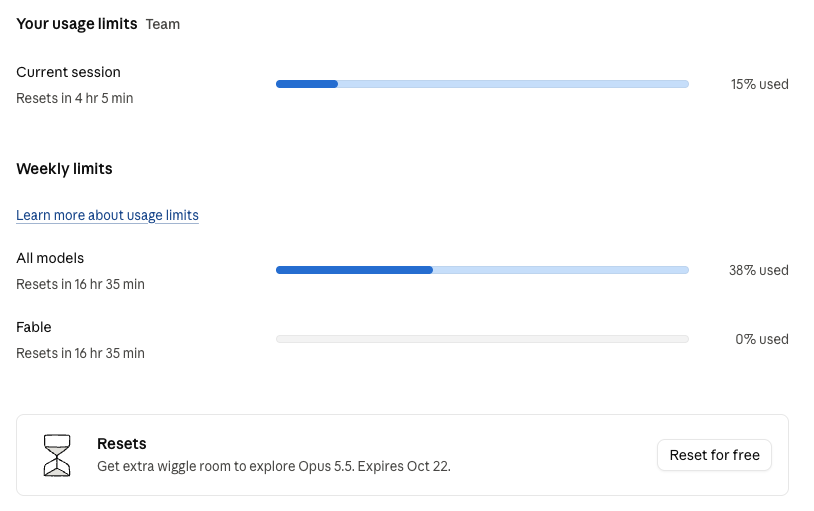
- Max (5x or 20x): Both are included, but Fable can use at most 50% of your weekly limit and drains it faster than other Claude models. That 50% comes out of your normal weekly allowance.
- Team: Premium seats work like Max. Standard seats work like Pro, with Fable on usage credits.
- API and usage-based Enterprise: Fable bills per token at standard API rates, the same rates as the table above.
Opus 5.5 also arrived with more headroom. At launch, Anthropic raised five-hour usage limits on Pro, Max, Team, and seat-based Enterprise plans, and gave subscribers a limit reset they can save for later, as long as they use it before the offer expires.
If you're still deciding between subscriptions in the first place, it helps to see how Claude's plans compare with ChatGPT's before you pick a tier.
In Claude Code
For most developers, the Opus-or-Fable choice happens inside Claude Code, Anthropic's terminal-based AI coding agent. Claude Code draws from the same usage pool as your chats, so a long Fable session in the terminal eats the same allowance as Fable in the app.
A few things to know before you switch:
- Version: Fable 5.1 needs Claude Code 2.1.255 or later.
- Switching: Type /model to change models mid-session, and you keep your conversation when you do. You can also start with claude --model claude-opus-5-5 (or claude-fable-5-1), per Anthropic's model configuration guide.
- Effort: Higher effort uses more tokens and hits limits sooner, while Low and Medium stretch your usage further on routine tasks, per Anthropic.
{{templates}}
How to hand work from Opus 5.5 to Fable 5.1
The simplest setup is to start on Opus and escalate to Fable when Opus gets stuck. A few details decide whether that habit saves you money or doubles the bill.
- Set effort on purpose. The defaults don't match. Opus 5.5 defaults to Medium on the API, while Fable 5.1 defaults to High on the API and in Claude Code, and to Medium in Claude.ai and Cowork.
Leave both on their defaults and you're comparing two different amounts of thinking. - Push Opus higher before you switch. Anthropic's own advice is to move to Fable when Opus at higher effort still falls short. The effort ladder runs Low, Medium, High, Extra high, and Max, and Extra high is built for long coding and agent tasks.
- Escalate upward on the API. Per Anthropic's Opus 5.5 migration notes, a conversation that moves from Opus 5.5 up to Fable 5.1 keeps its reasoning.
Move from Fable back down to Opus and the turns after the switch run without Fable's earlier reasoning. The request still succeeds, since the API drops what the new model can't read. - Don't switch models to dodge a refusal. Both carry similar cybersecurity and biology safeguards, and Claude's apps send flagged requests to a fallback model. The exception: Fable 5.1 can be used to find software vulnerabilities, while Opus 5.5 reroutes most cybersecurity tasks to Opus 4.8.
- Check your data rules first. Fable requires 30-day data retention by default for safety monitoring, though eligible customers get zero retention until Anthropic's Enterprise Frontier Safeguards arrive. Opus 5.5 offers zero data retention, like earlier Opus models.
- Know you lose fast mode on Fable. Fast mode runs Opus 5.5 up to 2.5x faster for $8 and $40 per million input and output tokens, and Fable 5.1 doesn't offer it, so a latency-sensitive job slows down when you move it to Fable.
Which should you choose? A pick for every user and task
{{cta}}
Make Opus 5.5 your default and let Fable 5.1 earn its spot
The Opus 5.5 vs Fable 5.1 choice comes down to a default and an exception. Opus 5.5 is the default, because it's cheaper, included on Pro, and ties or beats Fable in nearly every test that matches their settings.
Fable 5.1 is the exception you keep for the problems Opus can't crack at higher effort. If your week looks like most people's, here's a simple way to set it up:
- Switch your default to Opus 5.5 and set effort to High for real work.
- Keep a short list of tasks Opus has failed, and rerun only those on Fable 5.1.
- Check Settings > Usage after a week to see what Fable is costing you.
If your team works in Slack, Lindy is an AI teammate that lets you pick a model for each task (most major models are available).
And if Claude's limits or pricing still don't fit, there are solid Claude alternatives for coding, writing, and business work.
If you're weighing OpenAI's newest flagship instead, our Opus 5.5 vs Astra comparison compares the two on the same real tasks.
Frequently asked questions
Is Fable better than Opus?
No, Fable 5.1 isn't better than Opus 5.5 for most work. Artificial Analysis scores them evenly at default settings (51 each), and Opus leads when both run at the same effort. Fable keeps small edges on some knowledge-heavy reasoning tests and uses fewer tokens at Max.
Is Opus cheaper than Fable?
Yes, Opus 5.5 is cheaper than Fable 5.1 on every price line. It costs $4 and $20 per million input and output tokens against Fable's $10 and $50. Artificial Analysis measured it at about a third of Fable's cost per task at default settings.
Is Fable Medium better than Opus High?
No, Fable 5.1 on Medium scores below Opus 5.5 on High. Artificial Analysis puts them at 49 and 54 on its Intelligence Index, and Opus on High still costs less per task ($1.82 vs. $2.98).
Is Fable 5.1 being retired?
No, Fable 5.1 isn't being retired yet. Anthropic's model deprecations page lists it as active, with retirement no sooner than September 1, 2027.
Which Claude plans include Fable 5.1?
Fable 5.1 is included on Max plans and on premium Team and seat-based Enterprise seats, up to 50% of weekly limits. Pro and standard seats use it through pay-as-you-go usage credits, and it isn't available on the Free plan.