AI Sales Chatbots: Top 9 Picks and Guide for 2026
Everett tested nine AI sales chatbots, including Tidio, Chatfuel, and Salesloft, weighing lead qualification accuracy, channel coverage, and CRM integrations.


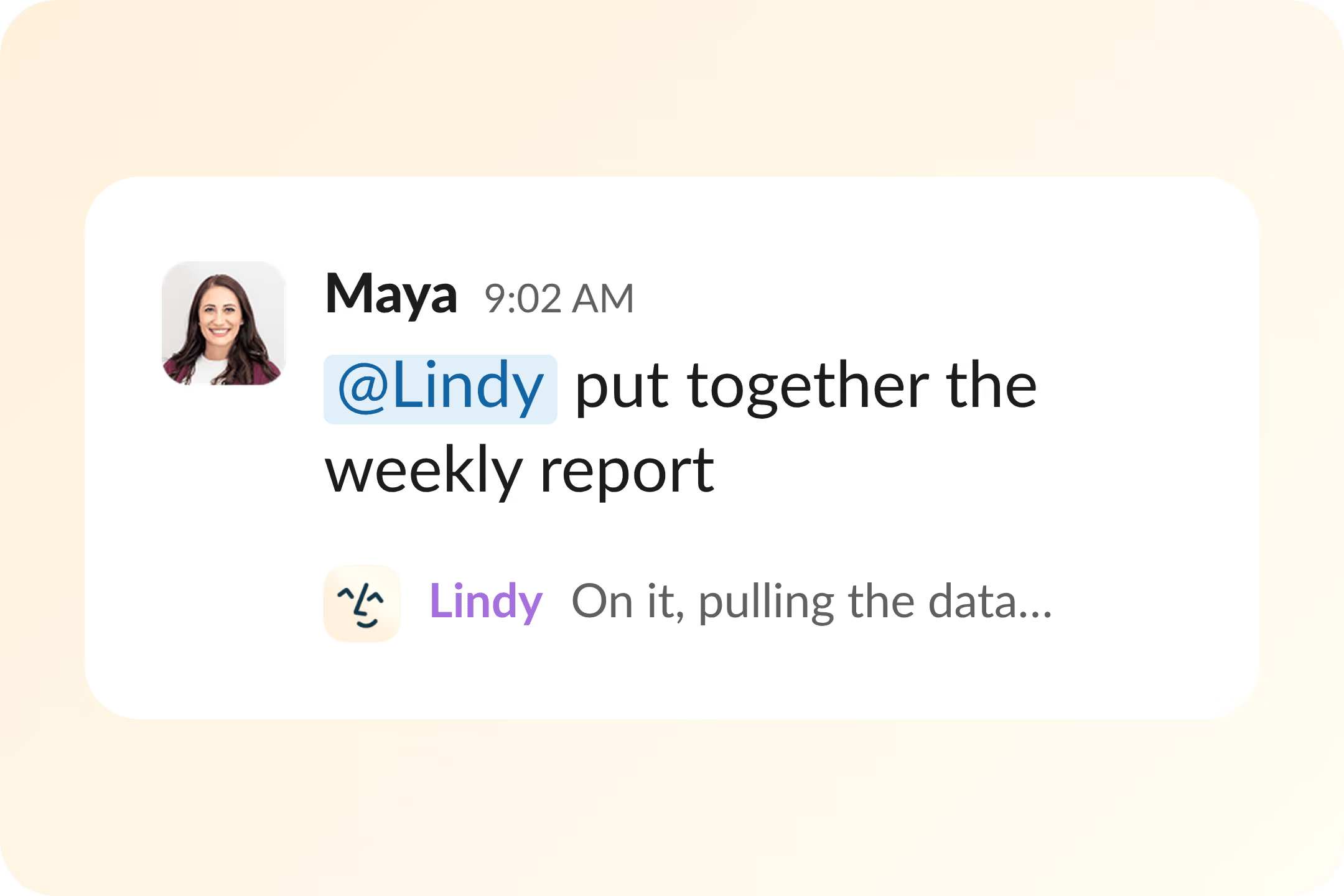
Most teams want to respond faster, qualify leads better, and close more deals, but don’t want to add headcount to do it. That’s where AI sales chatbots help you out. The best ones can book meetings on your behalf, route leads, and follow up across channels like email, chat, and even voice.
In this article, we’ll cover:
- The 9 best AI chatbots for sales
- Which sales AI chatbot is best for your team
- What features to look for
- How sales chatbots drive revenue
- Tips to choose the right tool
We start with a crisp list of the top 9 picks.
The 9 best AI sales chatbots: TL;DR
You’ve plenty of AI chatbot options for sales, but the best one depends on your channels and team size. Plus, whether you need full-funnel automation or just lead capture. If your goal goes beyond inbound chats, implementing outbound sales automation can further accelerate your pipeline generation.
Here’s a quick list of the best AI chatbot tools we tested, and what each of them is best at: Evaluating how these tools fit into comprehensive ai sales automation helps teams optimize their revenue workflows.
- Chatfuel – Best for Facebook/Instagram DMs
- Tidio – Best for marketing teams of small and medium businesses
- Rep AI – Best for businesses running Shopify
- Chatsimple – Best low setup plug-and-play option
- Watermelon – Best for multilingual customer support
- Zendesk Answer Bot – Best for hybrid support/sales teams
- Fin AI – Best AI built into a CRM
- Salesloft – Best for B2B SaaS pipelines
- ManyChat – Best for campaign-based sales
We didn’t rank these picks, but organized them by use case so you can quickly find the ones that fit your workflows. For a broader look at autonomous automation in revenue teams, explore our guide on ai agents sales.
Let’s now explore each one of these in detail.
1. Chatfuel – Best for Facebook/Instagram DMs
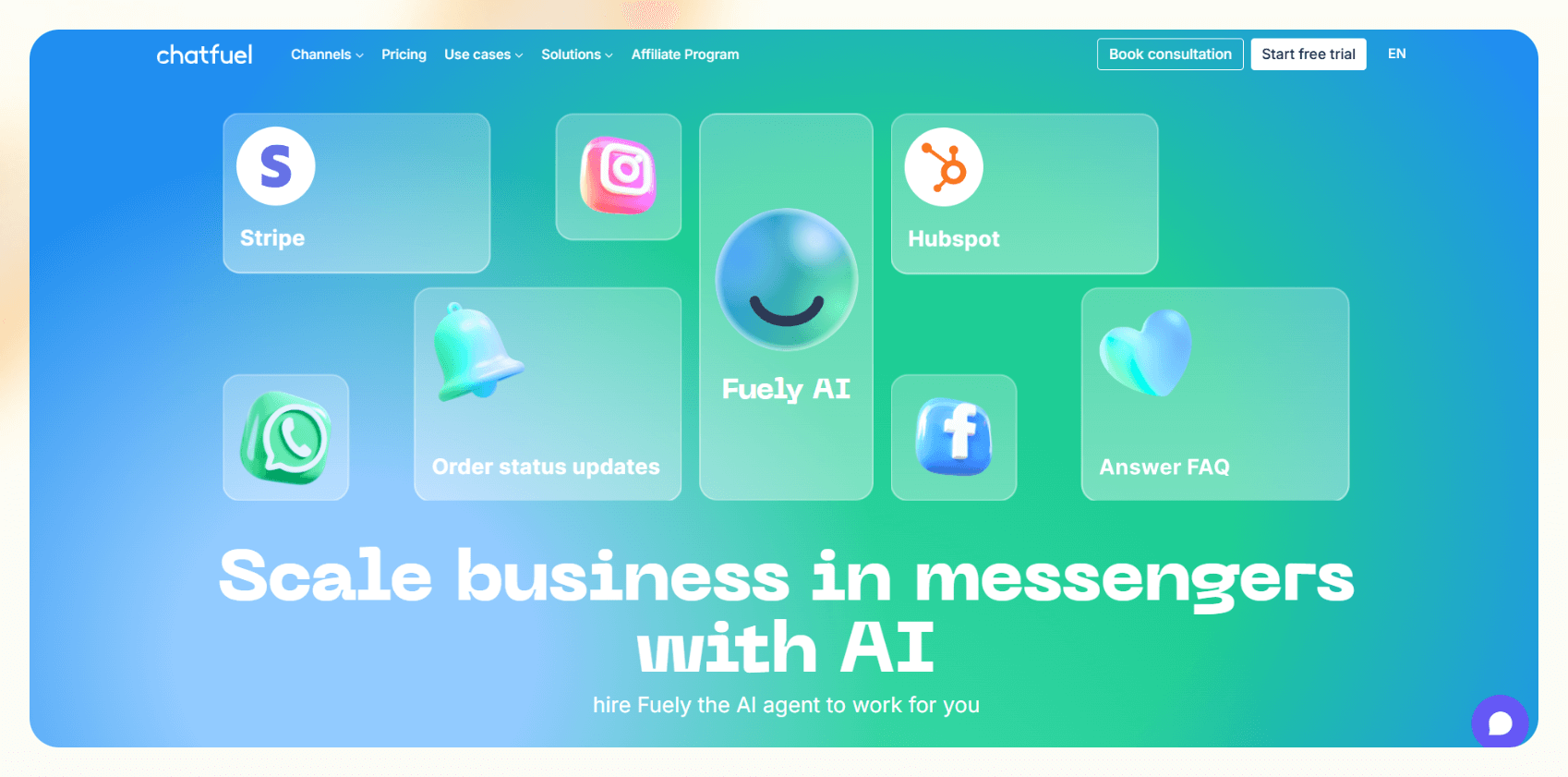
Chatfuel is a chatbot builder focused on automating sales and support inside Meta platforms like Facebook Messenger, Instagram, and WhatsApp. It offers pre-built flows for lead generation, product recommendations, cart recovery, and customer engagement. This makes it a popular choice for teams seeking social-first ai lead generation chatbot software.
It’s designed for DTC brands and sellers who rely on social traffic and want to scale 1:1 messaging without hiring more reps.
Features
- Visual chatbot builder with drag-and-drop templates
- Works with Facebook Messenger, Instagram, and WhatsApp
- Built-in automation for FAQs, lead capture, and abandoned cart recovery
- API and CRM integrations available on paid plans
Pros
- Easy to deploy for non-technical users
- Fast setup using ready-to-use templates
- Strong social channel support
Cons
- Only supports Meta platforms
- Pricing scales with message volume
Pricing
- Chatfuel Light: Free plan, no credit card required
- AI PRO: From $49/month for Instagram, Facebook, and WhatsApp automations
If your sales motion starts in DMs or stories, Chatfuel helps automate that first touch so you can scale without burning out your team.
2. Tidio – Best for marketing teams of small and medium businesses
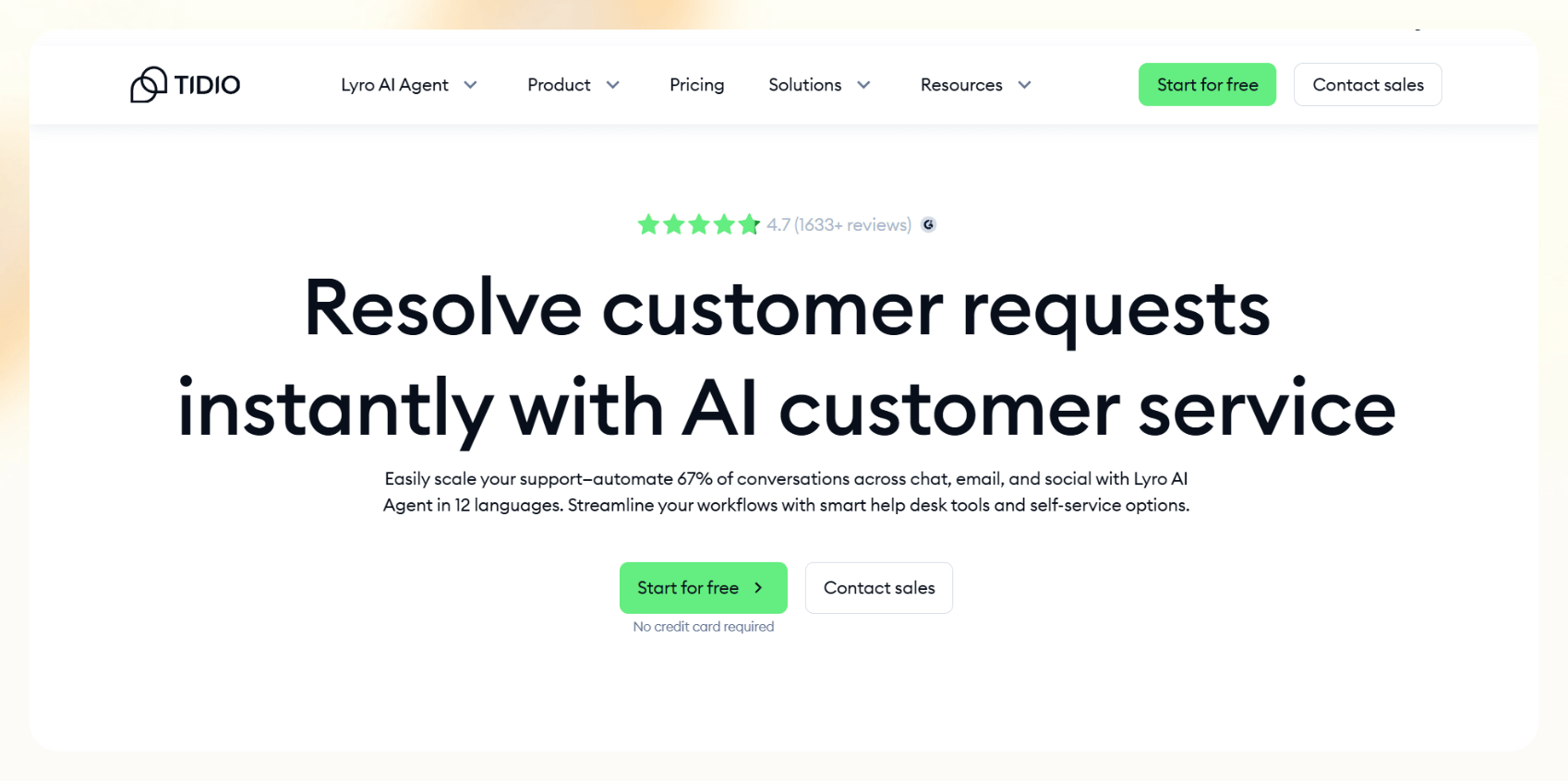
Tidio is a live chat and chatbot platform built for small to mid-sized businesses. It combines AI-powered automation with live agent support, letting businesses respond to leads in real-time, recommend products, and automate follow-ups.
It's ideal for teams that want a single tool to handle both sales and support, without needing a dedicated dev team. Learning how to leverage AI for customer support can help streamline operations across both sales and service teams.
Features
- AI chatbot (Lyro) for handling customer queries and lead capture
- Live chat, email marketing, and helpdesk features in one tool
- Integrates with Shopify, WordPress, Messenger, and more
- Visual editor for building custom workflows
Pros
- Combines live chat and automation in one place
- Easy setup with helpful templates
- Offers multilingual support on higher plans
Cons
- AI chatbot (Lyro) only available on paid plans
- Limited multichannel reach beyond the web and Messenger
Pricing
- Free plan available
- Starter: $29/month, billed monthly
- Growth: $59/month, billed monthly
- Plus: $749/month, billed monthly
- Premium: Custom pricing
- Lyro AI agent: from $39/month for 50 conversations
If you’re an SMB looking for a single platform to manage both sales and support, Tidio gives you the core tools without overcomplicating things. If you want to evaluate dedicated support tools, explore options for the best customer service chatbots software available.
3. Rep AI – Best for Shopify stores
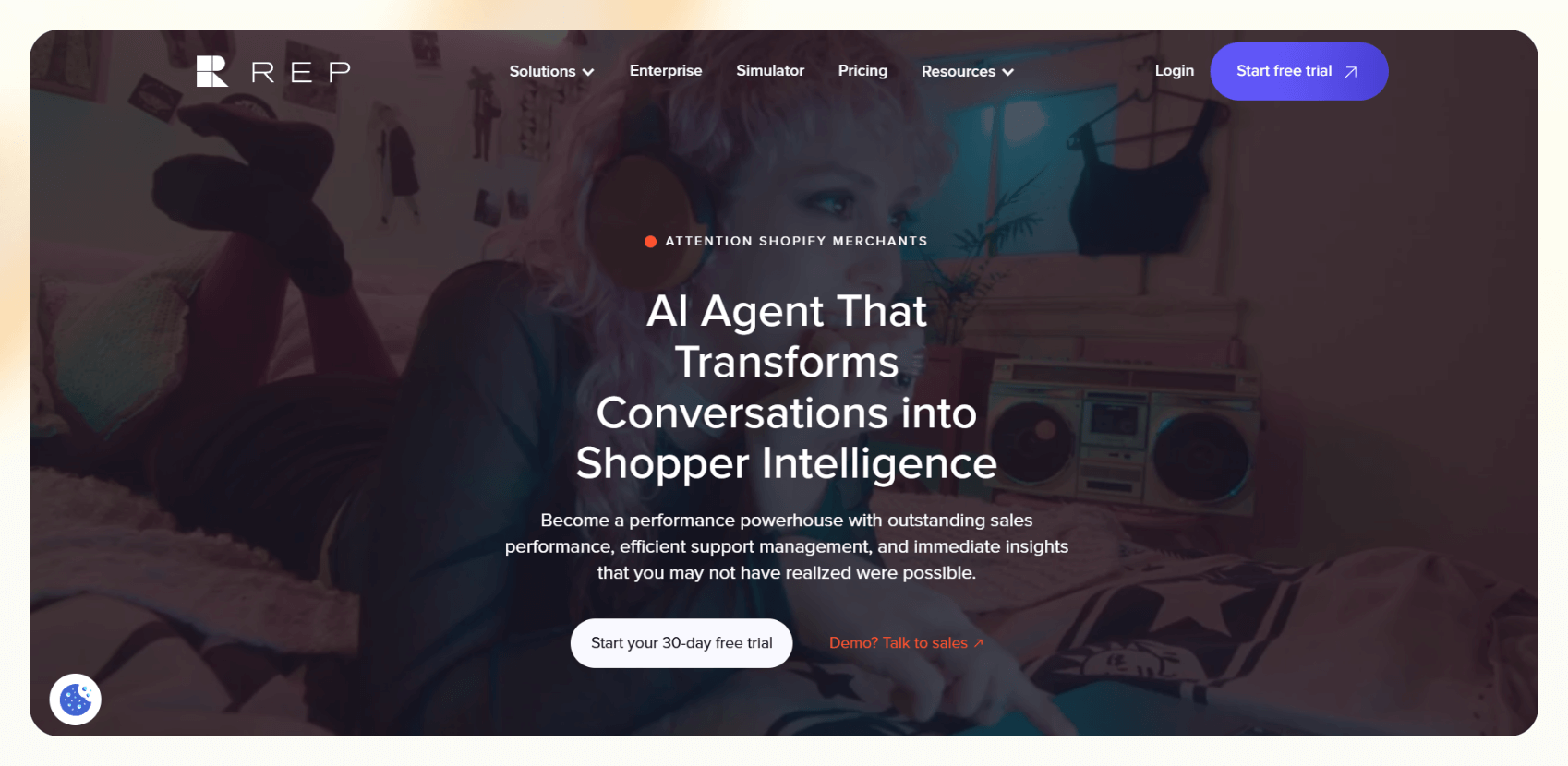
Rep AI is an AI-powered sales assistant built specifically for Shopify stores. It connects directly to your product catalog, engages shoppers in real-time, answers questions, and recommends products, all to increase conversions and average order value.
It’s best for e-commerce brands that want a hands-off way to guide users and recover sales without relying on live chat agents.
Features
- 1-click Shopify integration
- Product recommendations, cart recovery, and order tracking
- Proactive behavior-based chat triggers
- Performance dashboard for sales and support metrics
Pros
- Fully optimized for Shopify environments
- Can handle up to 97% of customer queries
- Helps boost conversion rates and AOV
Cons
- Only works with Shopify
- No email or outbound engagement features
Pricing
- Free to install, then $12 per 1,000 extra visitors
- Starter: $104/month, billed monthly, for up to 10,000 visitors/month
- Price increases as the number of visitors increases
Rep AI is ideal for brands that want a conversion-focused AI chatbot for sales that doesn’t just respond but actively sells for you.
4. Chatsimple – Best plug-and-play option
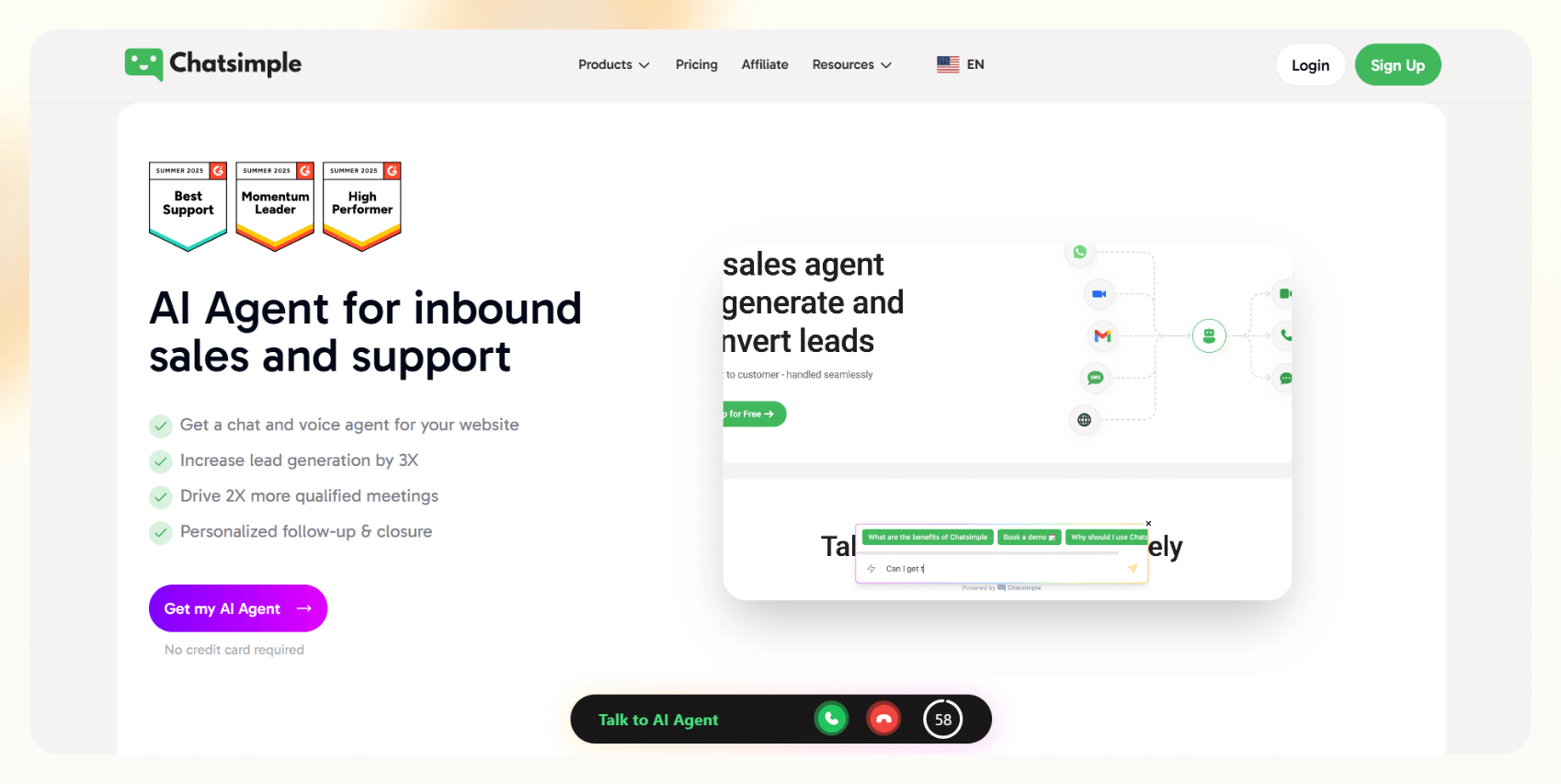
Chatsimple is a no-code chatbot platform designed for instant deployment. It supports voice and text, handles multiple languages, and integrates with CRMs for lead capture and follow-up. For broader operational tasks beyond customer chat, dedicated ai business assistant software can further streamline your daily workflows.
It’s built for small businesses and startups that want a fast, low-lift way to engage visitors and qualify leads around the clock. Finding the right chatbot for small business operations can help automate lead qualification without increasing headcount.
Features
- Multilingual, voice-enabled AI chatbot
- CRM and email integrations
- GDPR and SOC 2 compliant
- Works across websites and landing pages
Pros
- Quick to set up, with no technical experience required
- Voice chat support sets it apart from most competitors
- Offers useful lead gen tools like pitch writers and email responders
Cons
- Limited support documentation
- Lacks advanced automation features seen in other platforms
Pricing
- Free plan for 10 conversations/month
- Growth: $500/month, billed monthly
- Business: $1,250/month, billed monthly
- Enterprise: Custom quote
If your priority is speed and simplicity, Chatsimple gives you just enough automation to get started without the usual setup friction.
5. Watermelon – Best for multilingual customer support

Watermelon is a drag-and-drop chatbot builder that lets businesses create GPT-4 powered bots for both customer support and sales. It supports over 100 languages and works across platforms like WhatsApp, Facebook Messenger, and Instagram.
It’s a strong fit for customer service and sales teams operating across multiple markets or languages.
Features
- Multilingual AI that auto-detects incoming language
- No-code flow builder with GPT-4 support
- Omnichannel support across web, social, and messaging apps
- Live agent handoff and centralized inbox
Pros
- Excellent for international support and lead gen
- Easy to build and customize without a developer
- Strong analytics around chatbot accuracy and performance
Cons
- Prices listed in euros only
- More focused on support than outbound sales automation
Pricing
- Starter: €99/month, billed monthly
- Advanced: €199/month, billed monthly
- Business: €399/month, billed monthly
- Enterprise: Custom pricing
If your sales and support teams operate across different languages or regions, Watermelon helps you stay responsive without juggling multiple tools.
6. Zendesk Answer Bot – Best for hybrid support/sales teams
Zendesk Answer Bot is a conversational agent built into the Zendesk platform. It uses your help center content to answer customer questions automatically and can hand off to live agents when needed.
While it’s primarily designed for support, it can also capture leads, qualify intent, and surface relevant content to move buyers forward. It’s best for teams that already use Zendesk and want to add automation without adding new tools.
Features
- Pulls answers from your knowledge base
- Works across email, web, and messaging platforms
- Supports multiple languages
- Agent handoff and intent detection
Pros
- Integrates into Zendesk workflows
- Helpful for triaging both support and sales requests
- Scales well with growing ticket volumes
Cons
- Not a true generative AI chatbot
- Limited functionality outside the Zendesk ecosystem
Pricing
- Included in Zendesk Suite plans: Team, Professional, Enterprise
- Starts from $69/month, billed monthly
For teams that already use Zendesk for ticketing or support, Answer Bot is a low-effort way to start automating inbound conversations.
7. Fin AI (Intercom) – Best AI built into a CRM
Fin AI is Intercom’s chatbot that uses GPT-4 to execute tasks. It pulls from your knowledge base to answer questions, assist agents, and surface relevant information to both prospects and reps.
It’s designed for companies that already use Intercom for live chat, CRM, or helpdesk and want to add an AI chatbot for sales without stitching together external tools. Furthermore, it’s not limited to Intercom and can work independently as well.
Features
- GPT-4 chatbot trained on your knowledge base
- Agent assist features real-time suggestions
- Built-in analytics, reporting, and conversation summaries
- Tight integration with Intercom’s CRM and inbox tools
Pros
- High accuracy and fast response time
- Reduces load on sales and support teams
- Seamless for existing Intercom users
Cons
- Pricing is usage-based
- Requires an existing Intercom or similar helpdesk infrastructure
Pricing
- For non-Intercom usage, $0.99 per outcome
- For Intercom users, $0.99 per outcome + $39/seat/month, billed monthly
If you’re already using Intercom or any other helpdesk tool for live chat or CRM, Fin AI makes it easier to qualify leads and reduce manual work without adding another tool to your stack.
8. Salesloft – Best for B2B SaaS pipelines
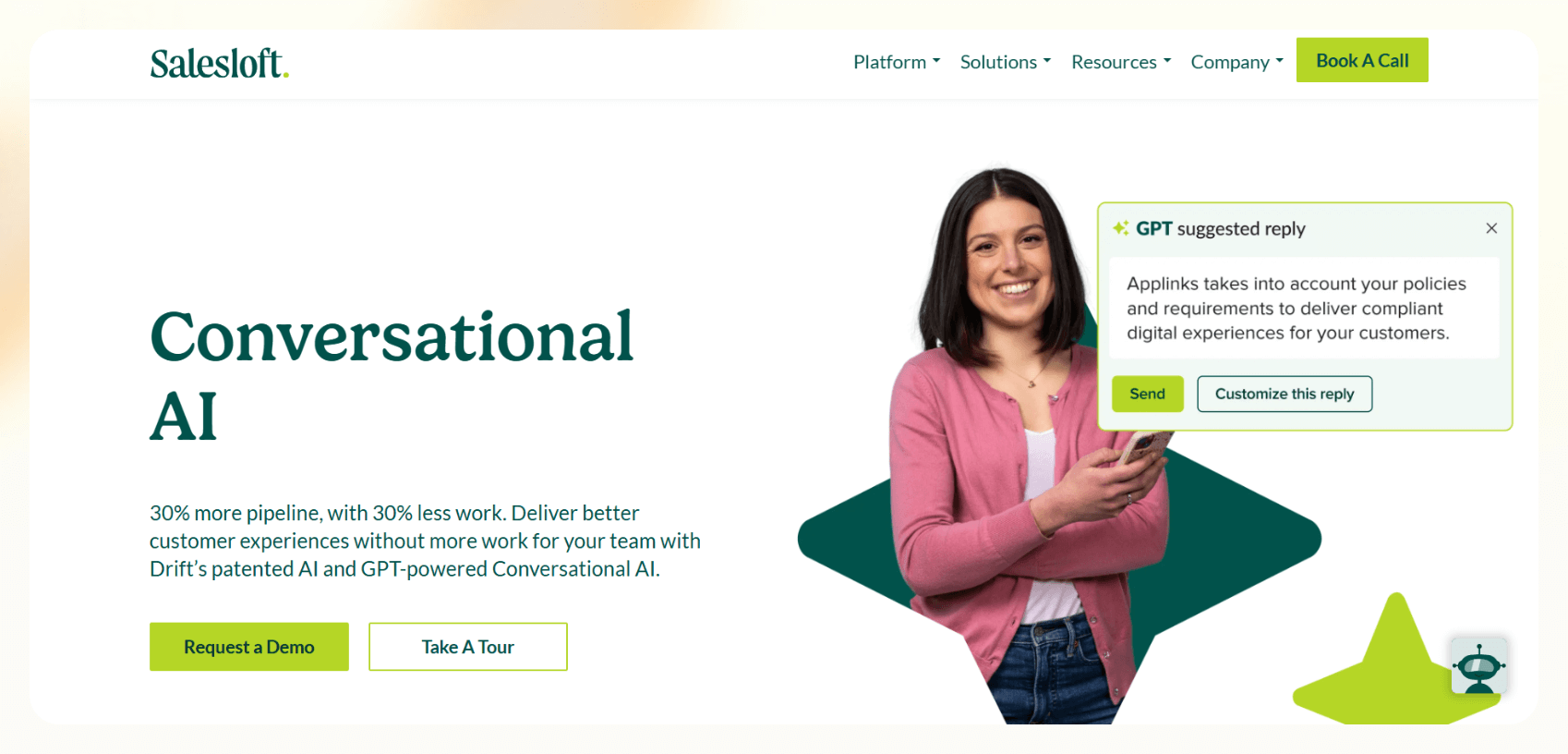
Salesloft’s AI agent suite combines conversational AI with sales engagement tools. It’s designed to help reps qualify leads, summarize calls, send follow-ups, and move deals through the pipeline within one platform.
It’s best suited for mid-market and enterprise B2B teams running complex sales cycles.
Features
- AI chat agents for lead qualification and routing
- Call summaries, email assistance, and real-time coaching
- Pipeline analytics and intent-based workflows
- Integrates with CRMs and calendars
Pros
- Built for full-funnel B2B sales
- Combines AI chat with sales engagement tools
- Strong analytics and playbooks
Cons
- More suited for larger teams than smaller ones
- Drift-style website chatbot still evolving under Salesloft
Pricing
- Pricing not public
- Request a demo for a custom quote based on your needs
If your sales process involves multiple stages, handoffs, and long cycles, Salesloft’s AI tools can help keep momentum without overloading your reps.
9. ManyChat – Best for campaign-based sales
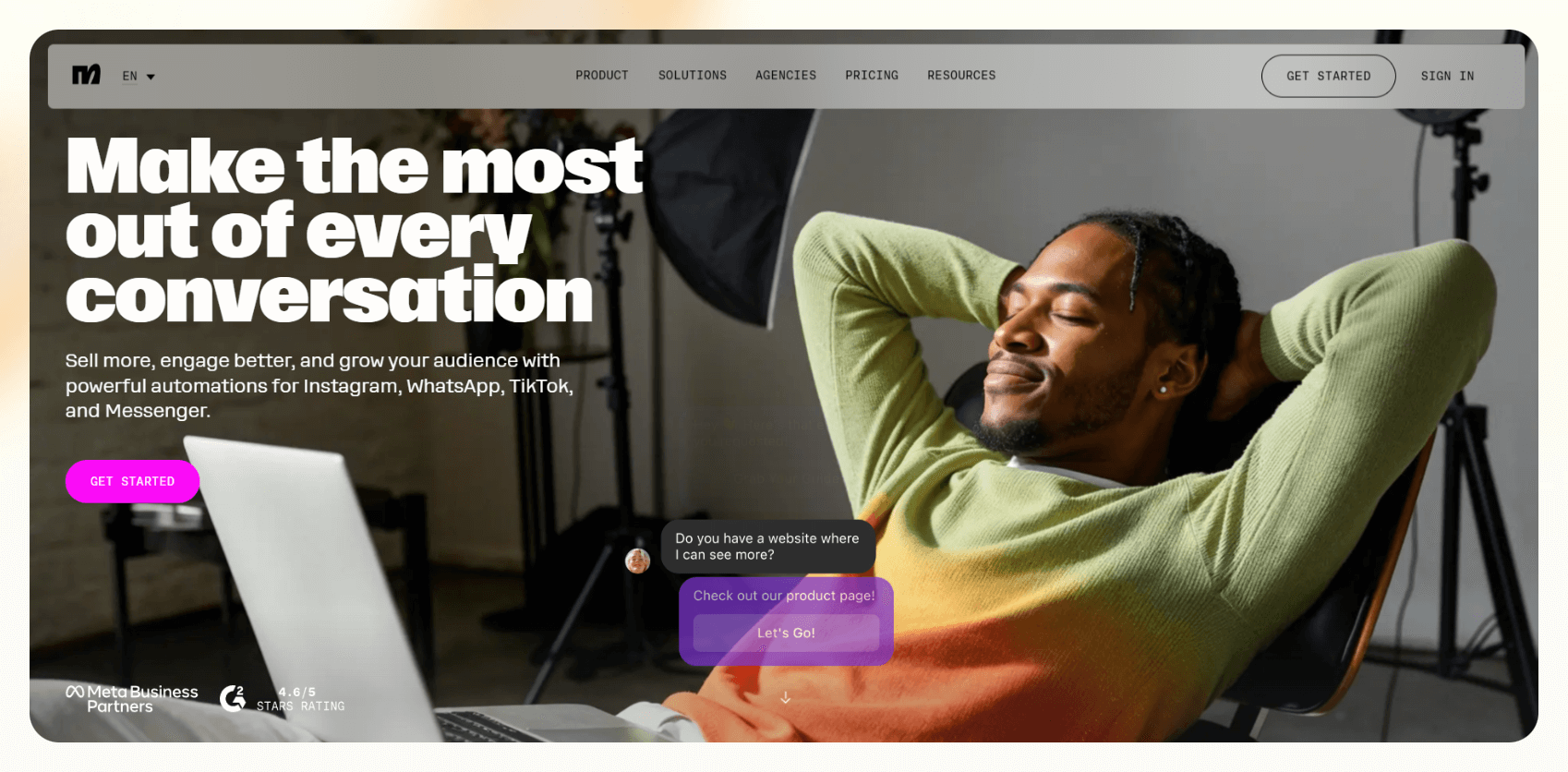
ManyChat is a chatbot builder focused on messaging automation for Facebook Messenger, Instagram, WhatsApp, and SMS. It’s built to help businesses run drip campaigns, engage prospects, and collect leads at scale, all inside chat apps.
It’s a great fit for marketing teams that want to turn followers into buyers through timed broadcasts and interactive flows.
Features
- Campaign builder for Messenger, IG, WhatsApp, and SMS
- Lead capture forms, quizzes, and message sequencing
- Integrates with Shopify, Zapier, Google Sheets, and CRMs
- Visual workflow editor
Pros
- Strong engagement rates via messaging apps
- Great for time-bound offers and product launches
- Easy to customize without writing code
Cons
- Limited to social platforms
- Broadcast messaging has restrictions based on platform policies
Pricing
- Free plan available
- Paid plans start at $17/month, billed monthly
For teams running high-volume promotions or seasonal campaigns, ManyChat helps automate outreach without relying on email.
With that, we’ve covered the current top nine chatbot software options. Keep in mind, features, pricing, and channel support for these tools can evolve rapidly as AI technology advances, so always check each vendor for the latest details.
Top AI sales chatbots: at a glance
If you’re just scanning for fit, here’s a quick breakdown of all 9 tools: what they’re best for, how much they cost, and how easy they are to set up.
| Tool | Best For | Price | Setup Type |
|---|---|---|---|
| Chatfuel | FB/IG messaging | From $49/month | No-code templates |
| Tidio | SMBs | Free – from $29/month | Visual editor |
| Rep AI | Shopify stores | From $104/month | 1-click Shopify |
| Chatsimple | Plug-and-play deployment | Free – from $500/month | Instant setup |
| Watermelon | Multilingual support | From €99/month, billed monthly | Drag-and-drop |
| Zendesk Answer Bot | Support + sales blend | Part of Zendesk Suite | Template-based |
| Fin AI | Built-in CRM automation | $0.99/outcome | Integrated |
| Salesloft | B2B sales pipelines | Enterprise pricing | AI playbooks |
| ManyChat | Campaign-based messaging | Free – from $17/mo | Visual builder |
This table gives you a quick way to compare setup time and price range before diving deeper into any specific platform.
How I tested the best AI sales chatbots
With so many tools claiming to do similar things, the only way to compare them fairly was by running them through the same lens. Here's what we looked at while testing each sales chatbot:
- Lead qualification accuracy: Did the chatbot ask smart, relevant questions? Could it distinguish between high- and low-intent leads without hand-holding?
- Ease of setup and customization: How long did it take to go from signup to live bot? Could someone non-technical deploy it confidently?
- Channel coverage: Could the chatbot run across the channels that matter most, like web, email, voice, and social DMs?
- CRM and calendar integration: Did the bot sync data back into tools sales teams already use? Could it book meetings, update lead stages, or assign reps?
- Analytics and feedback loops: Did it track performance, flag fallback cases, and provide actionable insights?
Using this approach, we focused on practical usability over just feature lists. This matters for teams that want real sales outcomes.
What does an AI sales chatbot do?
An AI sales chatbot uses artificial intelligence to generate leads, qualify them, and help move them through the sales funnel without requiring a human rep at every step.
AI chatbots can understand intent, ask context-aware questions, and retain memory across conversations. That makes them far more useful for handling sales conversations where the path isn’t always linear. To understand how fully autonomous tools differ from conversational assistants, explore our comparison of an ai agent vs chatbot.
Most AI sales bots are used at the top and middle of the funnel. They can:
- Start conversations on websites, in Slack, or through social DMs
- Ask qualifying questions and route high-intent leads to reps
- Book meetings directly into rep calendars
- Respond to objections, FAQs, or product questions
- Trigger follow-ups over email or chat
The difference between an AI chatbot and a basic scripted bot is flexibility. If a lead goes off-script or asks something new, the AI can usually handle it. This makes them a better fit for dynamic sales environments, especially where speed and personalization matter.
How can sales chatbots drive revenue?
The main job of a sales chatbot is to increase the number of qualified conversations your team can have without hiring more reps. Here's how the best ones move the needle:
- Qualify leads instantly: Chatbots can ask pre-set questions or use AI to determine buyer intent, helping you skip unqualified conversations.
- Book meetings directly: Many bots connect with tools like Google Calendar or HubSpot to auto-schedule demos or intro calls.
- Respond to objections 24/7: Instead of making buyers wait for a response, bots can handle FAQs and push conversations forward even outside business hours.
- Recommend products in real-time: Tools like Rep AI integrate with product catalogs to suggest relevant options and guide purchasing decisions.
- Improve email open and reply rates: Chatbots that connect to email can send timely, personalized follow-ups based on user behavior.
- Scale outreach without spam: Unlike blast campaigns, chatbots engage people in conversations that feel personal, even at scale.
- Give reps more time to close: By automating early-stage touchpoints, chatbots free up sales teams to focus on high-intent leads and pipeline deals.
If you implement them correctly, they help your team increase revenue.
Tips for choosing the right AI sales chatbot for your business
Not every chatbot for sales is built the same, and not every business needs the most advanced AI out there. Here’s how to narrow down your options without wasting time:
Start with what you need it to do
If your goal is to automate lead capture on Instagram, a tool like Chatfuel makes sense. If you need full-funnel automation (emails, CRM updates, meeting booking), something like Salesloft is better.
Think about setup and integrations
You can deploy some tools in minutes, like Chatsimple, while others may require more planning. Also, check for native integrations with your CRM, calendar, and communication tools. This makes a huge difference in how useful the bot becomes.
Don’t ignore cost at scale
Watch out for per-lead or per-message pricing models. They may seem cheap upfront, but can get expensive if you scale fast.
Who shouldn’t use a sales chatbot?
If your business has highly technical, consultative, or offline workflows, a chatbot might not replace that first interaction. Also, teams without a CRM in place may struggle to get the most value.
Know when to pass to a human
AI is great at triage, but you need humans to close deals. The best bots know when to loop in a rep, not replace them entirely.
Frequently asked questions
What’s the best AI chatbot for sales?
For social selling, Chatfuel or ManyChat are strong picks. For complex B2B pipelines, Salesloft combines AI chat with sales engagement tools. What’s “best” depends on your goals, channels, and budget.
Can AI chatbots qualify leads automatically?
Yes. Most sales chatbots are built to ask qualifying questions, score leads, and decide whether to pass them to a rep or continue nurturing.
Do sales chatbots work with my CRM?
Tools like Intercom and Tidio offer built-in integrations with CRMs like HubSpot, Salesforce, or Pipedrive. Always check for compatibility before committing.
Can I use the same chatbot for support and sales?
Yes, you can, especially with tools like Zendesk, Tidio, or Watermelon. These platforms let you build different flows for each function or hand off to humans when needed.
What’s the best free AI sales chatbot?
ManyChat and Tidio offer solid free plans that’ll help most teams get up and running with their sales flows.
What’s the fastest way to launch a chatbot for my site?
If you’re looking for speed, go with tools like Chatsimple or Tidio. Both offer no-code builders and pre-made templates for quick deployment.