


Best AI Time Tracking Software in 2026 (I Tested 12)


Last October, I was rebuilding an invoice for a client I'd been writing SEO content for across six weeks. My tracking system at the time was a Notion table I updated when I remembered to, which was maybe twice a week if I was being disciplined. I billed 31 hours. I know I worked closer to 50.
Those hours just never got logged. Research tangents, quick Slack threads, edit rounds that started before the timer did. I sent the invoice and started looking for something that would fix this at the source.
Over the next six weeks, I tested 12 AI time-tracking tools across three workflows. Solo client writing work, personal deep-work sessions, and a brief run with a small content agency tracking its three-person team.
7 tools didn't make this list, and I'll tell you exactly why. Each of the 5 solved a different version of the same problem.
Here's what I found.
Best AI time tracking software: TL;DR
What is AI time tracking?

AI time-tracking tools automatically record and categorize your work hours, without you having to start a single timer. The software runs in the background, watching your app usage, calendar, and document activity to build an accurate timesheet of your day.
Manual time tracking fails because you forget. You start a task, you're immediately at work, and starting a timer is the last thing on your mind. Forty minutes later, you try to reconstruct what happened and log something approximate. Do that across 20 tasks a day for a week, and your timesheet is fiction.
The best AI time trackers fix this at the source. They run silently in the background, capture every app, browser tab, and document you open, and use machine learning to figure out which client or project each session belongs to. The output is a draft timesheet based on what you worked on, not on what you remembered to log.
AI time tracking software in this guide falls into three broad categories:
- Fully automatic trackers: These run silently in the background and log everything without any action on your part. You open a document, switch to your browser, and jump into a Google Meet. The tracker captures it all, then uses AI to categorize each session by client or project. You review the output once a day (usually 2-5 minutes) and approve what's accurate.
- AI-assisted flexible trackers: These are still fundamentally timer-based, but AI does meaningful work to reduce the maintenance overhead. They learn which projects you commonly work on, surface smart entry suggestions, detect idle time, and fill in patterns when you forget to log something. You still track intentionally, but the system catches what falls through the gaps.
- AI calendar defense and time protection: These tools don't track time you've already spent. They use AI to schedule protected blocks for focused work, handle recurring task scheduling, and prevent your calendar from filling up before you've had a chance to do real work.
A fourth angle: Tools like Lindy don't fit neatly into any of these three categories. Lindy is an AI assistant you text to handle the scheduling, meeting prep, and follow-up admin that inflates your non-billable hours.

How I tested these tools
Most AI time-tracking reviews assess whether a tool has AI features. I tested whether those features change how much you have to think about tracking. That's a different question, and it changes which tools look good.
I cared about whether automatic capture was accurate in week one and how fast the AI categorization got reliable on its own. On the output side, the timesheet had to work for real client billing, not just look good in a dashboard. For the agency test, the only thing that mattered was whether the team continued to use it voluntarily.
I ran each tool for at least 10 working days. The ones that made this list I used longer. I tested on a MacBook Pro across writing tools, browser research, Slack, Google Meet, and Notion. For the agency run, I added two Windows machines and one more Mac.
What didn't make the list:
- Clockify has a useful free tier, and the interface is clean. But the AI features are mostly smart search and tag suggestions. You still start and stop timers yourself. For teams who already have good timer habits, it works fine. For people trying to escape the timer entirely, it doesn't fix the problem.
- Harvest is solid for invoicing. It connects billing, time, and expenses in one place. But the tracking layer is manual, and the AI barely shows up. It's a well-designed traditional tracker.
- DeskTime automatically categorizes productive vs. unproductive time, which sounds useful. The problem is the framing. It's built for managers tracking teams. Every person I showed it to either felt monitored or just ignored the productivity categorizations. Neither reaction is useful.
- TimeCamp covers a lot of ground. GPS tracking, attendance, payroll integrations, invoicing. The AI categorization exists, but it's rules-based more than pattern-learning. Getting it to categorize accurately required a lot of manual rule setup upfront, which defeated the purpose for me.
- Hubstaff is an employee monitoring tool that also tracks time. It does that job well. Screenshots, keystroke activity, GPS clock-ins. That's a different category from AI time tracking, and it's not what most people searching for an AI tracker want.
- RescueTime was one of the first passive trackers and is still mentioned in many roundups. But the interface hasn't kept up; there's no real project or client layer, and you can't generate billable hour reports from it. Understanding your own habits is fine, but it's useless for billing a client.
- Memtime is worth an honorable mention. It runs automatic desktop tracking and is accurate. They're also openly opposed to using AI for tracking, which they explain clearly on their site. If you want automatic tracking without AI categorization, Memtime is worth looking at. It just falls outside the scope of this piece.

Most people searching for AI time tracking aren't starting from scratch. A thread on r/Notion from a year ago captures it well: someone had already tried Notion databases, forgot to log entries consistently, and went looking for something that runs in the background and figures out what they're working on automatically.
That's the same problem most people in this category are trying to solve. The tools that keep coming up in those threads are the ones that remove the manual habit entirely.
1. Timely: Best for zero-manual automatic time tracking
What is it best for? Agencies, consultancies, and freelancers who bill by the hour and have stopped pretending they'll build consistent timer habits. If the work always starts before the tracking does, Timely removes the problem at the source.

My honest review
The first thing Timely asks you to install is a small desktop app called Memory. It sits in your menu bar and starts logging the moment you open your laptop. Every app, every website, every document gets captured with its duration. You never open Timely to start a session. You just work.
At the end of your day, you open the dashboard and see a full timeline of everything you did. The AI has already taken a pass at categorizing it. That Figma session belongs to the branding project. The two hours in Google Docs were the content brief for Client A. You drag entries onto the right project, correct anything the AI missed, and submit.
I want to be honest about the first week, though. The AI gets maybe 60% of sessions right without your input early on. It doesn't know your projects yet. By week three, if you've been correcting mistakes consistently, you start nailing most entries by default. The drop from 15-minute reviews to under five minutes is real, but it takes patience to get there.
What made me stick with it was the output. The project dashboard shows burn rates, planned vs. actual hours, and budget health in real time. When I tested this with a small agency, that was the feature their project manager cared about. She could finally see where hours were going without chasing timesheet submissions from three writers every week.
Limitations
Invoicing is basic. You can create invoices in Timely and send them to QuickBooks Online in a click, but it's not a full billing suite. Heavy invoicers will still lean on QuickBooks. The Starter plan also caps at 5 users, so growing agencies hit the Premium tier faster than expected.
Pricing
Timely starts at $11/user/month on the Starter plan, which covers up to 5 users and 20 projects. The Premium plan at $20/user/month increases the limit to 50 users with unlimited projects. Unlimited is $28/user/month with no caps. There's a 14-day free trial on all plans.
2. Rize: Best for knowing whether your hours were productive
What is it best for? Freelancers, developers, and independent consultants who want more than a logged hour count. Rize tracks your time automatically and then scores its quality, which turns out to be the more useful number.

Instead of just building a timesheet, Rize gives you daily focus scores, deep work breakdowns, smart break notifications, and built-in focus music. It's tracking your time and actively trying to improve how you use it while you're in it.
I finished a Tuesday last month feeling like I'd crushed it. Seven hours complete, multiple tasks done, no major distractions. Then I opened Rize and saw my focus score for the day: 54 out of 100.
That number sat wrong. So I looked at the breakdown. Four of those seven hours were shallow work. Context switching, browser tabs, short bursts between Slack notifications. Only 2.5 hours registered as genuine deep focus. The rest technically counted as "working," but Rize categorized them as fragmented sessions under 20 minutes, which don't move the needle on real output.
I hadn't felt unproductive. That's the uncomfortable part. And that's the thing Rize does that no other tracker in this list does.
Similar to Timely, Rize runs a desktop app in the background and captures every app and website you use without timers. The automatic tracking works well from day one because it's measuring activity patterns rather than waiting for you to label projects. The AI auto-categorization learns quickly and integrates with ClickUp, Linear, Google Calendar, and Outlook, with two-way task sync for the first two.
For client billing, Rize handles billable and non-billable tagging, automatic categorization by client and project, and exportable reports filtered by date, client, or team member. Rize doesn't do native invoicing. You export the tracked hours and bill elsewhere.
Limitations
For now, you export the data and invoice elsewhere. Desktop only is the other real constraint. There’s no mobile tracking, so time spent on calls away from your desk isn't captured automatically.
Pricing
Rize starts at $12.99/month on the Basic plan, which covers automatic tracking, focus detection, and personal productivity reports. To get AI productivity insights and exportable client reports, you need Pro at $28.99/month. Business is $49.99/month and adds advanced AI insights and MCP server access. There's a 7-day free trial and no credit card required to start.
3. Toggl Track: Best for freelancers who want control with a safety net
What is it best for? Freelancers and small teams who prefer knowing exactly what they logged and why, but still lose hours when they forget to start a timer. Toggl gives you intentional tracking with automatic data running quietly in the background so nothing disappears.

Toggl Track is built for people who don't want full automation. They like the deliberateness of logging time themselves. They know which hours were billable, which were overhead, and which were rabbit holes they shouldn't invoice for. They want that judgment to stay theirs.
The tool is timer-based at its core. One click starts a session, you tag it to a client and project, and you stop it when you're done. It works across desktop (Windows and macOS), web, mobile (iOS and Android), and browser extensions for Chrome, Firefox, and Edge.
That cross-platform coverage matters more than it sounds. Timely and Rize are desktop-only. If you take a client call on your phone or do any work away from your laptop, those hours don't appear in either tool. In Toggl, you start the timer from your phone.
The automatic layer comes through a feature called Timeline. It runs in the background on the desktop, records your app and browser activity privately, and stores it as a reference only you can see. Nothing from the Timeline gets added to your timesheet automatically.
But when you sit down at the end of the day and realize you forgot to log the two hours you spent in Google Docs, the Timeline shows you exactly what you did and when. You pull from it manually. It's automatic tracking as a backup, and not a replacement for your judgment.
The free plan is decent, which is unusual in this category. It covers time tracking across all platforms, calendar integrations, browser extensions, and productivity reports. You lose billable rates and revenue reporting, but for a solo freelancer testing the waters, it's a real starting point, not a two-week countdown.
Limitations
Toggl's AI layer is thinner than those of Timely or Rize. There's no focus scoring or AI categorization that learns your projects over time. No draft timesheet gets generated from your activity either. You still do the logging. Timeline reduces what falls through the gaps, but it doesn't replace the habit. If you're looking to remove manual tracking entirely, this isn't the right tool.
Pricing
Toggl Track offers a permanent free plan for individuals and small teams that covers core tracking, calendar integrations, and productivity reports. Starter is $12/license/month and adds billable rates, revenue analysis, and team features. The paid plans come with a 30-day free trial.
4. Reclaim.ai: Best for defending your calendar before meetings take everything
What is it best for? Knowledge workers whose time problem isn't logging hours but losing them to back-to-back meetings before the day even starts. Reclaim plays offense on your calendar so you're not always working on whatever's left over.

There's a specific kind of bad week that Reclaim is designed to prevent. It goes like this: Monday starts with three meetings. Someone books Tuesday afternoon while you're in one of them. By Wednesday, you look at your calendar, and there's no block longer than 40 minutes without something in it. You get to Friday after working all week, and you're not sure when any of the actual work got done.
Reclaim's core feature is called Focus Time. You tell it how many hours of deep work you need per day or week, and it automatically blocks those hours on your calendar before other people can claim them. If a meeting is scheduled over a focus block, Reclaim finds the next best open slot and moves it there. The AI re-optimizes around your schedule rather than just letting meetings win by default.
The Habits feature works on the same logic. You set recurring routines (email processing, exercise, admin, research) and Reclaim finds the best available times for them each week, auto-rescheduling when conflicts arise. It treats your habits like meetings with yourself that the calendar protects.
Smart Meetings does the inverse. When you need to schedule something with other people, Reclaim analyzes everyone's calendars and finds the slots that cause the least disruption to focus blocks and existing commitments.
Buffer Time auto-schedules short breaks between back-to-back meetings, so you're not going straight from one call into another.
The time tracking layer is decent but secondary. Reclaim shows you how your time broke down across meetings, focus work, habits, and tasks. It's useful for understanding where the week went, but it's a reporting view. You won't use this to generate a client timesheet. Most people run Reclaim alongside Toggl or Timely, rather than replacing them.
Limitations
On the downside, Reclaim still lacks the depth of a full-fledged time tracker. It only runs on Google and Outlook Calendar, so if your team uses anything else, it won't be as useful. Most people end up pairing it with Toggl or Timely for the actual logging.
Pricing
Reclaim has a free plan that covers all five core features (Focus Time, Habits, Buffer Time, Smart Meetings, and Meeting Quality) for individual users. Starter is $12/seat/month for teams of up to 10 and includes more scheduling options and integrations.
5. Lindy: Best AI assistant for cutting non-billable overhead
What is it best for? People who've solved the tracking problem and still can't figure out why so many hours are going to non-billable work. Lindy is an AI assistant you text to handle the scheduling, note-taking, and follow-up work that sits around your actual work and quietly eats your day.
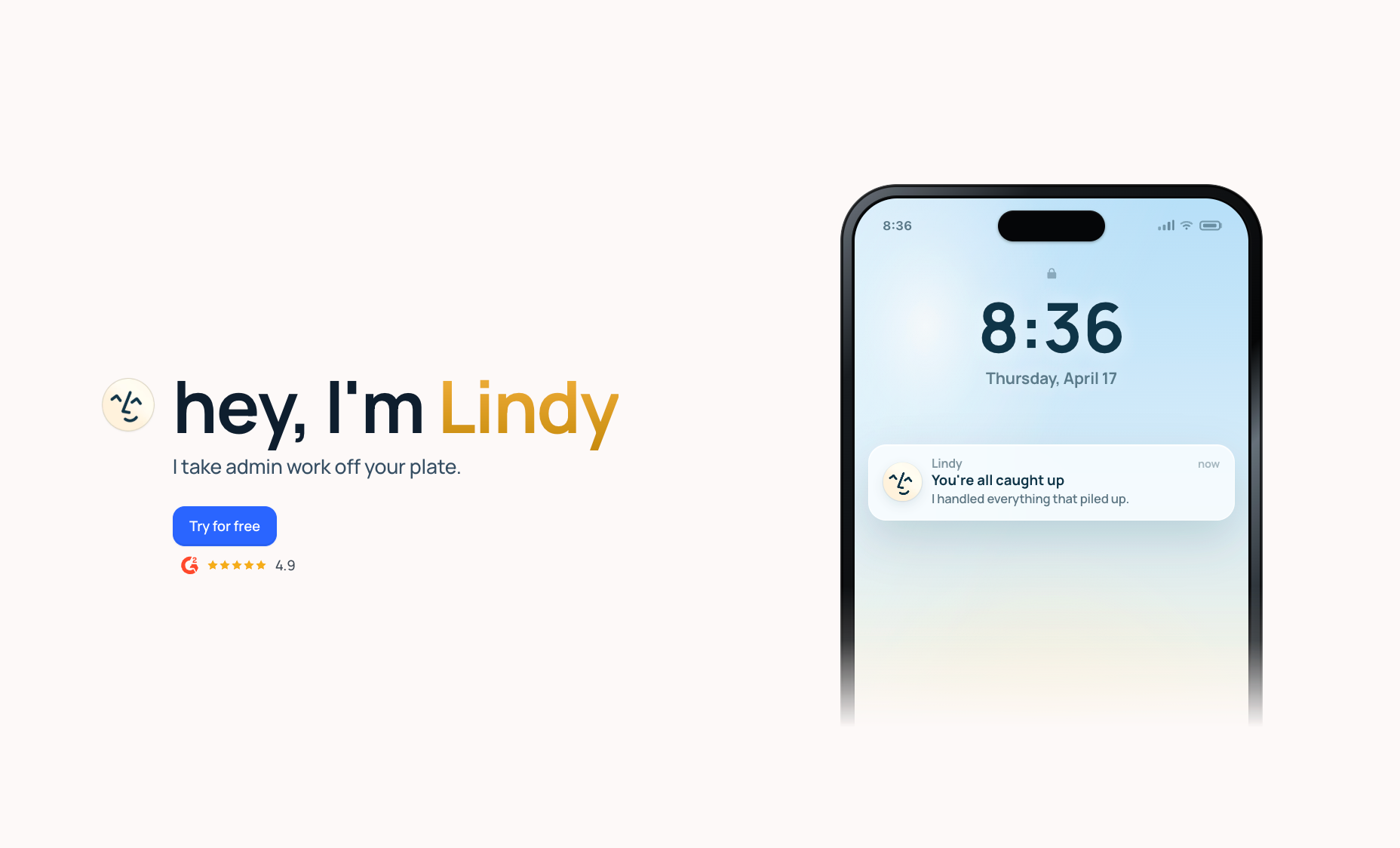
Before a call, Lindy sends you a briefing that includes attendee research, context from past conversations, and the agenda, without you asking. Text Lindy to schedule a meeting and it checks your calendar, finds available times, sends invites, and handles rescheduling if something conflicts.
During the meeting, Lindy automatically joins via Google Meet, Zoom, or Microsoft Teams, records the conversation, and transcribes it in full. After the meeting, Lindy generates a structured summary with key decisions and action items, sends a follow-up email to attendees, and can push action items to Slack, Todoist, Notion, or your CRM, depending on what you tell it to do.
The entire sequence runs without you touching it. The meeting stays 45 minutes instead of 45 minutes plus an hour of admin around it.
Your meeting library becomes a searchable knowledge base over time. Text Lindy "What did we decide in last week's call with Sarah?" and it pulls the answer from the transcript. That context layer gets more useful the longer you use it.
For inbox management, text Lindy to triage your email, draft replies in your voice, or flag urgent messages. For tasks, text what you need done, and Lindy handles it. Lindy connects to hundreds of integrations across email, calendar, CRM, and team tools, so the work lands wherever it's supposed to go.
Limitations
At $49.99/month, Lindy is the most expensive option here, and it won't produce a billable timesheet at all. If logging hours is your only problem, it's overkill. Lindy earns its price only when scheduling, notes, and follow-up admin are what's eating your week.
Pricing
Lindy starts at $49.99/month on the Plus plan, which covers up to 2 connected inboxes, meeting notes, scheduling, follow-ups, email drafting, and hundreds of integrations. Pro is $99.99/month with 3x more usage and up to 3 inboxes. Max is $199.99/month for heavy workloads and up to 5 inboxes. All plans include a 7-day free trial.
{{templates}}
How to choose the right AI time tracking tool
If you bill clients by the hour and hate timesheets, start with Timely. If you want to understand the quality of your work, beyond the quantity, try Rize. If you want flexibility and a free entry point, use Toggl Track. If your calendar is out of control, Reclaim. If the admin around your meetings is the real drain, use Lindy.
Four questions narrow it down fast:
- Do you need automatic tracking or intentional logging? If you lose hours because you forget to start timers, you need automatic tracking. Timely or Rize. Both run in the background and capture everything without any input from you. If you prefer to know exactly what you logged and why, Toggl Track's Timeline provides automatic data for reference while keeping the final call yours.
- Are you billing clients or tracking personal productivity? For client billing, you need a tool that outputs a clean, exportable timesheet with billable hours clearly separated. Timely and Toggl Track both do this well. Rize handles billable time tracking but has no native invoicing. Reclaim doesn't generate timesheets at all.
- Is your problem logging time or protecting time? These are different problems. If you track time fine, but your calendar is always full before you get to do real work, Reclaim is the right starting point. It's not a tracker. It's a calendar defense tool. Most people who use it pair it with one of the others for the actual logging.
- Do you need a tracker or an AI assistant for everything around it? If the scheduling, meeting notes, and follow-up admin are what's eating your non-billable hours, none of the trackers fix that. Lindy does. It's a different product category, but it addresses the same underlying problem. Hours you can't account for at the end of the week.
The five tools in this list are different products. Picking the wrong one means paying for something that doesn't solve your actual problem.
Try Lindy: The AI assistant that handles the work your time tracker can't
Lindy is an AI assistant you text to get work done. The hours that never make it onto a timesheet (the scheduling, the prep, the post-meeting admin) stop slipping through.
Here’s what that looks like in practice:
- Get answers instantly: Text Lindy to pull information from your email, calendar, or CRM without having to shuffle through tabs.
- Send emails and follow-ups automatically: Ask Lindy to draft, personalize, and send outreach. It handles replies automatically.
- Take meeting notes and share summaries: Lindy joins meetings, writes structured notes, and follows up afterward.
- Update your CRM without manual entry: After a call, Lindy logs notes and automatically fills in missing fields.
- Find and qualify leads in minutes: Tell Lindy your ideal customer profile and get curated lead lists ready for outreach.
- Hundreds of app integrations: Lindy connects with the tools you already use, so everything stays in sync.
{{cta}}
Frequently asked questions
What's the best AI time tracking tool for freelancers?
The best AI time tracking tool for freelancers depends on whether you prefer automatic or intentional logging. Timely is the strongest option if you want zero manual input and hourly billing. Toggl Track is the better fit if you like knowing exactly what you logged, and its free plan means you can test it properly before paying anything.
Can AI time tracking work without me having to start timers?
Yes. Tools like Timely and Rize run a lightweight desktop app in the background that captures every app, website, and document you work with without any action on your part. You review a draft timesheet at the end of the day and approve what's accurate. The first week requires more corrections while the AI learns your projects, but most users get to under five minutes of daily review by week three.
Is automatic time tracking private?
Yes, both Timely and Rize are built with privacy as a core constraint. Timely's Memory app stores all captured data locally on your device until you choose to submit an entry. Nothing is shared with your employer or clients unless you explicitly approve it. Rize similarly captures activity metadata without screenshots or keylogging. You control what gets logged.
Which tool works best for client billing?
Timely is the strongest for client billing. It tracks hours automatically, lets you set billable rates at the project level, marks time as billed, and locks entries after invoicing. Toggl Track is close behind and adds QuickBooks integration so you can send invoices directly. Rize handles billable time tracking but doesn't yet have native invoicing. Reclaim.ai and Lindy are not billing tools.
What's the difference between Reclaim and a regular time tracker?
A regular time tracker like Timely or Rize records what you've already done and turns it into a timesheet. Reclaim uses AI to protect future time on your calendar before meetings consume it. It shows you how your time is broken down across focus work, meetings, and habits, but it won't generate a client timesheet. Most people use Reclaim alongside a tracker.










Blog
Related Articles
.png)
%20(1).png)
%20(1).png)

.png)
.png)

The AI assistant that runs your work life
Lindy saves you two hours a day by proactively managing your inbox, meetings, and calendar, so you can focus on what actually matters.
