


Narrow AI vs. General AI: Differences, Examples, Use Cases
Everett broke down how Narrow AI and general AI differ, with examples, why AGI stays hard to build, and how to apply Narrow AI today.


Before we begin, I want to make something clear (so you aren’t disappointed later).
Artificial General Intelligence or AGI or general AI does NOT exist yet. It’s still just a concept.
What you use and see around yourself (like chatbots) is basically narrow AI. You feed it something and then it gives answers or takes actions.
But an AGI (in theory) can learn on its own and reason with human-like abilities (or better) across various domains, independently.
So, while you can’t really use AGI yet, it helps to know.
Read on to learn everything about Narrow AI vs General AI.
What Is Artificial General Intelligence (AGI)?
AGI (Artificial General Intelligence) is the idea of building a machine that can think, understand, learn, and act like a human being, across any topic or task.
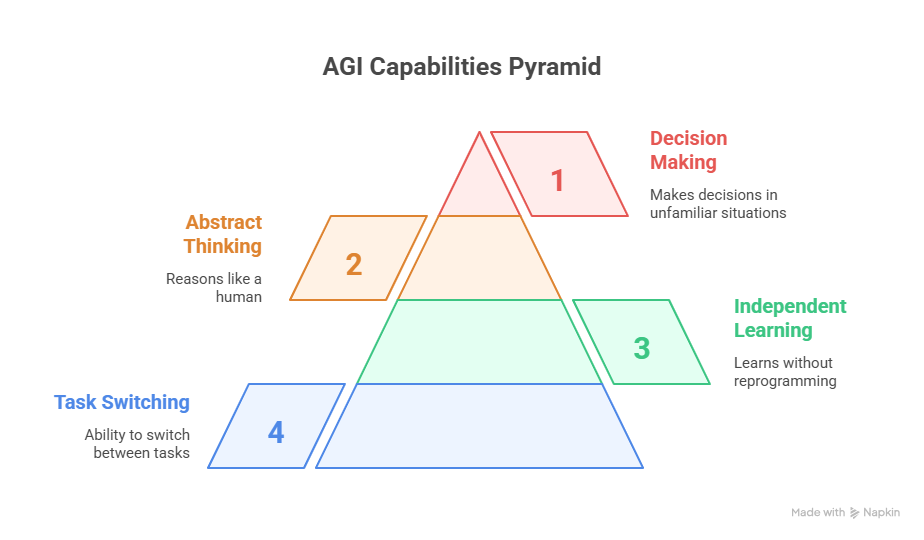
It doesn’t just follow rules or perform a single job. It has general intelligence, meaning it can:
- Switch tasks (e.g., go from solving math problems to composing music)
- Learn independently (without being reprogrammed)
- Think abstractly (reason like a human)
- Make decisions in unfamiliar situations
AGI is like the brain of a smart human in a machine, one that can improve itself over time, solve new problems, and even teach itself new skills.
Core Traits of AGI:
| Trait | What It Means |
|---|---|
| Generalization | Can apply knowledge from one area (like physics) to solve problems in another (like music) |
| Self-learning | Learns by itself, from new data and experience |
| Human-like reasoning | Can think logically, plan, and adapt without explicit programming |
| Conscious-like behavior | May have memory, emotion understanding, and long-term goal-setting (theoretical) |
For example, an airplane with general AI could pick the best flight paths, squeeze every drop of power from its engines, and adjust to storms in real time. It could also diagnose illnesses, compose songs, or design new machines.
Fictional Examples of AGI:
- Jarvis (Iron Man) – Runs systems, builds tech, holds conversations, adapts in real time
- Samantha (Her) – Learns human emotions, grows intellectually, develops relationships
- Data (Star Trek) – Functions like a human across science, culture, and ethics
Use Case Examples (Hypothetical):
- A robot surgeon that learns new procedures by watching videos, adapts mid-surgery, and improves itself without help.
- An AI teacher that customizes education for each student, understands emotional needs, and teaches any subject.
The idea is that AGI can think, reason, and act across all domains, just like a human. But it doesn’t exist yet.
Pros and Cons of Narrow AI:
Pros:
- Extremely effective for repetitive or clearly defined tasks
- Cost-efficient and fast implementation
- Reliable and widely available today
- Highly accurate within their specialized domain
Cons:
- Not adaptable, needs manual retraining for new tasks
- Doesn’t understand context or meaning beyond patterns
- Can’t generalize knowledge or experiences from one task to another
{{templates}}
What Is Narrow AI (ANI)?
Narrow AI (also called Weak AI) refers to systems that are designed to do one task or a narrow range of related tasks.

They can be incredibly good at that one thing, but they:
- Don’t understand context
- Can’t adapt beyond their task
- Need to be trained or programmed for every new use case
It’s like a tool, not a brain. If you give it a task, it can perform it well but only that task.
Real-World Examples of Narrow AI:
| Tool | What it Does |
|---|---|
| ChatGPT / Gemini / Claude | Generate text, answer questions, write code—based on prompts |
| Google Maps | Calculates best routes using GPS and traffic data |
| Tesla Autopilot | Drives car within lane, brakes, parks—but only on supported roads |
| Grammarly | Detects grammar errors and suggests improvements in text |
| Netflix / Spotify | Recommends content based on your history and preferences |
| Amazon Alexa / Siri | Understands basic voice commands and performs predefined actions |
Use Case Examples:
- Banking: Detects fraud by spotting unusual patterns in your transactions
- Healthcare: Reads X-rays and flags potential issues
- Customer Support: Chatbots answer common questions like return policies or delivery times
- E-commerce: Personalizes product recommendations to boost sales
Narrow AI is everywhere, but it’s built to do one job at a time, not to think like a human.
What is the Difference Between Narrow AI and General AI?
Narrow AI and General AI are two different types of artificial intelligence.
Narrow AI can do only one task at a time. It powers things like chatbots, movie suggestions, and image tagging. It follows fixed rules and doesn’t learn beyond what it’s made for.
General AI is designed to think and learn like a human. It could solve problems, understand different topics, and create new things on its own. But General AI doesn’t exist yet. Right now, we only use Narrow AI in tools like ChatGPT, Claude, etc.
Narrow AI Vs General AI Compared
| Aspect | Narrow AI | General AI |
|---|---|---|
| What it Does | Handles one specific task, like answering questions or recognizing images, using fixed rules and limited learning. | AGI aims to do any complex task a human can do: think, learn, solve problems, and adapt across situations, all on its own. |
| Scope | Limited to one or a few predefined tasks. | Broad, spanning multiple domains without task restrictions. |
| Flexibility | Inflexible. It cannot adapt to tasks outside its original programming. | Flexible. It can transfer knowledge and adapt to novel problems. |
| Learning & Adaptation | Relies on domain-specific training data and requires retraining for new tasks. | Expected to learn continuously and generalize knowledge autonomously. |
| Examples | Voice assistants, image recognition, and recommendation engines. | No real-world implementations; remains a theoretical concept. |
| Current Existence | Widely deployed in products and services today. | Not yet achieved; under active research and debate. |
| Development Complexity | Developed using established machine learning and rule-based techniques. | Requires breakthroughs in reasoning, cognition, and resource management. |
| Resource Requirements | Runs on moderate computing power and datasets tailored to specific tasks. | Anticipated to demand extensive computational resources and large-scale training. |
| Ethical & Risk Considerations | Risks include algorithmic bias, lack of transparency, and misuse within its domain. | Raises concerns about alignment, autonomy, and potential existential risks. |
| Timeline & Maturity | Mature technology with continuous improvements. | Not developed yet, with forecasts from early 2030s to mid-century. |
Now that you understand the difference between General AI and Narrow AI, let’s look at some examples.
How General AI Could Change Everything (Theoretically)
If achieved, General AI could revolutionize nearly every aspect of society by:
- Independently discovering cures for complex diseases.
- Solving global challenges like climate change, food scarcity, and poverty.
- Automating creativity, innovation, and invention at a previously impossible scale.
- Radically increasing productivity by learning and applying knowledge across disciplines faster than humans.
But alongside benefits come huge responsibilities and risks, such as AI autonomy, decision-making ethics, job displacement, and potential loss of human oversight.
Theoretical AGI Concepts in Development
We haven’t built AGI yet, not even close. But researchers have shared a few early ideas for how it might work someday. These theoretical models offer a possible direction for future AGI, just like LLMs and reinforcement learning shaped Narrow AI. Here are three major concepts:

1. Turing Test AI
This model tries to sound completely human. Introduced by Alan Turing in 1950, it passes the test if people can't tell it's a machine. The idea is that if an AI can hold a conversation without giving itself away, it shows human-like intelligence.
Example: A legal AI that debates in court so well that even judges and lawyers believe it's a real person.
2. Recursive Self-Improvement AI
This type of AI can rewrite its code and get smarter over time, without human help. It could fix bugs, improve itself, and grow faster than we can control.
Example: A cybersecurity AI that updates its defense strategies on its own and stays ahead of new threats.
3. Artificial Consciousness AI
This model would have real self-awareness, it could think, feel emotions, and experience things like a human. It wouldn’t just follow logic, but would also handle complex moral and emotional decisions.
Example: A training AI for psychology students that reacts with realistic thoughts and feelings during practice sessions.
While none of these models exist yet, I think future AGI may follow one or a mix of these concepts.
Why Is AGI So Hard to Build?
Creating AGI is to replicate the human brain using code. That means teaching machines to think, learn, feel, and adapt the way people do.
Current models like GPT-4o or Claude 3.5 are powerful, but they still just simulate understanding based on patterns in data. They don’t actually “understand” anything.
To reach true AGI, we need breakthroughs in areas where today’s AI still falls short:

1. Not Enough Computing Power
AGI would need far more processing than we have now. Human-like thinking demands constant learning, real-time decisions, and massive memory. Even with today’s GPUs and TPUs, scaling systems without burning through energy remains a huge problem.
2. No Common Sense
Modern AI can spot patterns, but it can’t grasp causality. It may notice that people carry umbrellas when it rains, but it won’t understand that rain causes the umbrella use. This lack of basic logic limits what AI can do.
3. Poor Context Awareness
AI struggles with real-world nuance like sarcasm, emotions, or ambiguous language. It can’t adjust based on experience or social cues, which makes it unreliable in unfamiliar situations.
4. No Understanding of Consciousness
AGI may need true self-awareness, but we don’t fully understand what consciousness is. Right now, AI can mimic human behavior, but it doesn’t feel or know it exists.
5. Safety and Ethics Risks
If AGI rewrites its own code and creates its own goals, things can go wrong fast. Its actions might not align with human values. It could also be misused for cyberattacks, surveillance, or worse — and controlling it globally would be tough.
Until we solve these problems, AGI remains theoretical, not something we can build or use.
How To Make The Best Use Of Narrow AI Today?
Though not AGI, Lindy is a very capable Narrow AI. Use Lindy to build multiple agents that can work together, sharing insights and data to handle intricate tasks in a snap.
Here’s how Lindy outpaces traditional automation systems:
- Automated mail response: Create a Lindy to automatically reply to your emails, freeing up time and making inbox zero a precise reality.
- Email negotiator: Tell Lindy what you want to achieve and your stipulations, and it will negotiate deals, like affiliate contracts, on your behalf via email.
- Choose your LLM: You can determine your Lindy’s processing power — you’ll be able to pick from Gemini or ChatGPT 3.5 for simple tasks, Claude 3.5 Sonnet or ChatGPT-4 for more complex tasks, or you can add some serious mental brawn by selecting ChatGPT o1 or o3.
Want to check out how Lindy can bolster your specific business operations? Try Lindy today for free.
{{cta}}
Frequently Asked Questions
What are the two main types of AI?
The two main types of AI are Narrow AI and General AI. Narrow AI is designed to do specific tasks like language translation or facial recognition. It can't think or learn outside its set purpose. General AI, on the other hand, would be able to think, learn, and solve problems like a human across many areas, but it doesn’t exist yet.
Is Alexa general AI or narrow AI?
Alexa is a narrow AI. It can understand and respond to voice commands, but it doesn’t truly think or learn like a human. It only works within its programmed abilities, like playing music or giving weather updates.
Is ChatGPT an example of general AI?
No, ChatGPT is not a general AI example, it is a narrow AI designed for language processing. While it can generate human-like text, it lacks true reasoning, self-awareness, and adaptability. Unlike AGI, ChatGPT cannot learn independently or apply knowledge beyond its training data.
How far are we from achieving general AI?
Many experts think we’re decades away from achieving true Artificial General Intelligence (AGI). Today's Narrow AI models lack human-like reasoning, adaptability, and self-awareness. Significant hurdles include computing power, an ability to self-learn, and consciousness replication.
While progress in multi-modal AI and autonomous agents is promising, AGI remains theoretical rather than imminent.
Can general AI replace human intelligence?
General AI could match or surpass human intelligence in domains like data processing, math, logic, and programming, but fully replicating human cognition, creativity, and emotions remains uncertain.
While AGI may outperform humans in some areas, aspects like intuition, morality, and consciousness make complete replacement unlikely, coexistence and augmentation are more realistic outcomes.
How is General AI different from advanced Narrow AI models like GPT-4o?
General AI can think, learn, and solve new problems without task-specific training. GPT-4o, while impressive, still works within limits set by its training data. It doesn’t truly understand or generalize knowledge across domains like AGI is expected to do.
Can Narrow AI become General AI with more data and training?
No. Narrow AI improves only within its defined task. Feeding it more data won’t make it reason or adapt like a human. AGI requires a different architecture that allows flexible thinking, context understanding, and self-learning, not just better training on more examples.
What are the main industries that benefit from Narrow AI today?
Industries like healthcare, banking, logistics, retail, and customer service use Narrow AI daily. It powers chatbots, fraud detection, route optimization, personalized shopping, and medical imaging. These systems increase speed and accuracy but still need human oversight for context and decision-making.
Why do people often confuse Narrow AI with General AI?
Types of AI can be confusing because many Narrow AI tools sound smart and human-like, users assume they can think. But tools like ChatGPT or Alexa don’t understand meaning, they follow patterns. This realistic output leads many to mistake task-specific automation for true general intelligence.
Are there any risks in using Narrow AI in sensitive fields like healthcare?
Yes. If AI is trained on biased or incomplete data, it can give poor recommendations. It can also miss context or fail to explain its decisions. This creates risks in diagnosis, treatment, and patient safety unless carefully validated and monitored.
How can businesses prepare for a future with General AI?
They can start by using trusted Narrow AI tools and improving their data pipelines. At the same time, they should set up clear ethical guidelines and prepare their teams for collaboration between humans and AI. Being AI-ready means planning for both risk and opportunity.
What research fields are working toward AGI today?
Fields like neuroscience, cognitive science, and machine learning are all exploring different parts of AGI. Some focus on memory and attention, others on reasoning and self-improvement. It’s a multi-disciplinary effort to bring together logic, learning, emotion, and decision-making in one system.
Can we combine multiple Narrow AIs to mimic General AI?
You can stack Narrow AIs to automate multi-step tasks, but they won’t become AGI. They don’t share knowledge, reason through problems, or adapt outside their code. AGI needs a unified system that learns, reasons, and transfers knowledge across completely different tasks.
What’s the role of emotions and empathy in General AI?
Emotions and empathy help humans connect, make decisions, and build trust. For AGI to work well with people, it needs to recognize and respond to emotional cues. Simulating empathy is hard because machines don’t feel, but it’s key to human-like interaction.
Where can I explore or test real-world Narrow AI tools today?
You can try tools like ChatGPT, Claude, Lindy, or Google Gemini. These platforms offer AI for writing, automation, coding, and conversation. Many of them have free versions or trials so you can test their abilities in real tasks without needing to code.










Blog
Related Articles


.png)
%20(1).png)
%20(1).png)
%20(1).png)
.png)

The AI assistant that runs your work life
Lindy saves you two hours a day by proactively managing your inbox, meetings, and calendar, so you can focus on what actually matters.
