


AI Agents in Healthcare: Use Cases and Benefits in 2026
Lindy broke down how AI agents streamline healthcare documentation, patient scheduling, and follow-ups, weighing HIPAA compliance and EHR integration challenges for medical teams.
.avif)

AI in healthcare has many practical use cases that may surprise you. Healthcare providers already use AI agents every day to take on routine clinical tasks like documentation, scheduling, and patient follow-ups — saving time without cutting corners.
In this article, we’ll cover:
- What AI agents do in healthcare settings
- Which tasks they automate most effectively
- Challenges of AI in healthcare
- Examples of agent-powered healthcare workflows
Let’s begin by defining AI agents in healthcare.
What is an AI agent in healthcare?
An AI agent in healthcare is a software assistant that uses artificial intelligence to complete tasks without constant human oversight. These agents can interpret context, make decisions, and take action, like summarizing a clinical visit or updating an EHR.
These agents are quite advanced compared to traditional automation tools. Chatbots typically wait for user input and follow rigid scripts. Rule-based systems have static logic –– if a condition is met, it triggers an action.
In contrast, healthcare agents are dynamic. They gather inputs, understand intent, and adjust actions based on new information. This behavior makes them “agentic.” They're autonomous, which means they don’t need a human to click through every step.
For example, if a patient replies that they can’t make an appointment:
- A rule-based system might only send a static reminder and log the reply.
- An AI agent could interpret the message, find the next available slot, reschedule the visit, notify the care team in Slack, and send updated pre-visit instructions — all in one flow.
Next, we’ll look at how that intelligence benefits the medical care teams.
Key benefits of AI agents for medical teams
The advantage of AI technology in healthcare is how quietly it can automate high-friction tasks that take away clinicians’ time and focus. Here are a few examples:
Time saved on documentation
Most providers spend hours documenting patient care details –– typing SOAP notes, re-entering patient info, or summarizing conversations. AI agents can handle all of that using voice commands, structured templates, or even real-time transcription.
AI-powered documentation platforms are already changing how clinics handle paperwork.
Reduced burnout from admin overload
Admin work causes burnout. From inbox cleanup to note-taking, the daily tasks add cognitive load that doesn’t help patients — and often extends into after-hours time. By delegating that work to AI, teams can offload the repetitive stuff and stay focused on care.
Better patient communication
AI agents can act as follow-up assistants. They send reminders, flag important updates, and deliver messages in a conversational tone that patients read. No more templated auto-texts or voicemails.
Improved continuity of care
When agents sync across calendars, inboxes, and docs, fewer things fall through the cracks. A note from a voice call can show up in the chart. A patient message can trigger a workflow.
Better accuracy with smooth integrations
By connecting to tools teams already use — like EHRs, CRMs, or Google Docs — agents reduce human error and ensure updates stay consistent across systems.
These are some real-world applications of AI agents in healthcare. Next, let’s look at the biggest challenges teams face when using AI agents.
Challenges of AI healthcare agent deployment
In healthcare, where systems are fragmented and compliance is compulsory, installing AI agents is challenging. Here are four such challenges that come up the most:
EHR integration complexity
Many EHR systems now offer APIs and support FHIR standards. But integrating with them can still be slow and costly, due to system variability and vendor limitations.
Lindy sidesteps this by offering no-code workflows and integrations with CRMs, calendars, spreadsheets, and communication tools. It connects to the tools already in the loop, making it quick to use for documentation, scheduling, and follow-ups.
Data privacy and compliance (HIPAA)
Tools that interact with patient data must comply with the security standards and regulations. Lindy meets HIPAA and SOC 2 standards, with end-to-end AES-256 encryption, admin-level permissions, and no unnecessary data retention.
Training for edge-case recognition
AI agents work best with clear, structured inputs, but healthcare is full of edge cases — symptoms that don’t fit, exceptions that break the workflow.
Lindy allows agents to flag unclear inputs and escalate to a human, instead of guessing. This keeps things safe and compliant without slowing the system down.
Importance of fallbacks or human-in-the-loop
AI systems cannot fully run on autopilot. There will be scenarios where a human must intervene and take over. Lindy supports fallback logic and multi-agent flows where handoff to a person is built into the design.
Now that we’ve covered the risks, let’s look at what these agents do and which tasks they’re best suited for.
{{templates}}
What specific tasks can AI agents automate in healthcare?
The best use cases for AI agents in healthcare are to automate repetitive tasks clinicians have to do daily. They often wear them down. Let’s explore some examples:
Clinical documentation
Agents can automatically draft SOAP notes, structure therapy summaries, and prep discharge instructions. They also transcribe phone or video calls and capture context. This way, the doctor can focus on the patient.
Patient intake and scheduling
AI agents can walk patients through digital intake flows, verify coverage details, and book appointments using calendar integrations. This helps small teams that don’t have the bandwidth for constant scheduling back-and-forth via paper forms or email trails.
Post-visit follow-ups
After a session, agents can handle reminders, send follow-up content, or check in automatically a few days later. The message can go out by email, voice, or whatever the patient prefers.
CRM and EHR updates
Once a call or appointment wraps up, agents can push the updates into platforms like Salesforce, HubSpot, or a shared doc — without a human needing to type it out.
Voice dictation and transcription
This is especially useful in therapy and primary care, where typing mid-session breaks the flow. AI medical charting tools help teams document efficiently without missing nuance.
Internal coordination
Agents can post updates in Slack, append data to a Google Sheet, or tag someone when a task needs input. They smooth internal communications and save time.
These are some AI healthcare examples of taking off the burden from healthcare professionals. Next, we’ll walk through some real-world use cases.
Real-world healthcare use cases
AI agents are fitting into healthcare workflows and making a difference. Here are a few real-world applications of AI agents in healthcare:
Primary care clinic
Instead of writing SOAP notes from scratch, providers speak naturally during or after the visit. An AI agent acts as a virtual scribe, identifies key elements (subjective, objective, assessment, plan), and drafts the full note for review and sign-off.
Mental health practice
Therapists can focus on the session while an agent passively captures key insights — like emotional tone, recurring stressors, and discussed interventions. It then creates structured summaries that support treatment planning, without disrupting client flow.
Specialty clinics (e.g., dermatology, PT, chiro)
After a visit, an agent can generate billing summaries, attach prewritten notes or diagnostic codes, and prep insurance claims. For small teams, this means fewer bottlenecks and faster claim turnaround.
Telemedicine platforms
Voice-based agents can answer incoming calls, qualify the patient, summarize the call content, and log everything to the provider’s CRM before forwarding the call to the clinician.
Now, we break down why Lindy can be an ideal AI platform to support these workflows.
{{cta}}
Why Lindy leads in healthcare agent design
A healthcare AI platform needs to be quick to deploy, secure, and highly capable for medical teams to see value. That’s where Lindy has an edge — not just in features, but in design choices that suit healthcare workflows.
Here’s how:
Pre-trained healthcare agents
Lindy offers prebuilt agents for common needs like SOAP note generation, patient follow-ups, and more. These are fully customizable templates and act as starting points that save teams weeks of setup.
Built-in HIPAA compliance
Lindy supports HIPAA and SOC 2 compliance standards out of the box, with encrypted data storage, access controls, and audit trails. It was designed for healthcare, not adapted after the fact.
7,000+ integrations (and growing)
Lindy supports a total of 7,000+ integrations across 1,600 apps via Pipedream partnership –– including EHRs, CRMs, communication tools, and scheduling platforms. Whether your team lives in Gmail, Google Calendar, HubSpot, Slack, or all of the above, Lindy connects natively to these tools.
Drag-and-drop visual builder
Need to tweak a workflow? Change a prompt? Add a trigger? The visual editor gives teams direct control over every step, without writing code. You can see exactly how an agent works, adjust logic, and test updates, all without waiting on engineering.
Multi-agent collaboration
Lindy supports multi-modal agents, where different agents handle different steps. One might gather intake info. Another sends an email. A third updates the CRM. This modular setup makes it easier to scale complexity without losing visibility.
Affordable pricing with a generous free tier
Lindy starts free with 400 monthly credits that you can use to automate up to 400 tasks. The paid plans include:
- Pro: $49.99/month, 5,000 credits
- Business: $299.99/month, 30,000 credits
- Voice calls (GPT-4o): ~$0.19/min
- AI phone numbers: $10/month
Lindy is for teams who want control, speed, and clear ROI without hiring a dev team.
Frequently asked questions
What are the best AI agent tools for small clinics?
Look for tools that don’t require IT dependency. Lindy works well for small practices because it offers a free tier, prebuilt healthcare agents, and an easy visual builder for customizing workflows.
Is Lindy a good fit for mental health or outpatient care?
Yes. Clinics can use Lindy to deploy agents that transcribe therapy sessions, manage appointment flows, or even help patients with self-tracking exercises between visits.
Can AI agents help reduce physician burnout?
Yes, they can, and they already do. Offloading tasks like charting, follow-ups, or patient scheduling gives back time and reduces after-hours admin work.
How do AI agents integrate with EHRs or CRMs?
AI agents integrate with EHRs or CRMs through native integrations, API-based workflows, or webhooks.
Are AI agents secure for sensitive medical data?
Yes, they are secure if they comply with regulations like HIPAA. AI agent platforms like Lindy have encryption, compliance, and access controls built in.
Can I train an agent on my practice’s workflows?
Yes. You can customize logic, language, and app triggers using the visual builder — or build from a template and tweak from there.
Lindy, a healthcare AI agent platform and more
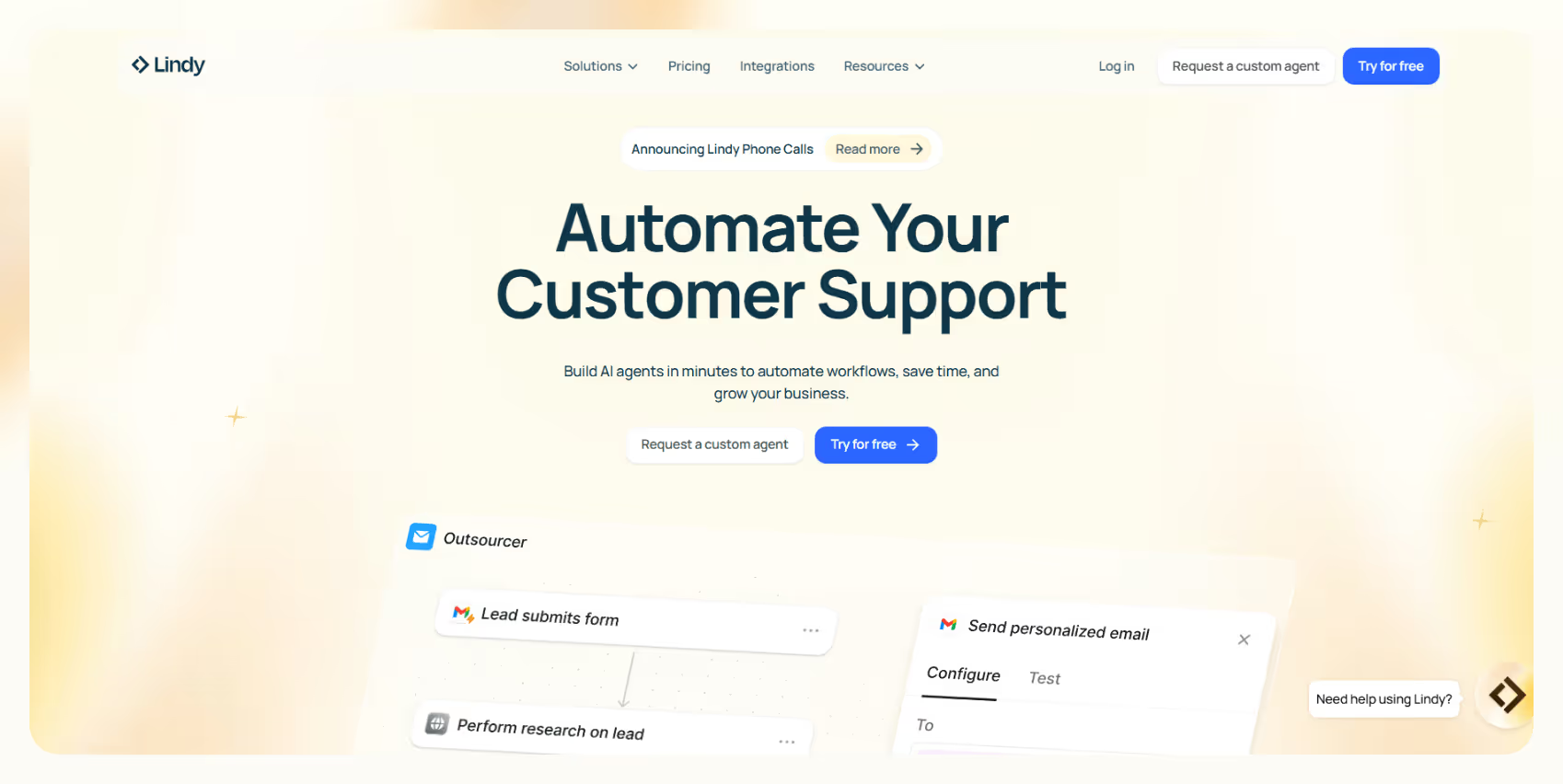
Looking for an AI tool that handles medical workflows and automates emails, meetings, and admin tasks? Go with Lindy.
Out of all the AI agent platforms, here’s why Lindy stands out and suits healthcare applications the most:
- Simple no-code interface: You won’t need coding, programming, or technical skills to create your automations with Lindy — it offers a drag-and-drop visual workflow builder.
- AI agents customized to your needs: You can make versatile AI agents that understand plain English and accelerate your productivity in many ways. For instance, create an AI agent that helps you follow up with your patients. Create another agent that sends out medical instructions based on the follow-up and schedule a meeting with the clinician.
- Affordability: Build your first few automations with Lindy’s free version and get up to 400 tasks. With the Pro plan, you can automate up to 5,000 tasks, which offers much more value than Lindy’s competitors.










Blog
Related Articles
.png)
.png)
%20(1).png)
.avif)

%20(1).png)
.png)
The AI assistant that runs your work life
Lindy saves you two hours a day by proactively managing your inbox, meetings, and calendar, so you can focus on what actually matters.
